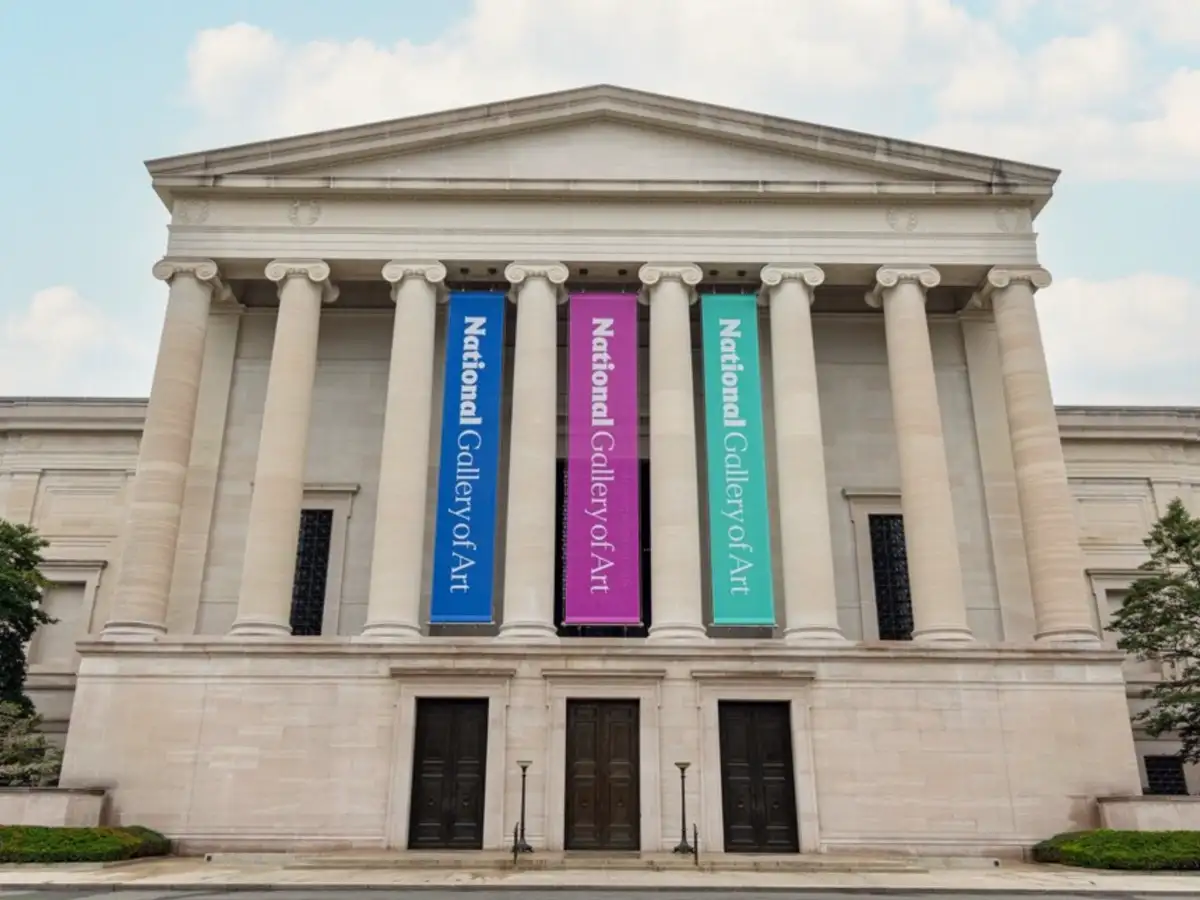
What can the loss of the head, a detached limb, or even a gunshot wound reveal to us about a sculpture that an intact sculpture cannot? This is a key question raised by “Broken: The Power of the Fragment,” an exhibition being held at Florence’s Palazzo Strozzi and will subsequently travel to the National Gallery of Art in Washington, DC, in 2027. “Broken” is an exhibition comprising over 80 works and fragments, exploring reasons behind the damage and destruction of sculptures as well as the creation of sculptural fragments.
According to The Guardian’s review of the exhibition in Florence, a case study in this respect involves a limestone fragment of a sculpture showing the nose and lips of the ancient Egyptian pharaoh Akhenaten. Only part of the face is preserved, but what makes the existing parts of the face more conspicuous are the missing parts.
This is one of the main themes of the exhibit. A sculpture doesn’t always lose its force if it loses a part of itself. There are times that the destruction will add to the appeal of the work.
The exhibit also includes artworks that were destroyed during political and religious conflicts. Among the artworks presented are a statue connected to the Protestant Reformation, fragments of a horse statue for Louis XIV, and a bust of Benito Mussolini that has a bullet hole after Italy’s downfall from fascism, as reported by The Guardian.
When destroying a statue meant attacking power
The history of destroyed sculptural works is linked directly to the history of political revolutions and upheavals.
According to The Guardian, one of the co-curators, Andrew Sears, states that it was common practice during political and religious revolutions to destroy any images of leaders and religious figures. It did not happen only because these images were considered offensive or unwanted. In fact, the idea was that images of these people had the very essence of their power or existence.
That is why faces, heads, or other parts of images were most often destroyed.
One of the pieces in the collection is a Roman bust of Germanicus from AD 19. The nose and upper part of the ears were cut, and a cross was carved on the forehead of this Roman emperor.
The way the sculpture was treated served to change its meaning entirely. A very powerful image can be used as an image of caution against an outdated system. At times, it is important to leave the damage there as well because it serves to deliver the message.
Damaged sculptures acquire a new purpose of their own. While the creator of the sculpture intended to pay homage to the ruler or deity in the first place, centuries later the damaged image will serve to depict their adversaries.
The strange beauty of statues that were never meant to be complete
It becomes even more surprising when it goes beyond politics and destruction.
Some pieces were not necessarily damaged because of their history; they were purposely made to appear as such.
According to The Guardian, one such work is the Michelangelo terracotta headless and armless statue of a woman, made somewhere around 1533. It may seem like a piece that was damaged, but studies show that the damage was done on purpose. Michelangelo worked at a time when artists in Rome were obsessed with newly found ancient sculptures.
Thus, breakage became a part of the artist's lexicon.
Dogū is another item found in this exhibition. Dogū is a fired clay figurine used in ancient Japan. These items have been commonly found broken into pieces in burial sites. As per the exhibition organisers, there is a possibility that these objects were purposefully broken during the rituals of endings and beginnings.
The pieces of these objects could have been shared among communities.
This is contrary to the assumption in modern times whereby any ancient broken object has been seen as a result of an accident. Sometimes the broken piece was the object.
Why ancient cultures deliberately smashed their sculptures
Another instance can be seen in the ancient capital of Tenochtitlan, which belonged to the Aztecs. Amongst the exhibits here, there is a lying figure which had been deliberately decapitated as part of an effort at rebuilding a temple.
According to The Guardian, the Mexica may have found the damaged state acceptable since it was a reflection of the deteriorated surroundings.
This view contradicts the common modern-day notion that the real value of any work of art lies in restoring it to its original state as much as possible.
Completion was not necessarily what all cultures aspired to. A damaged statue was more in keeping with the surroundings since the buildings and community around kept undergoing reconstruction and destruction.
This was also the case during the Renaissance in Europe, where people were fascinated with the fragmented sculptures of ancient Rome that lacked any limbs or heads. Rather than seeing each fragment only as an incomplete work of art that needed restoration, people saw it as something that had aesthetic significance on its own.
From Mussolini's bullet hole to broken bodies in modern culture
The exhibition will ultimately bring the question up to date.
One of the most politically loaded items on show is Adolfo Wildt's bust of Mussolini, which sports a bullet hole drilled right through its forehead. As the Guardian points out, the bullet hole was made after the fall of the fascist government.
In this case, the bullet hole is more than just physical damage. It captures the political shift.
The exhibition also showcases some contemporary artists who have been intentionally incorporating damaged or incomplete shapes into their artwork, such as Louise Bourgeois and German artist Julius von Bismarck, as noted by The Guardian.
The interest in broken bodies and incomplete figures has gone beyond museums, too.
The Guardian links the topic of the exhibition with the current popular culture – from one-armed Furiosa in Mad Max: Fury Road to those whose physical imperfections define them.
This makes the Washington exhibition more than just a display of broken antiques.
In this way, it invites us to question an assumption which has been ingrained into Western art since ancient times, and that is that beauty equals perfection.
The surviving fragment of Akhenaten’s face opens up an alternative possibility. By taking away enough pieces of a statue, the viewer could be made to stop seeing the whole image and instead see the pieces that remain.
A missing piece creates a new form of focus.