
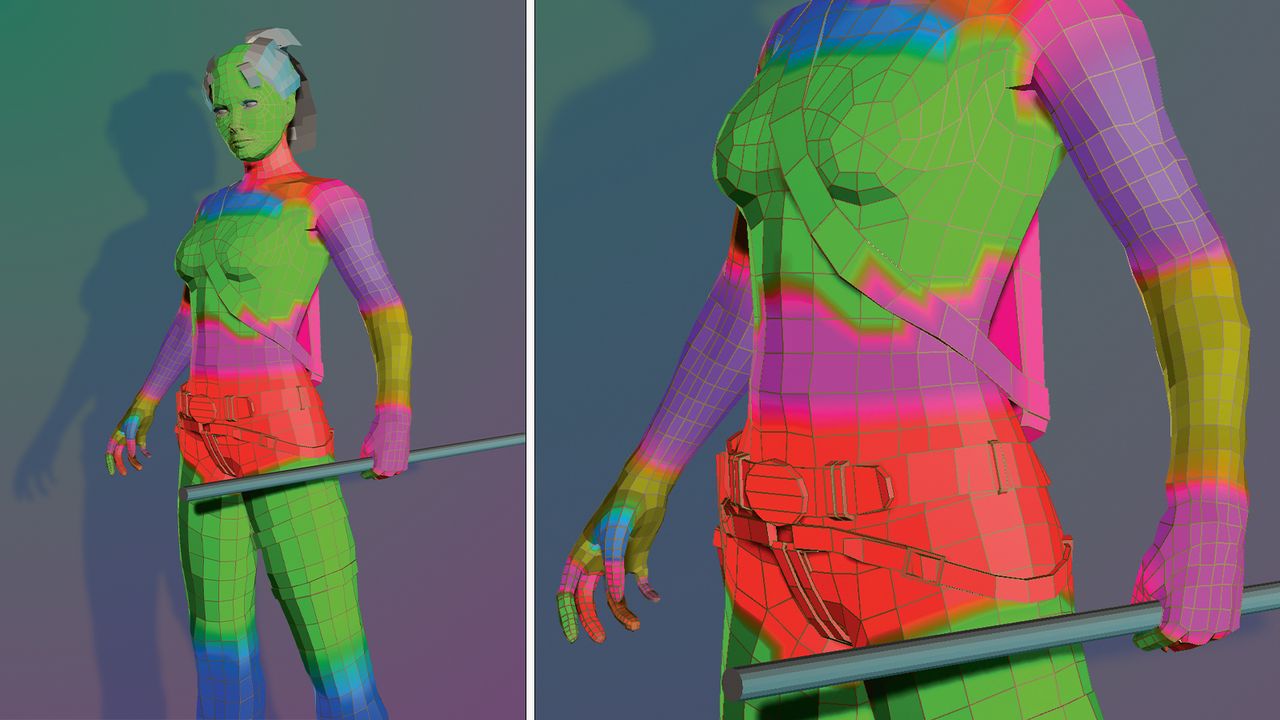
We’ve now discussed many of the elements that make up a 3D model, and if you’ve spent any time exploring the best 3D modelling software, you’ll already have seen how these fundamentals come together in practice. As we’ve seen, edges, vertices, and UVs are all key components that affect how the model looks, so what else is left to cover? Well, vertices don’t just store positional and UV data – they also hold colour data, too.
Vertex colours aren’t immediately obvious, but you will have seen them in action at some point. For example, in Maya, when painting skin weights, the values are represented using vertex colours. In sculpting applications, when you paint colour information onto models, this is usually done using vertex colours, too. If you’re working on more complex scenes, especially on the best laptops for 3D modelling, this kind of efficient data handling becomes even more important.















