Get all your news in one place.
100’s of premium titles.
One app.
Start reading
The Conversation
The Conversation
James Brocklesby, Lecturer in History, Sheffield Hallam University

Why Trump is attacking the UK over Chagos Islands – and what it tells us about Britain’s place in the world

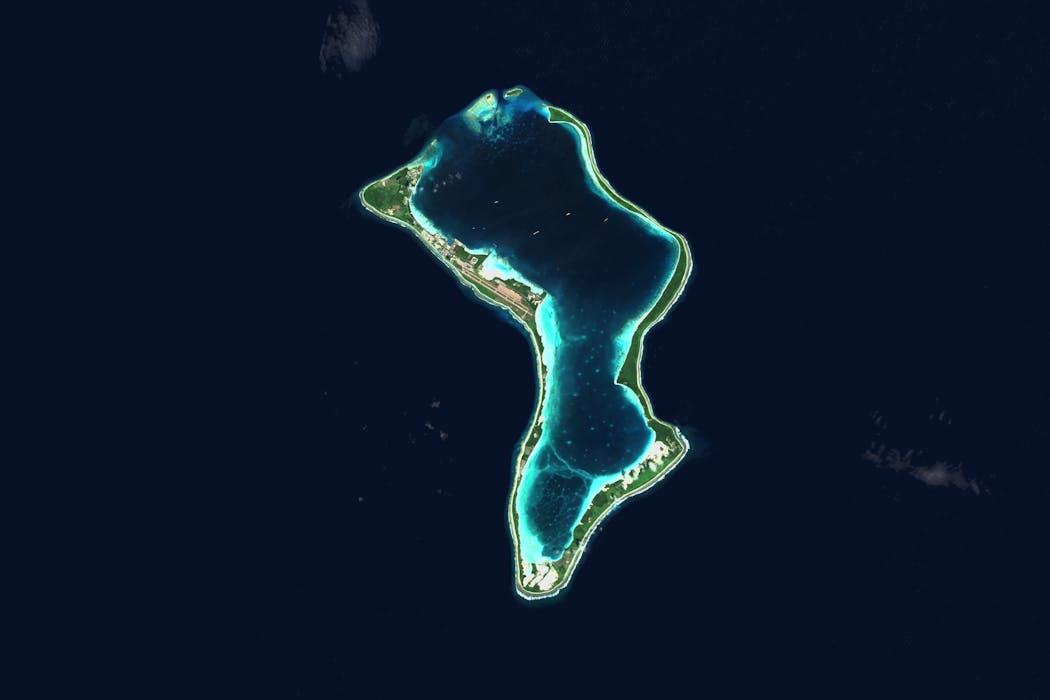
The US and UK maintain a joint naval base on Diego Garcia. zelvan/Shutterstock

The UK formally agreed to transfer sovereignty over the Chagos Islands to Mauritius in May 2025. With the Trump administration’s explicit support, this move ended one of the longest-running territorial disputes in Britain’s remaining overseas territories.

The decision has been hailed by some as a long-overdue act of decolonisation, condemned by others as a strategic misstep. Unexpectedly, Donald Trump has now reignited the debate, branding the deal an “act of great stupidity”.
Why has this small chain of remote Indian Ocean islands become such a flashpoint?

The roots of the crisis lie in the dismantling of Britain’s empire in the 1960s. The Chagos archipelago was historically administered as part of colonial Mauritius, then a British colony. In 1965, three years before Mauritian independence, the UK separated Chagos from Mauritius to create a new territory: the British Indian Ocean Territory.

The creation of a new colony was an act shaped by cold war strategy. Mounting economic and strategic pressures in the late 1960s – including the devaluation of the pound in 1967 and the Labour government’s 1968 decision to withdraw British forces east of the Suez Canal – together curtailed Britain’s regional defence role in the Indian Ocean.

As Britain retreated “east of Suez”, it still wanted a secure military foothold in the Indian Ocean, particularly one that could be used jointly with the US. Diego Garcia, the largest island in Chagos, was ideal: isolated, strategically positioned between Africa and Southeast Asia, near major trade routes and capable of hosting a major naval and air facility.

The costs were met by the UK, with £3 million paid to Mauritius to cede the islands. But the price of this strategy was paid by the Chagossians. Between 1967 and the early 1970s, the islanders were forcibly removed from their homes and relocated to Mauritius and Seychelles. Their removal was brutal: families were separated, livelihoods destroyed, and a distinct island community effectively erased.

Why the UK changed course

By the 21st century, Britain’s legal position was increasingly untenable. In 2019, the International Court of Justice ruled that the separation of the Chagos archipelago from Mauritius had been unlawful and that the UK should “terminate” its administration “as rapidly as possible”. The UN General Assembly backed this view with an overwhelming but non-binding vote.

Mauritius has consistently argued that the islands are a stolen part of its national territory, and therefore their decolonisation is incomplete. Over time, this case gained traction – Britain’s continued control of Chagos came to symbolise the unfinished business of empire.

By 2022, James Cleverly, then the UK’s foreign secretary, opened negotiations with Mauritius to “resolve all outstanding issues” over the archipelago. In October 2024, the Labour government under Keir Starmer concluded that a negotiated settlement was preferable to decades more legal wrangling.

The deal struck with Mauritius did two things: it transferred sovereignty over the archipelago to Mauritius, while securing a 99-year lease on Diego Garcia to allow the existing US-UK military base to continue operating at a cost of £3.4 billion.

On paper, this protected British (and by extension US) strategic interests in the region while satisfying the legal argument from the UN. However, while the deal was initially supported by the US, the deal has come under attack from other UK political parties, and increasingly jars with Trump’s vision of the world.

Why the islands matter strategically

The significance of Chagos is its location. Diego Garcia is one of the most important western military installations outside Europe and North America. It has been described as “an all but indispensable platform” for US interests in the Middle East and East Africa, with B-52 bombers recently used from the base to strike Yemen.

In an era of renewed great-power rivalry, the island’s value has increased. As China expands its naval presence in the Indian Ocean, western governments see Diego Garcia as a counterweight. However, critics of the deal have raised questions about the China-Mauritius relationship, arguing this would allow China a crucial foothold in the region.

For the UK, the base also underpins its claim to still be a meaningful military actor beyond Europe. For this reason, sovereignty transfer was carefully managed. Britain was not abandoning the base, but ensuring an arrangement that kept western military access intact while removing the colonial stain.

On one level, the Chagos deal looks like a model of decolonisation. Britain accepted international law, acknowledged a historic wrong and negotiated a settlement.

Yet this is happening at a moment when global politics is becoming more overtly imperial in style. Russia’s invasion of Ukraine, China’s assertive regional ambitions and Trump’s expansionist rhetoric about Greenland all suggest a world less governed by law and more by power.

In that context, Britain’s attempt to “do the right thing” over Chagos risks looking out of step. It reflects a rules-based worldview that is under pressure.

This creates a dilemma for the British government, which on January 20 vowed to “never compromise on national security”. The government defended the deal, saying it had to hand over the Chagos Islands because the military base was “under threat” from international legal action.

Britain is no longer an imperial sovereign with uncontested control over distant territories. It is a mid-sized power that must balance history, law, alliances and strategy.

This situation also exposes Britain’s continued dependence on the US for its global military clout and economic advantages. Without the US, Diego Garcia would be far less significant. The US substantially provides most of the base’s military capability. Trump’s criticism underscores a deeper vulnerability: Britain’s post-imperial identity remains tethered to American power.

The Conversation

James Brocklesby does not work for, consult, own shares in or receive funding from any company or organisation that would benefit from this article, and has disclosed no relevant affiliations beyond their academic appointment.

This article was originally published on The Conversation. Read the original article.

Sign up to read this article
Read news from 100’s of titles, curated specifically for you.
Already a member? Sign in here
Related Stories
Top stories on inkl right now
One subscription that gives you access to news from hundreds of sites
Already a member? Sign in here
Our Picks
Fourteen days free
Download the app
One app. One membership.
100+ trusted global sources.