Get all your news in one place.
100's of premium titles.
One app.
Start reading
Times Life
Times Life
Kashish Pandey

Why Thousands Believe These Stones Were Bhim's Childhood Marble?

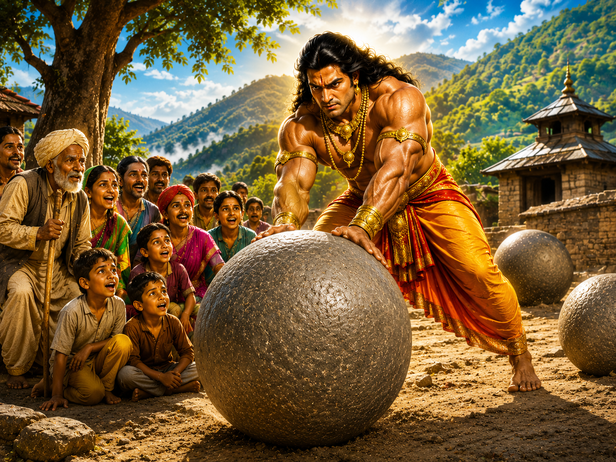
Do you remember playing marbles when you were a kid? Sitting on the ground, drawing small circles in the soil, aiming carefully… sometimes winning, sometimes losing… but always feeling like those tiny glass pieces mattered more than anything else in that moment. Now imagine someone tells you what if these huge stones, scattered silently across ancient land, were also marbles once? But not yours. Not mine. They belonged to Bhim from the Mahabharata.

At first, your mind smiles at the idea. It sounds like a childhood story told by elders to make the world feel magical. But then something unexpected happens you don’t completely reject it either. Because deep inside, we are already familiar with a world where mountains walk, rivers speak, and warriors are more than human.

Bhim: Strength That Became Legend

Bhim
Bhim

In the Mahabharata, Bhim is described as unmatched in strength someone who could lift mountains, defeat giants, and move with power beyond ordinary human limits. Strength is never just physical. It becomes symbolic. Bhim is not only a warrior; he is the idea of force, energy, and raw life itself.

So when people look at enormous stones scattered across land, their imagination naturally searches for connection. And Bhim becomes that bridge between human experience and the unexplainable scale of nature. It is not about literal truth alone it is about how myth gives shape to awe.

When Stones Begin to Feel Like Stories

Geology may explain these formations as the result of time, pressure, and natural movement. But ancient beliefs does something different it gives emotion to geography. These stones don’t feel arranged like human hands placed them. They feel left behind. As if something immense once interacted with them in ways we can no longer see. And that is where the belief grows.

In oral traditions, people begin to associate such landscapes with familiar epics. The Mahabharata is not distant history it is cultural memory. So Bhim naturally becomes part of the explanation.

“Maybe he played here…”

“Maybe these were his marbles…”

Not as scientific claim but as spiritual imagination.

How Oral Tradition Turns Geography Into Mythology

Oral tradition
Oral tradition

Epic stories in India does not stay fixed in books. It lives through storytelling. One generation passes it to the next. A place becomes sacred not through evidence, but through repetition, belief, and emotional connection.

Over time, landscapes are no longer just physical spaces they become narrative spaces. Every unusual rock formation carries a story. Every strange terrain carries meaning. And slowly, Bhim’s marbles become more than a phrase. They become a way of seeing the land itself as part of an ancient epic still unfolding in memory.

The Spiritual Layer Hidden in Belief

If you observe this closely, something subtle appears. This belief is not just about Bhim or stones. It is about how humans relate to mystery. We are surrounded by things we cannot fully explain. Instead of feeling disconnected, we create meaning. We turn silence into story. We turn matter into memory.

And in that process, Ancient beliefs becomes spiritual not because it replaces reality, but because it deepens our experience of it. It reminds us that not everything meaningful needs to be proven to be felt.

Outro

Whether or not these stones were ever truly Bhim’s marbles may remain unanswered in historical terms. Yet their significance extends far beyond the question of factual proof. For generations, local communities have preserved these stories, passing them down through conversations, folklore, and shared belief. In doing so, they have transformed ordinary stone spheres into symbols of a living cultural heritage.

What makes these stones remarkable is not merely their size or mystery, but the way they continue to inspire wonder. They invite visitors to imagine a time when legends walked the earth and epic heroes were part of everyday storytelling. The stones blur the line between history and mythology, encouraging people to explore the rich traditions that shape local identity.

Sign up to read this article
Read news from 100's of titles, curated specifically for you.
Already a member? Sign in here
Related Stories
Top stories on inkl right now
One subscription that gives you access to news from hundreds of sites
Already a member? Sign in here
Our Picks
Fourteen days free
Download the app
One app. One membership.
100+ trusted global sources.