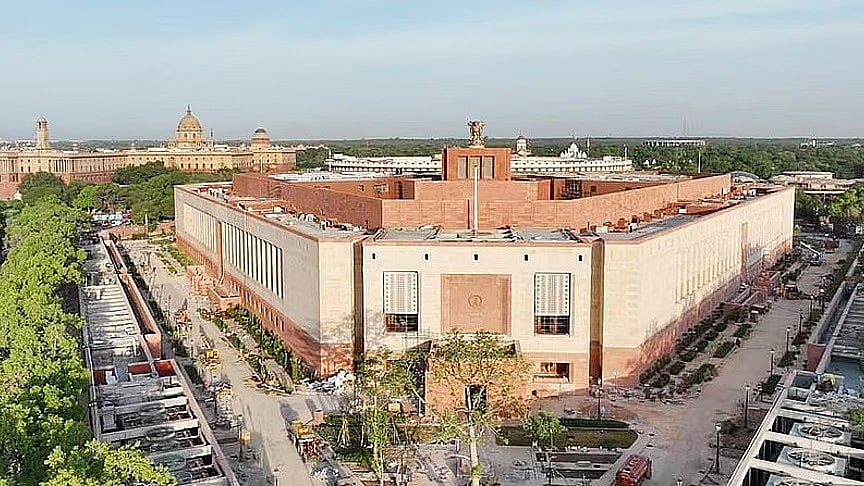
Special sessions of Parliament were historically called for crises and commemoration. The session in 2008, when the United Progressive Alliance (UPA) government lost the support of the Left, those in 1991 and 1977 for imposing President's Rule in various states, and the one in 1962 during the war with China, were all called in the wake of crises. Commemorative sessions have been called for anniversaries of the Quit India Movement, Ambedkar's birth anniversary, and the inauguration of the new Parliament, most recently in 2023.

The current government has the distinction, twice, of asking for special sessions on occasions that were neither crisis or commemoration. One was for the passage of the Goods and Service Tax (GST) Act in 2017, and the other is now. Three bills, none of which are urgent, are being tabled for passage within this three-day window. All of them relate to delimitation.
Delimitation involves the determination of two things: the number of Parliamentary and Assembly seats in each state, and the geographical boundaries of the seats. The bills propose significant changes to delimitation. One change disconnects women's reservation from census and delimitation, a linkage that should never have been in the original 106th Constitutional Amendment of 2023 (Nari Shakti Vandan Adhiniyam). This change betters bad law, and is also where the good news ends.
A slew of other proposed changes are controversial. They raise the size of Parliament from 545 to 850, with 815 MPs from states, and 35 from Union Territories. They delink delimitation from the census with a constitutional amendment. They now subject delimitation to parliamentary writ, so it can be initiated at the pleasure and expedience of the Parliament. Such a de-constitutionalised delimitation no longer needs a two-thirds majority.
The amendment also frees delimitation from the constitutional protections of seat freeze and boundary freeze. The 84th Constitutional Amendment (2002) had extended the seat freeze to continue to be based on the 1971 census by an additional 25 years, till 2026, while the 87th Constitutional Amendment legislated the use of the 2001 census for constituency boundaries.
The changes establish a Delimitation Commission, legislated to use the current latest census at any time, but without publishing a formula for how seats are to be allocated to states. The terms of reference of the commission are to be set solely by the Union, with states having advisory but no voting or veto powers. They also decree that the decisions of the Delimitation Commission cannot be challenged in any court of law; this is not new.
Even without a published formula, any seat allocation based on the latest, i.e., 2011 census, will dramatically reduce the power of states that have acted responsibly by the Union, in population control. Between 1971 and 2011, India's population grew more than double from 54.8 crores to 121 crores. However, every single southern state controlled its fertility rate to below the national average (as did Odisha and West Bengal, but not Gujarat), contributing much smaller population additions. Naturally, their share in India's overall population fell in this period. A fall so steep that, as a ratio of UP’s population, the combined population of Andhra Pradesh went down from 49% to 42%, Tamil Nadu’s from 46.5% to 36%, and Kerala’s from 24% to 16%. While Karnataka was not in its current shape and form in 1971, its Total Fertility Rate (TFR) at 2.0 (below replacement) in 2011, compared to UP's 3.6, guarantees its erosion of power.
While numerous estimates for seat allocations have been offered by various commentators, the bills themselves are mum on the formula, leaving it to the incontestable, non-justiciable wisdom of the Delimitation Commission. For the South, what the usage of any census post-1971 spells, is dramatically dwindled prowess within the Parliament in which laws need only a simple majority to pass. If this proposed delimitation succeeds, any government, current and future, could pass laws they please, bypassing the South completely. The southern contingent in Parliament would be rendered entirely irrelevant to much lawmaking. In fact, almost all laws could be passed using a clutch of north-of-the-Vindhyas-states: UP, Bihar, Rajasthan, MP, Gujarat, Chhattisgarh, Haryana, HP, Uttarakhand, Jharkhand together will likely occupy 50% of seats. These ten states may match the combined power of the other eighteen states: five of the South, eight of the North East, Odisha, West Bengal, Maharashtra, Goa, Punjab.
All this said, there is a compelling reason to delimit. Using the current census balances the under-representation of the populous states of the Hindi heartland. So, why are these bills so disquieting? It is because of the focus on the falling numbers of seats in the southern states, stark and ominous as they are, misses the iceberg that could sink the ship.
Democracy is a process, not an outcome. Politicians may care more about results, but for citizens, institution-driven process is all we can and have awarded ourselves through the Constitution, to secure our freedoms. The electoral process, for instance, gives all adult citizens the right of vote, even though the outcomes may not be optimal. Yet, the process is what matters, as voters determine their fates, for better or worse, and they can overturn it too. Similarly, the process of passing Constitutional Amendments is the citizens' shield against political power-play.
Since governments change but people continue as keepers of the Republic, a considered, deliberative process for negotiated outcomes has been constituted for such amendments. This iterative process involves multiple readings of bills, public consultations, expert and select committee analysis, and parliamentary debates, before calling for a vote. Following the process yields better and fairer methods of delimitation, benefitting from the soak time for critical examination of clauses, adapting best practices from elsewhere (like degressive delimitation of the European Union), wide-ranging inputs from experts and the public, and diverse perspectives from MPs. In particular, given the finality of decisions by the Delimitation Commission, due process insulates delimitation against structural anomalies, breaches of fundamental rights, and democratic illegitimacy.
Instead, monumental bills have been shoved into an abrupt, unplanned three-day affair, bang in the middle of the heat and humidity of the Tamil Nadu and West Bengal elections. The Parliamentary institution and processes befitting the heft of the bills have been replaced with a compressed Insta-reel, followed by a swipe-right-and-match for a speed-date vote. Added to this, there are verbal “guarantees” from the Prime Minister on the floor of the Parliament, instead of carefully considered formula encoded in writing in the bills. Could law-making get more casual?
This is an apt time for Parliamentarians to remind themselves of the basics. Firstly, Prime Ministers are transient, and so are their guarantees; only written laws are reliable. PM Manmohan Singh’s commitment of Special Category Status to Andhra Pradesh on the floor of Parliament, was reneged by PM Modi. It is still unfulfilled. Secondly, governments are notorious flakes, even with their Parliamentary commitments. The Union’s own Committee on Government Assurances, that scrutinised their word in Parliament, found the 2014 NDA government left 300% more assurances unfulfilled than the previous government. Lastly, Prime Minister Modi and Home Minister Amit Shah’s personal assurances on the floor of Parliament have stayed unfulfilled. Both claimed that peace has returned to Manipur, even as it continues to burn today.
When the 2023 Women’s Reservation Bill was linked to census and delimitation, it raised questions of intent and commitment to the cause of women’s political representation. Even as those questions remain and amplify with the passing of time, the untimely introduction of an amendment delinking these, along with verbal commentary on an unspecified formula for delimitation, raises questions of law-making competence. Worse, it reeks of a cavalier attitude of the Government of India, as if they can’t be bothered with the complexity of the nation’s challenges and the intricacy of laws needed to govern it.
Once such precedent is allowed, what prevents this and future governments from ramming through Constitutional barricades, with oral revisions, time and again, for their electoral expedience and perpetuation of power?
This is what is most dangerous about these bills: trampling of sacrosanct institutions and processes. It prevents MPs from adequately examining the bills before the fateful votes on 131st Constitutional Amendment Bill, the Delimitation Bill and the Union Territories Laws (Amendment) Bill, 2026. It expects MPs to vote on oral transmission without any written commitment. It is at such time that the mettle of MPs becomes self-evident.
How southern MPs vote on these bills will determine the existential identity of the south within the Union. Will Kannada, Malayalam, Tamil and Telugu voices shape their own fates and India's policies in the future, or become subordinate to majoritarian Hindi voices? For southern MPs from BJP and the rest of NDA, voting yay on this delimitation proposal is condemning their own state's future. But that is not all. Over and above these key considerations, all MPs need to determine if the government is allowed to bypass due process, no matter whether the bills under review are conducive or unfavourable. The 'fell clutch of circumstance' from overriding due process is what the Members of Parliament can and must avert.
Indeed, the third grade mathematics teacher could teach this lesson to the Government of India: Unless each intermediate step of the multiplication or division problem is clearly derived for all to see, the final answer, right or wrong, merits a zero. The process is the right answer, no matter the bill. And this one is suspicious.
Tara Krishnaswamy is a political creature with an urge to write. She works on political and policy communication. X: @tarauk
This piece was republished from The News Minute as part of The News Minute-Newslaundry alliance. Read about our partnership here and become a subscriber here.
Elections are not just about who wins, but about the questions that often go unasked – and this time, they matter more than ever. Support our new NL Sena on the five upcoming assembly polls to help us follow the missing voters, the shifting politics, and the stories that could shape India’s future.
Newslaundry is a reader-supported, ad-free, independent news outlet based out of New Delhi. Support their journalism, here.