Despite soaring energy prices and geopolitical tension, travel demand remains strong as the summer kicks off. The U.S. Travel Association projects inflation-adjusted travel spending to grow 1% in 2026 and 3% in 2027, with international travel in the U.S. rebounding due to the World Cup. Earlier this month, CoStar and Tourism Economics upgraded their U.S. RevPAR (revenue per available room) forecast to 2.8% year-over-year (YOY) following a 4.0% figure in Q1 2026, the highest quarterly RevPAR number on record.
Naturally, the travel sector is booming, right? Not so fast, my friend. Hotel stocks are making new highs, but airline, cruise line, and other travel stocks are lagging both the broader market and their hotel industry peers. Why is one subsector winning big while the rest of the industry lags? The answer, of course, lies in the Strait of Hormuz.
Oil Is the Travel Sector’s Macro Sorting Mechanism
Oil prices have been elevated above $90 per barrel since early March when Iran closed the Strait of Hormuz. High energy prices have squeezed consumers, yet travel demand remains firm. However, oil has become a sorting mechanism in the travel industry, and the market is re-rating the sector based on fuel exposure in earnings, not raw demand.
-
Airlines: Fuel is one of the three biggest cost line items for any airline, and consistently high jet fuel prices are cutting into airline profits. The U.S. Global Jets ETF (NYSE: JETS) is down more than 2% year-to-date (YTD), and the best-performing airline stock, Delta Air Lines Inc. (NYSE: DAL), is also the most hedged since it owns a refinery.
-
Cruiselines: Despite record bookings, the cruise line industry’s earnings are also facing pressure from the oil shock. Norwegian Cruise Line Holdings Ltd. (NYSE: NCLH) already lowered its full-year 2026 EPS outlook during its Q1 2026 report last month. And the only oil-hedged cruise line, Royal Caribbean Cruises (NYSE: RCL), is still down more than 3% YTD.
-
Online Travel Agencies (OTAs): OTAs aren’t insulated from the oil shock despite having no fuel costs. Tapped-out vacationers are eschewing international travel for cheaper domestic trips that reduce overall spend and slash OTA fee revenue. Airlines could also offset fuel cost increases by slashing commissions paid to OTAs for their listings. Booking Holdings Inc. (NASDAQ: BKNG), the largest publicly-traded OTA, is down more than 25% YTD.
It’s not hard to see why hotels have outperformed. Hotels are best positioned to monetize travel demand because they don’t have to cover fuel costs. And some of the industry leaders aren’t even paying the mortgage on the real estate anymore.
2 Hotel Stocks Setting New Highs This Summer
The three hotel stocks listed here all have a common theme: a franchise business model. Under this model, a hotel franchisee bears all cyclical risks, including mortgage costs, labor, depreciation, insurance, and utilities. The brand collects a percentage of gross room revenue and other fees, and allows the operator to use their name and access their booking and loyalty engines. A capital-light system with recurring revenue is ideal for a macro shock environment, which is why these stocks have soared to new highs this year.
Marriott: Fee Machine Firing on All Cylinders
Non-RevPAR revenue streams are what set Marriott International Inc. (NYSE: MAR) apart from its peers.
Card fees were up 37% YOY in Q1 2026, and management boosted full-year gross fee guidance to a range of $5.93 billion to $5.99 billion.
The pipeline is also robust; a record 618,000 rooms, 43% of which are already under construction. Q2 RevPAR guidance was also boosted to a top range of 2.5%.
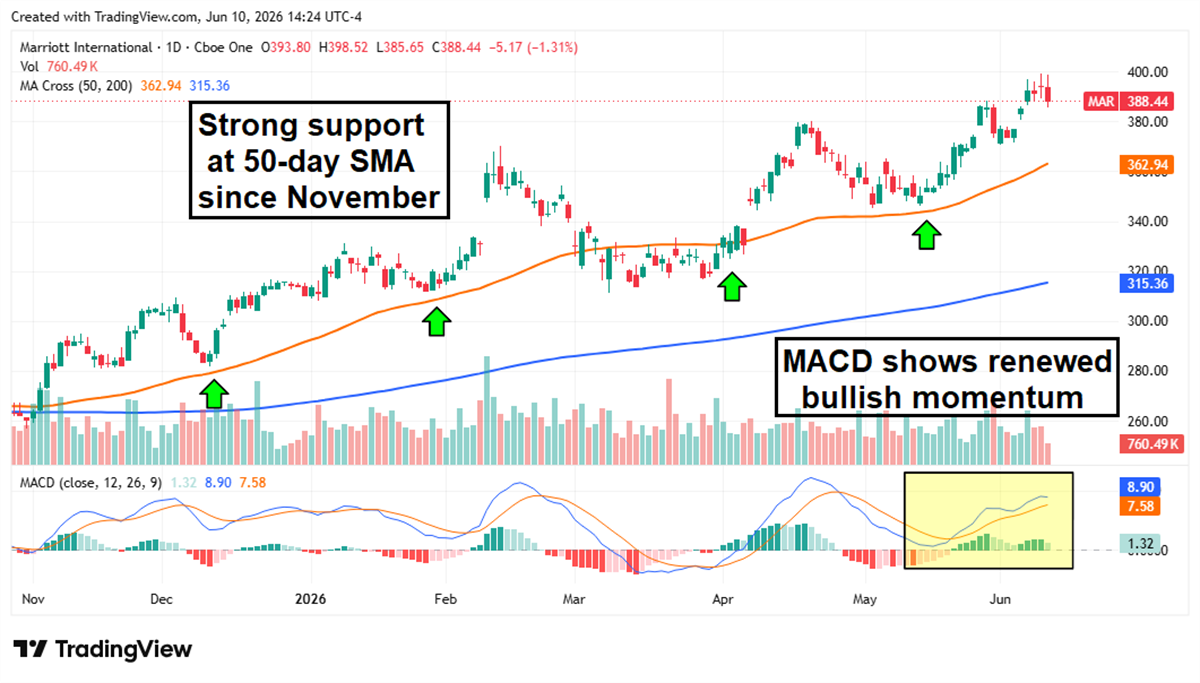
MAR shares are also enjoying strong technical momentum. The 50-day moving average has provided support for nearly a year, and the Moving Average Convergence Divergence (MACD) indicator is signaling a bullish momentum uptick. The fundamentals and technicals confirm the same story, and that’s more upside ahead.
Hilton: The Hotel Industry’s Purest Compounder
Net unit growth is the catalyst for Hilton Worldwide Holdings Inc. (NYSE: HLT). The company reported 131 new hotel openings during its Q1 2026 earnings release, with industry-leading net unit growth of 6.3%.
Hilton is targeting 6-7% unit growth over the rest of the year, and it is confident enough in this projection to raise RevPAR growth despite Middle East headwinds. System-wide RevPAR of 3.6% outperformed expectations, and a record 527,000 rooms are currently in the pipeline.
HLT shares have traded flat since the start of April, but remain up more than 15% YTD, and there’s evidence that the next leg of the rally is imminent. Support remains strong along the 50-day moving average, and the Relative Strength Index (RSI) has now pushed back into bullish territory.
The stock trades at a premium multiple of 37 times forward earnings, but the growth rate and capital returns ($3.5 billion in buybacks and dividends scheduled for 2026) command attention.
The article "Why These 2 Hotel Stocks Are Beating Travel Peers" first appeared on MarketBeat.