The failure to release the pent-up flood waters from Onehunga's lagoon had dire consequences for trapped and endangered motorists, and inundated locals who rightly worried that it would happen again. It highlighted systemic problems in Auckland's infrastructure management, writes Jonathan Milne.
On low-lying Beachcroft Ave in Onehunga, Greg Capper watched from the door as the waters rose. "I was so nervous with the water lapping up onto my door steps," he says. "Those gates could have, or should have, been opened earlier."
He's talking about the sluice-gates from Te Tauranga Lagoon to Manukau Harbour that, as Newsroom revealed on Friday night, were left closed as the flood waters rose up to swamp the south-western motorway and nearby houses.
"We had to wake our children to evacuate them," says another local, Helen Embleton. "Our house was badly flooded and we agree the situation has been handled terribly. Who would we contact to ensure floodgates are open before this evening? We’re petrified it might happen again."
She was right.
READ MORE: * Raw sewage leaves Auckland’s weekend up shit creek * State of emergency: Auckland floods 'a wake-up call' * Tim Murphy: A self-destructing mayoralty * Auckland's historic flooding explained in five charts
Early on Wednesday morning, the parked cars on Beachcroft Ave were again submerged; community board member Debbie Burrows shared video footage of a bus ploughing through water that came halfway up its windscreen. One of the two sluice gates had been opened but this time the tide was rising; the incoming tide was combining with the torrents rolling down the hill to create a new flood.
Purshottam and wife Indu Merai look down from the upstairs verandah of the home, further down Beachcroft Ave, where they've lived nearly 30 years. "Slowly, slowly, slowly the water is coming up," says retired businessman Purushottam Merai, 78. "The road is covered up already, and it's coming right in through my door."
Merai and his brothers established a well-known tailors' business in Onehunga nearly a half century ago; in all that time, the couple say they have never seen anything like these floods.
But all the locals know that with climate change, Auckland and the rest of New Zealand can expect to experience such extreme weather events ever more frequently.
Insurance Council chief executive Tim Grafton had warned on Friday night that the floods were "a wake-up call". He, too, was right. There are many respects in which Auckland Council, infrastructure providers, and private business including insurance companies themselves, were found to be snoozing on the job.
Newsroom investigations indicate the closed sluice-gates are an example of the systemic problems in emergency preparedness.
There were two gates that could have released the water through culverts beneath the south-western motorway causeway, as the tide in the Manukau Harbour dropped from a high king tide at 3.42pm Friday, to a low tide at 9.52pm.

The northern gate, though, was undergoing critical repairs by contractors STF Group – the gates were examples of how the city had allowed its water infrastructure to deteriorate for decades, says one Auckland expert.
That left only one gate, 100m further south – and responsibility for opening and closing that officially sits with the council's Community Facilities department. That's been delegated to the manager of a wakeboarding business that is licensed to operate in the lagoon.
"If council had known that the key was with someone on the North Shore, the decision would have been different." – Debbie Burrows, Maungakiekie community board
Marcel Morgan, Auckland Council's manager of area operations, says the gates are not used as a flood-prevention measure as they are designed to keep water in.
Late on Tuesday, Morgan offers the community an assurance: "The southern sluice gates are now completely open and will remain so for the balance of the rain warnings."
The northern sluice gates are currently undergoing renewal, and are therefore closed. However these gates do still serve as a backup in case the southern gates fail, and vice versa. Their inactivity will not impact the water level, he insists.
"The sluice gates in Onehunga are managed by a commercial operator who controls the water level in the lagoon so that during low tides the community can take part in water-based recreational activities," he says.

On Friday, that operator wasn't able to open the southern gates.
"Flooding in the maintenance room meant it was not safe to operate the gate’s controls until the next morning. After a heavy rain event, the council requires the gates to open to allow the lagoon to be flushed with the tides, which we will continue to do for the balance of the rain warnings."
That's not the whole story, though. That "maintenance room"? It's a metal box above the sluice-gate, beside the dog-walking path on the motorway causeway.
And Mark Harrison, the manager of the Rixen Cableways water park in Onehunga, says he does have a key – but he's not the only one. The council staff also have one.
Anatomy of a disaster
Mark Harrison is a little angry the council is passing the buck to him, when council staff have their own key to the controls – and unlike him, their office is in Onehunga. They could have got there within minutes. "I spoke to them on Friday and it didn't seem like they were blaming us," he says. "If they are, that is a bit of hypocrisy."
When Rixen Cableways Ltd first won consent to build its wakeboard facility in the lagoon, the previous directors fought to be allowed to control the sluice-gates – and council backed them.
And as the rain began to fall more and more heavily on Friday afternoon, Harrison says he left work on Auckland's North Shore to drive down to Onehunga to open the southern sluice-gate. But it took hours to navigate through the gridlocked traffic.
From 6pm, the water began back-flowing from the lagoon into the homes on Beachcroft Ave, Church St and other parts of low-lying Onehunga. The rainfall peaked just before 7pm. The water collected on the slopes of Maungakiekie, then cascaded down the hill.
"That was the second when a huge tree fell. It felt like an apartment building had collapsed over my head. I was in shock." – Peter Bekhet, Corporate Cab driver
The main road, Onehunga Mall, was a torrent. So too were streets like Selwyn St and Normans Hill Rd – running straight into the lagoon.
By the time Harrison got to Onehunga, he took one look at the lagoon and knew there was no way he could open the gate. "I was trying to get down there as quick as possible. As soon as I got there, it was pretty awful."
The controls were beneath a lake of flood water. "The gates are actually designed so they do have an overflow. But obviously, I've never seen anything like that. I don't think any of us have."
By 7pm, it was climbing up over the causeway to inundate the motorway. Unhappy concertgoers, who had left the cancelled Elton John show, pushed down the motorway onramp from Queenstown Rd. Coming in the other direction were frustrated travellers who had left the flooded Auckland Airport, their flights cancelled.

They met at Onehunga, where the floodwaters closed three lanes of southbound traffic. A fire engine, siren wailing, struggled to force its way through stalled and abandoned vehicles. On the northbound side, motorists aided by knee-high floodwaters were able to float another abandoned car from an offramp that it had been blocking.
Some northbound traffic, in a bid to avoid the inundated motorway, followed their GPS off at Neilson St, then up the waterfront Orpheus Drive by the new Onehunga Beach.
Among those drivers was Peter Bekhet, a Corporate Cab driver with passengers he had picked up from the airport – a mother and her teenage son, whose flight out to Adelaide had been delayed. "All the way from the airport, she was watching the flooding, and she was upset."
It was 8pm. The traffic was moving about 5-7km/h, he tells Newsroom, which was better than the motorway alongside them. That wasn't moving at all.
"I was in shock. It looks like I went unconscious for about 10 seconds, then returned back again. The lady was screaming." – Peter Bekhet, Corporate Cabs driver
As he reached the end of the beach and the traffic ahead of him cleared, the 62-year-old pressed gently on the accelerator of his near new 2022 Škoda Superb, to drive out of the waters and up the hill. "Just before going up, that's when the traffic for a second stopped."
There was an enormous crack. "That was the second when a huge tree fell. It felt like an apartment building had collapsed over my head."
A branch pierced the windscreen. "I was in shock. It looks like I went unconscious for about 10 seconds, then returned back again. The lady was screaming."
"I'm not that religious," says Bekhet, who grew up in Egypt. "But in our culture we say, it's as if I saw my death with my eyes. It looks like a movie coming across my in the front of my, my eyes. All the big events in my life, going fast like a movie."
Other motorists rushed from their cars to crawl through the tree to his taxi. They pulled back branches and banged on the windows, asking if he and his passengers were okay. "And suddenly you realise that no, you're still alive. You went to the light at the end of the tunnel, but then, you've come back."

It was because the lagoon had overflowed onto the motorway, stopping traffic, that Bekhet had taken that parallel road beneath sodden hillsides. But incredibly, neither he nor his passengers were hurt.
He called 111 for help. The operator asked, was anyone injured? No, he replied. In that case, sorry, but you're on your own.
Emergency services were overwhelmed. Another motorist offered his passengers a ride to their hotel.
As for Bekhet, he stood in the rain until 11.20pm when his wife Amira was able to get from their home way up north in Long Bay, down to Onehunga to pick up her bruised and shocked husband.
"I was standing there in my uniform, a suit and tie and a badge on my jacket. People were stopping and saying, you were the driver? Yes. Was there anyone with you? Yes. And you all came out, nobody was hurt? Yes.
"You should buy a Lotto..."
A sinking tide
The 2016 decision to hand responsibility to a small business operator is the same as at Ōrākei Basin, where an experienced waterski club operator has the key to the sluice gates.
Infrastructure experts tell Newsroom the Ōrākei operator will often use his judgment to open the gates, even when the council is slow to advise him of the risk of flooding.
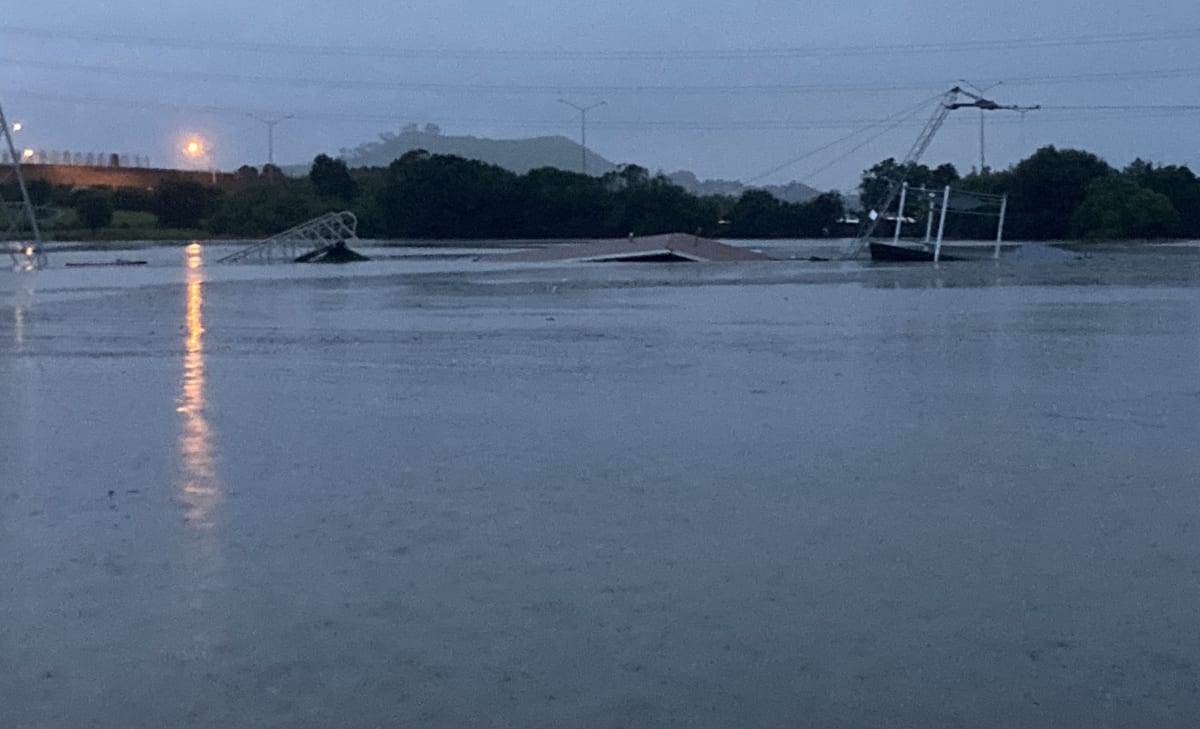
But there's a difference: the controls to the Ōrākei sluice gates can be accessed from a bridge above them; the controls of the Onehunga sluice gates can be cut off by even minimal flooding. And there's no remote control.
Auckland Council's Marcel Morgan says Friday night’s rainfall coincided with a 4 metre king tide, meaning with this amount of water, the gates would have been little help if they were open or not.
But what he doesn't say is that the tide had lowered by the time the floods hit. If the gates had been open, the water would have been able to flow out into Manukau Harbour from about 6pm, as the tide dropped.

Would opening the gates have made a difference? "Absolutely," says Harrison. "It would have made a difference, definitely."
Too little, too late
Maungakiekie community board members Debbie Burrows lives further up Beachcroft Ave. She was alarmed to discover the sluice gates were closed on Friday night – but by the time the extent of the rainfall became apparent, she says it was too late to access the controls and open the southern gate.
"At 5.30pm, that would have been the perfect time to have done it. A lot of damage could have been avoided. But that's with hindsight. Nobody had elevated the alert at that time. People were still making their way to Elton John, at that time!"
Burrows got council staff out on Saturday morning to open the gate – but Harrison had already returned that morning, and beaten them to it. By that point, he was working to fix Rixen's damaged jetty, pontoons and gantries.

Burrows says she will now be seeking the restoration of remote council control of the sluice-gates, as well as an automated system triggered to open the gates when the waters rise to a certain level.
When Rixen Cableways was given its key, the company's operators were based in Onehunga – and she hadn't realised that had changed. "If council had known that the key was with someone on the North Shore, the decision would have been different."
But the problem is about more than who holds the key, she says. It's about the degradation of water infrastructure throughout the city. "Across council and businesses, stormwater infrastructure hasn't kept up with the intensification happening in Auckland."

That's the debate. Should we build more pipes and channels and culverts to respond to intensification or, as some water infrastructure experts tell Newsroom, should we be trying to limit the intensification of our cities?
"It was a 250-year flood, but these will be happening more often," says one. "I think we're trying to control nature, building in every corner of our city, rather than leaving space for nature. We're vulnerable because we haven't put water at the forefront of our decisions about building our cities."
On Beachcroft Ave, Purshottam Merai says he's never seen floods like the ones he and his wife experienced over the past few days. They bought their house in 1994; if they knew then what they know now, they might not have.
But, they agree, back then nobody realised.