
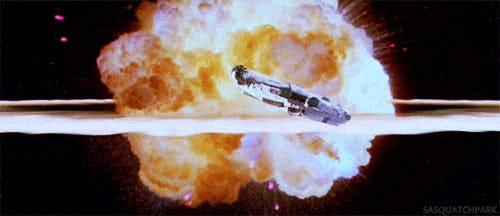
What makes for a realistic explosion in space? In 1976, when pyrotechnic artist Joe Viskocil blew up the Death Star, he noted that “No one has actually seen a space station or ship blown to smithereens.” This is still true today. While astronomers have observed supernovas (as a speck of light), and nuclear weapons have been detonated in low Earth orbit, and of course, actual spacecraft have exploded during launch, the notion of something like a moon-sized space station blowing up from the inside is the kind of thing that only exists in movies or TV series that rely heavily on VFX.
Today, nearly all spaceship sci-fi explosions in movies (or TV shows) are handled digitally, which is, of course, much safer than blowing up plastic or wood or fiberglass models inside a warehouse. And, for on-set explosions, like the decimation of Blofeld’s base in the 2015 James Bond film Spectre, you still need to set off real explosions. In fact, Spectre entered the Guinness Book of World Records for the largest film stunt explosion of all time, proving that things that go boom on movie sets are still an art form that is very much alive. And yet, a close relative of the on-set, full-scale explosion is basically extinct: The miniature explosion — a term that sounds like a joke — is basically a thing of the past. And what’s odd about this single piece of sci-fi tech is that none of your favorite movies could exist without it. And like many historical VFX milestones, we have Star Wars to thank.














