Get all your news in one place.
100's of premium titles.
One app.
Start reading
The Independent UK
The Independent UK
Maira Butt

Why the loss of Oscar-nominated Persepolis creator Marjane Satrapi is a tragedy for Iran

Marjane Satrapi, the Iranian-French cartoonist best known for her 2007 film Persepolis, died on Thursday aged just 56.

Her death comes just a year after the loss of her husband, the Swedish film producer and actor Mattias Ripa, and marks the loss of a powerful voice in Iranian culture.
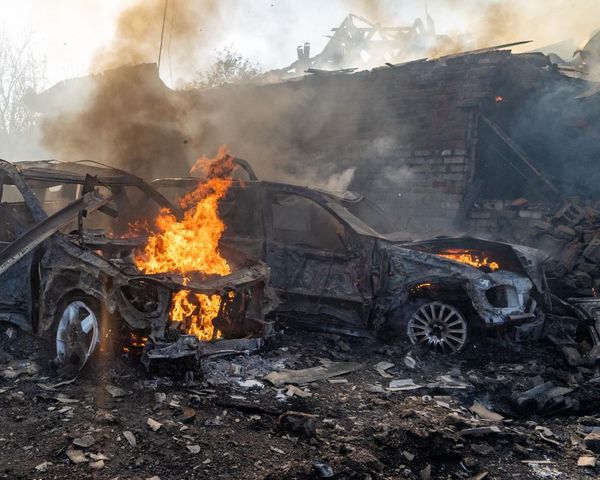
It also comes at a time of immense upheaval for her homeland Iran, currently in the grips of a conflict with the US and Israel, and torn between pressure from the West and its own nationalist dogma as it faces the worst fighting and political repression it has seen in decades.

But in contrast to other war-torn nations across the world, Iran is somewhat hidden from view; relatively little insight into civilian life emerges from the country, as strict censorship is enforced by the authorities, affecting every single facet of life.

Satrapi, born on 22 November 1969 in the Iranian city of Rasht, managed to cut through and became of Iran’s most widely read authors. In 1983, when she was a teenager, she was sent to Vienna, Austria following the 1979 Islamic Revolution, which brought Ayatollah Ruhollah Khomeini to power.

French-Iranian graphic novelist and illustrator Marjane Satrapi during the 2024 Princess of Asturias award ceremony at the Campoamor Theatre in Oviedo (AFP/Getty)

She missed home too much, and returned in 1989 to attend Tehran University, earning a degree in visual communications before eventually leaving in 1994 to move to France, where she remained until her death.

Her best-known work is the striking graphic novel Persepolis, later adapted into an Oscar-nominated film, which sheds light on the plight of women in Iran following the revolution.

The autobiographical drama, by turns moving and humorous, follows a young woman coming of age amid political turmoil and competing identity structures.

With its international success, the critically acclaimed work served as an educational experience for many Westerners, who perhaps knew little of the country or its conflicts.

Weam Namou – an Iraqi filmmaker and author, and the CEO of non-profit organisation Unique Voices in Films – found herself reflected in the story.

‘Persepolis’ was nominated for an Oscar in the Best Animated Feature category in 2007 (Sony Pictures Classics)

“I came across Marjane Satrapi’s Persepolis while doing research on Middle Eastern women who have written and made films about their stories. When I watched Persepolis, I was entranced by her story, which I could relate to,” Namou tells The Independent.

“In the 1970s, Marjane was an eight-year-old girl in Iran. I was the same age in Iraq. She was deeply traumatised by Ayatollah Khomeini’s fundamentalist ruling, I by Saddam Hussein’s.

“I’m currently in production of my own feature documentary, A Chaldean American Storyteller, and when I read about her death, I realised she was part of my inspiration.”

Satrapi had her critics, with some claiming her work was orientalist and simply reinforced Western stereotypes of Iran and of Muslim women. She would disagree, and instead highlighted the similarities between superficially different cultures.

“If I have one message to give to the secular American people, it’s that the world is not divided into countries,” she once said. “The world is not divided between East and West.

Satrapi passed away ‘of sadness’, her family said, a year after the loss of her husband (Getty)

“You are American, I am Iranian, we don’t know each other, but we talk together and we understand each other perfectly. The difference between you and your government is much bigger than the difference between you and me. And the difference between me and my government is much bigger than the difference between me and you. And our governments are very much the same.”

Satrapi’s work added nuance and layers to the complex lives of Iranian women, while advocating for their autonomy and freedom.

“It overturned a lot of lazy, stereotypical, prejudiced thinking,” says Michael Walling, founder and artistic director of Border Crossings, an intercultural, multimedia theatre company.

“Europeans and Americans like to construct the woman as victim, and the institutional oppression of women under regimes like the Taliban, [Isis] and the Islamic Republic can easily compound that, leading to people talking about Islam as inherently sexist (which it is not), about Western Asia as a ‘backward’ or ‘barbaric’ place, about people ‘living in the Middle Ages’.

Protesters mark the third anniversary of Mahsa Jina Amini’s death in memory of Iranian victims of the Woman, Life, Freedom movement at Queen’s Park in Toronto (AFP/Getty)

“When you hear the voices of women who have lived under those regimes, and recognise their profound commitment to their people, their cultures and their sisters, the sheer depth of their humanity, the articulacy with which they express their ideas – then you start to understand that they are not being oppressed by anything culturally inherent in their societies, but by yet another right-wing patriarchal power grab.”

Satrapi was fiercely passionate about the rights of women in Iran, and in 2023 coordinated with a group of artists and academics to produce the book Femme, vie, liberté (Woman, Life, Freedom), capturing the revolutionary moment sparked by the death of Mahsa Amini in 2022 at the hands of the “morality police”.

“Supporting the women’s revolution in Iran cannot be reduced to photos or speeches,” wrote Satrapi in a January 2025 letter to the French authorities. “When people are fighting for democracy, we should support them.”

Namou believes her loss comes at a crucial time for women in Iran in particular.

“It’s a tragedy for Iran and the Middle East in general, which does not have enough women voices, and even fewer with her global reach,” she says. “Her work humanised the the region for the world, empowered women filmmakers, and validated shared regional trauma.”

Walling agrees: “In terms of her hopes for her country – I think the phrase ‘Woman, Life, Freedom’ encapsulates it pretty well.”

Sign up to read this article
Read news from 100's of titles, curated specifically for you.
Already a member? Sign in here
Related Stories
Top stories on inkl right now
One subscription that gives you access to news from hundreds of sites
Already a member? Sign in here
Our Picks
Fourteen days free
Download the app
One app. One membership.
100+ trusted global sources.