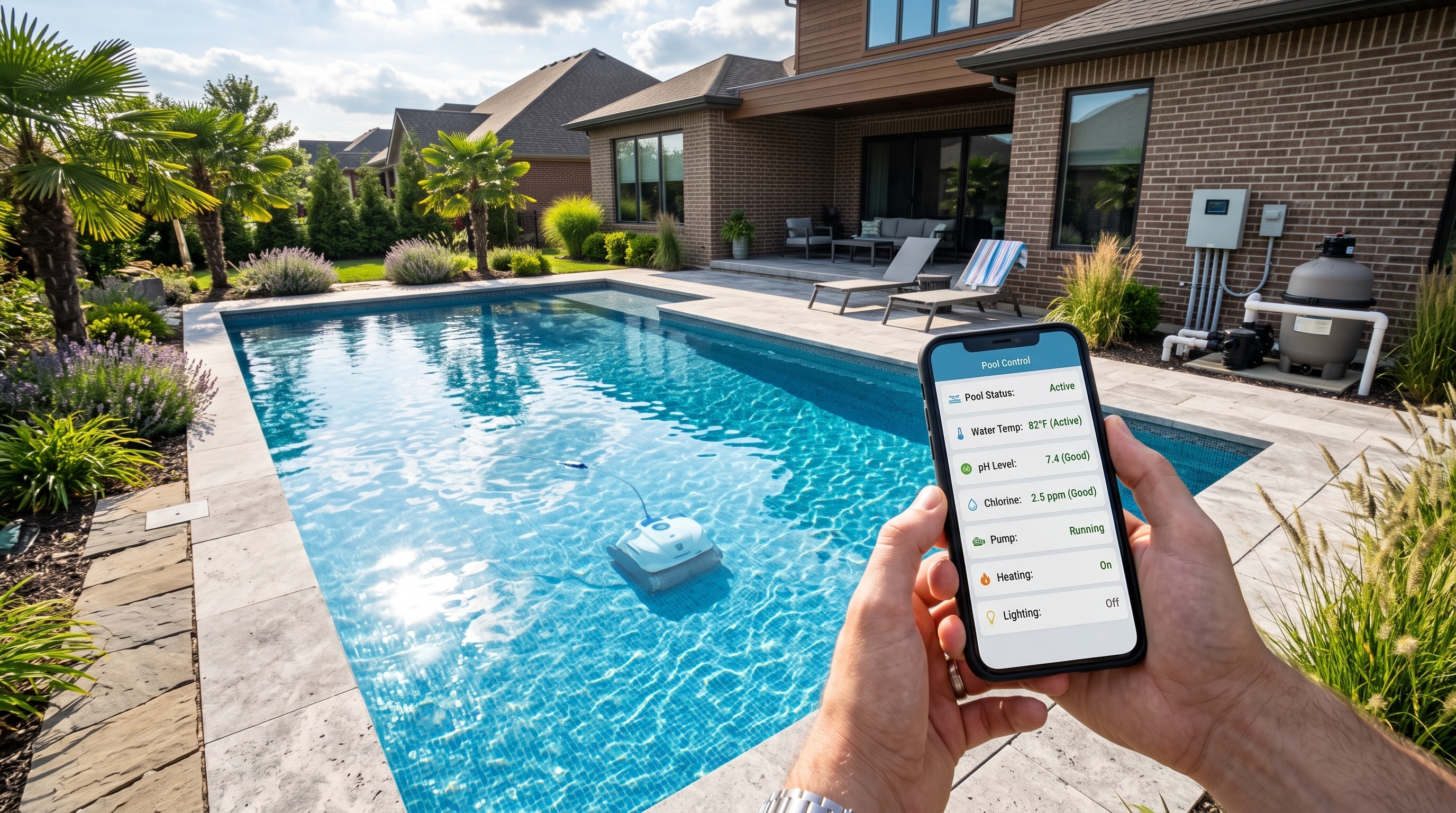
You know the routine. You test the water with strips that turn a color you have to squint at. You scrub the tile line every weekend. You guess whether the chlorine reading means "add more" or "wait a day." Then you check again tomorrow, because you're never quite sure you got it right.
The old routine is changing. Modern pool automation can handle much of the scheduling, monitoring, and equipment control for you, while automated cleaners can reduce the amount of manual cleaning required. For many homeowners, the appeal isn't simply having another app. It's having more control over how the pool operates and fewer trips to the equipment pad.
What Is a Smart Swimming Pool?
Pool automation used to be mostly about timers and schedules. You set the pump to run from 8 a.m. to 4 p.m. and hoped that was enough. Basic schedules still have their place, but connected systems can provide more flexible control and, when paired with compatible sensors or equipment, additional monitoring.
A smart pool works differently. Pumps, heaters, sanitization equipment, lights, and sensors can connect through a shared control system, allowing different pieces of equipment to be monitored and managed from one place.
- Your heater, pump, lights, and other connected equipment can be controlled from one system.
- Sensors can monitor conditions such as temperature and water chemistry, depending on the equipment installed.
- Your phone can give you remote access to connected equipment.
- Some systems can automatically adjust schedules or chemical dosing based on sensor readings and programmed settings.
From Timers to IoT
It's the shift from simple automation to something closer to a network. You'll see this called the Internet of Things, or IoT, the same general idea behind your smart thermostat or your video doorbell. Connected equipment can share information through a central control system, allowing the system to respond to programmed schedules and, where supported, sensor readings.
A pump in the "automation 1.0" era ran on a timer according to a preset schedule.
Today's connected systems can add remote control, equipment-status alerts, sensor data, and more flexible scheduling. Exactly how automated the pool becomes depends on which pumps, chemical controllers, sensors, and other devices are installed. A standard automation system does not necessarily detect a hot afternoon, rainfall, or heavy swimmer use and automatically know how to compensate for each one.
Key Features of Modern Pool Automation
The technology behind today's smart pools falls into a few core categories. Each one can reduce some of the hands-on work involved in owning a pool.
Automated Cleaning Systems
Some robotic pool cleaners use sensors and navigation technology to improve their cleaning routes across the pool floor and walls. Depending on the model, they may use programmed or sensor-guided navigation to improve coverage. On models that support scheduling, you can set cleaning cycles in advance and let the cleaner handle routine runs automatically.
It’s a real shift from manual vacuuming. Instead of manually vacuuming as often, you can let the cleaner handle routine debris collection and empty its filter or debris container when needed. The debris still gets collected. You just stop being the one vacuuming all of it yourself.
More advanced models may use navigation sensors to improve route planning and coverage, but capabilities vary significantly by model. Always check the specific cleaner's features rather than assuming every robotic model maps or remembers the pool.
Smart Water Quality and Chemical Management
Traditional testing gives you a snapshot of water chemistry at the time you test it. You dip a strip, squint at the color, and get a reading for that moment in time.
Some smart water-monitoring systems can track parameters such as pH, ORP or sanitizer-related readings, temperature, and other chemistry indicators at regular intervals and alert you when readings move outside a programmed range. That can help you spot a developing imbalance earlier, giving you a chance to correct it before it contributes to water-quality problems.
If you've ever fought a green pool back to normal, you know exactly how much time and chemicals it can take. Continuous or frequent monitoring may help catch changes earlier, but it doesn't eliminate the need for proper testing, maintenance, or chemical adjustment.
Remote Control and Smart Home Integration
Many modern pool automation systems use their own dedicated apps, and some may also support integrations with other smart-home platforms or voice assistants. Compatibility varies by manufacturer and equipment. Depending on the equipment installed, you can adjust heating settings, control pool lights, or turn connected equipment on and off from your phone.
A setup like this turns your pool into another connected system you can manage remotely, rather than a separate system you always have to control from the equipment pad.
Some systems can also show equipment status, chemistry data, alerts, or operating history. The information available depends on the equipment and sensors connected to the platform.
Financial and Practical Benefits for Homeowners
The appeal of a smart pool isn't just convenience. Depending on the equipment you choose, automation can also help manage energy use and give you better visibility into how the system is operating.
- Convenience: Tasks such as changing schedules, adjusting temperatures, controlling lights, or checking connected equipment can often be handled from one app instead of directly at the equipment pad.
- Energy efficiency: Variable-speed pumps can be programmed to operate at lower speeds when high flow isn't necessary. ENERGY STAR notes that reducing pump speed by half can reduce power demand dramatically, although actual energy savings depend on the pool, pump, operating schedule, and required flow.
- Safety: Certain connected safety products, such as compatible gate alarms or cover systems, may add another layer of awareness or protection. These technologies should supplement, not replace, physical barriers and active supervision around children.
- Property value: Connected pool equipment may appeal to buyers who value smart-home features, but the effect on a home's resale value varies and shouldn't be assumed to produce a specific financial return.
How Automation Changes Residential Pool Maintenance
A common assumption is that automation replaces the need for a pool professional. It doesn't. What it changes is the information homeowners and, with compatible systems and permission, service professionals may have available.
Some connected systems can share equipment status, alerts, water-chemistry information, or other operating data with a pool professional. That can give a technician useful information before a service visit and, in some cases, allow certain settings or configurations to be reviewed remotely.
That doesn't mean every repair can be diagnosed remotely. Mechanical problems, leaks, electrical issues, and many water-quality concerns still require hands-on inspection and testing. But alerts and operating information can help identify when something deserves attention before a complete failure occurs.
Certain connected systems can also allow authorized pool professionals to monitor equipment remotely or receive alerts. What they can view or adjust depends on the specific platform, connected equipment, and permissions enabled by the homeowner.
That can turn an emerging problem into routine residential pool maintenance rather than waiting until the equipment stops working altogether.
Key Considerations Before Upgrading
Smart features can transform how you own a pool, but a few things are worth weighing before you commit.
Cost versus ROI: Smart equipment costs more upfront than basic pumps and timers. Whether it pays for itself depends heavily on what you're replacing and how the pool is operated. The clearest energy-saving opportunity is often replacing an older single-speed pump with an appropriately sized variable-speed pump and operating it at lower speeds when full flow isn't required. ENERGY STAR notes that variable-speed pumps can be programmed to match the flow needed for different pool functions and that reducing pump speed substantially lowers energy use.
Compatibility: You don't necessarily need a new pool to add smart controls. Some existing pools can be retrofitted, but compatibility depends on the age, brand, communication protocol, electrical setup, and model of the existing pump, heater, lights, sanitizer, and other equipment. A pool professional can evaluate what can be integrated and what may need to be replaced or controlled separately.
Also consider whether you want to stay within one equipment ecosystem. Mixing brands is possible in many pools, but certain advanced controls and monitoring features may work best when compatible equipment is designed to communicate within the same platform.
Embracing the Era of Effortless Pool Ownership
The next phase of pool technology is likely to focus on better monitoring, more precise automation, and tighter integration between equipment and connected-home systems. The goal isn't simply to add more apps. It's to make pool operation easier to monitor, control, and optimize.
If you're weighing an upgrade, look at what your current setup already handles well and where it's still asking too much of you. Talk to a pool professional about which smart features fit your budget and equipment, and where to begin.