Get all your news in one place.
100's of premium titles.
One app.
Start reading
MyLifeXP
MyLifeXP
Noopur Kumari

Why Ravana's Biggest Mistake Was Hanuman's Tail

Why did Ravana choose Hanuman Ji's tail for punishment instead of any other part of his body? Was it simply an insult to a monkey, or was there a deeper spiritual mystery hidden in this moment? According to popular devotional traditions, Hanuman Ji's tail carries a divine significance that many devotees have never heard. This fascinating belief connects Mata Parvati, Lord Shiva, and one of the most powerful moments in the Ramayana. The story reveals why Ravana unknowingly invited the destruction of his own kingdom.

The Sacred Mystery of Hanuman Ji's Tail

Divine Hanuman with his radiant tail

Many devotional traditions associate Hanuman Ji's tail with divine energy.

According to a popular devotional belief, when Lord Shiva incarnated as Hanuman Ji to serve Lord Rama, Mata Parvati wished to accompany Him. Since Hanuman Ji chose to remain a celibate devotee completely devoted to Lord Rama, tradition says Mata Parvati symbolically resided in his tail. This belief is cherished in many devotional circles, although it is not explicitly described in the primary Ramayana texts. For devotees, Hanuman Ji's tail became a symbol of divine power, devotion, and the presence of Shakti.

Ravana's Decision Changed Everything

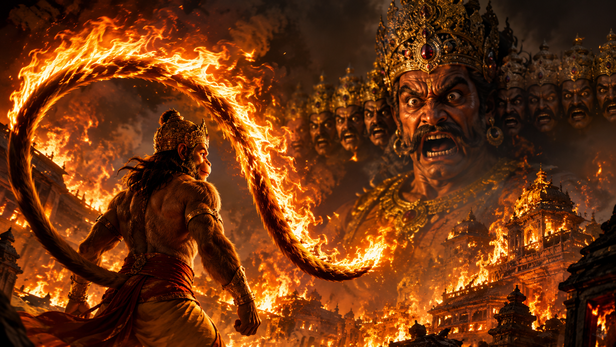
Ravana ordering Hanuman's tail to be set on fire

Ravana believed he was insulting Hanuman but unknowingly invited disaster.

In Sundara Kanda, after Vibhishana reminds Ravana that a messenger should not be killed, Ravana decides on another punishment. Believing that a monkey treasures its tail the most, he orders his soldiers to wrap Hanuman Ji's tail with cloth soaked in oil and set it on fire. Ravana thought this would humiliate Hanuman. Instead, according to the Ramayana, the decision became the turning point that led to the burning of Lanka and foreshadowed his eventual downfall.

Fire Became a Weapon of Justice

Once Hanuman Ji's tail was set ablaze, he used the opportunity to leap across the golden city of Lanka. One palace after another caught fire, spreading destruction throughout Ravana's kingdom. Devotional traditions see this event as a reminder that evil often creates its own downfall. The very punishment Ravana planned became the instrument through which divine justice unfolded, proving that arrogance can blind even the most powerful rulers.

The Symbolism Behind the Burning Tail

Spiritually, Hanuman Ji's burning tail represents far more than a physical event. The flames symbolize the power of unwavering devotion overcoming pride and injustice. Hanuman Ji never acted for personal revenge. Every action he took was in service of Lord Rama's mission. This transforms the story from a tale of destruction into one of righteousness, courage, and complete surrender to divine purpose.

Sundara Kanda's Powerful Lesson

Sundara Kanda repeatedly teaches that courage rooted in devotion is stronger than worldly power. Hanuman Ji remained calm even while surrounded by enemies because his confidence came from Lord Rama, not from himself. The episode reminds readers that faith allows people to remain fearless during life's greatest challenges, even when circumstances appear impossible.

Why Devotees Still Remember This Story

This story continues to inspire devotees because it highlights the victory of humility over ego. Many people recite Sundara Kanda believing it strengthens courage during difficult times. Whether viewed spiritually or symbolically, Hanuman Ji reminds devotees that sincere faith, patience, and service eventually overcome every obstacle, no matter how powerful it appears.

The Real Message Behind Lanka's Destruction

The burning of Lanka was never about anger or revenge. It was about restoring dharma and delivering Lord Rama's message. Popular devotional traditions also connect this event with the divine presence of Mata Parvati, adding another layer of spiritual symbolism. While this belief is based on later devotional interpretations rather than the core Ramayana text, the lasting lesson remains the same: when faith, humility, and righteousness stand together, even the greatest darkness cannot survive.

Unlock insightful tips and inspiration on personal growth, productivity, and well-being. Stay motivated and updated with the latest at My Life XP.

Sign up to read this article
Read news from 100's of titles, curated specifically for you.
Already a member? Sign in here
Related Stories
Top stories on inkl right now
One subscription that gives you access to news from hundreds of sites
Already a member? Sign in here
Our Picks
Fourteen days free
Download the app
One app. One membership.
100+ trusted global sources.