Get all your news in one place.
100’s of premium titles.
One app.
Start reading
Digital Camera World
Sebastian Oakley

Why my mechanical film camera is still more convenient than your $5,000 digital camera

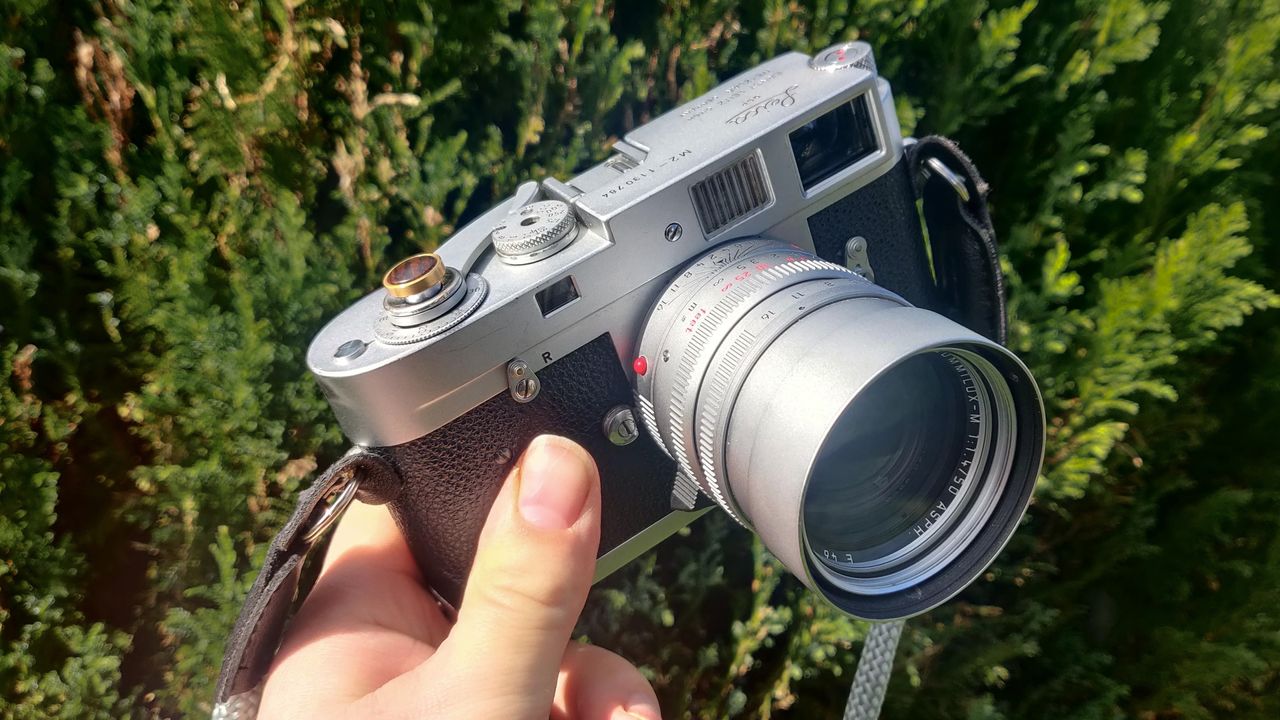
Leica M2 being held in someone's hand outdoors.

For all my affection for digital Leicas, and believe me, I’ve used them long enough to know their strengths inside out – the thing I’ve never been able to quite reconcile is this idea that digital is the “convenient” option. On paper, it absolutely should be. You press the shutter, the image appears instantly, and the whole process feels like the pinnacle of photographic efficiency.

But that moment of convenience is built on a surprisingly fragile foundation, and it only takes the slightest shift in reality to reveal how much work goes into making digital feel effortless.

(Image credit: Future)

Because before you even get to that magical click-and-review moment, you need a few things to align perfectly. The sensor has to be clean; otherwise, you’re spending the evening cloning out dust spots the size of dinner plates. The memory card needs to be formatted, because nothing kills inspiration faster than a “Card Full” message flashing angrily in your face.

The batteries must be charged – in fact, not just charged, but fully charged, because digital doesn’t politely warn you when it’s about to give up: it dies, instantly and without apology. And even that power dictates how many images you can take, meaning that your creativity is, quite literally, limited by how much lithium-ion you remembered to pack.

We all do this little pre-shoot ritual now, often without thinking. The checklist is universal, even if unspoken: sensor clean, card empty, batteries topped up, settings reset, firmware updated. It doesn’t matter how long we’ve been shooting; digital photography has turned us all into technicians before we get to be photographers.

And that’s fine if you’re planning a day out, or a job, or a dedicated shoot. But what about spontaneity? What about stepping outside, seeing a moment unfold, and wanting to capture it right there, without rummaging, checking, charging, or cursing?

Because if I grab my Leica M2 and a roll of film, I’m shooting in seconds. Not ten minutes later, once I’ve verified that everything inside the camera is working, powered, and ready to obey me. Seconds. There is genuine convenience in that kind of mechanical certainty – a simplicity digital will never reclaim, no matter how many firmware updates promise to “streamline workflow.”

Image shot with Leica M2 and Fomopan 400 film (Image credit: Future / Sebastian Oakley)

And maybe it sounds like a pointless, nostalgic rant, but think about it honestly: how much trust do you really have in your digital camera if you haven’t touched it in a week? Do you assume it still has battery life? Do you believe it’ll wake instantly without complaining? Do you consider you can shoot all day without hitting the dreaded single-digit percentage that turns every photographer into a power-saving strategist? Most of us don’t trust our digital gear to simply work anymore. We’ve been conditioned to babysit it.

Then there’s longevity – the elephant in the room that tech companies rarely want us to mention. Can you confidently say your £5,000 digital camera will still be performing at the same level in ten years? It might survive, sure, but the odds are stacked against it. The electronics age.

Sensors attract dust and decay. Buttons soften. Screens dim. Batteries inevitably die. Meanwhile, if I take care of my mechanical film camera, it will outlive me. And it will outlive whoever inherits it next. Mechanical cameras aren’t just durable; they’re generational.

Film isn’t cheap, especially if you rely on a lab, but that’s only one way to approach it. Once you learn to develop at home – and truly, it’s far simpler than people imagine – the cost drops dramatically, and the process becomes part of the joy. You’re participating in something that has existed for decades, a craft rooted in chemistry, patience, and intention. It’s more than clicking a shutter and watching a screen light up. It’s far more than convenience. It’s a connection.

Image shot with Leica M2 and Fomopan 400 film (Image credit: Future / Sebastian Oakley)

So yes, I’ll happily use my digital Leicas for work, for speed, for reliability in chaos. But when it comes to convenience – true, unfiltered, grab-and-go convenience – it’s the mechanical film camera that wins every time. No batteries. No menus. No diagnostics. Just a beautifully engineered tool that always works when you need it, doesn’t demand your attention when you don’t, and rewards you with something digital still can’t replicate: trust.

If digital is supposed to be the easy option, why does the mechanical camera make my life simpler? That’s the question I keep coming back to, and it’s the reason I’ll always reach for film when convenience actually matters.

Sign up to read this article
Read news from 100’s of titles, curated specifically for you.
Already a member? Sign in here
Related Stories
Top stories on inkl right now
One subscription that gives you access to news from hundreds of sites
Already a member? Sign in here
Our Picks
Fourteen days free
Download the app
One app. One membership.
100+ trusted global sources.