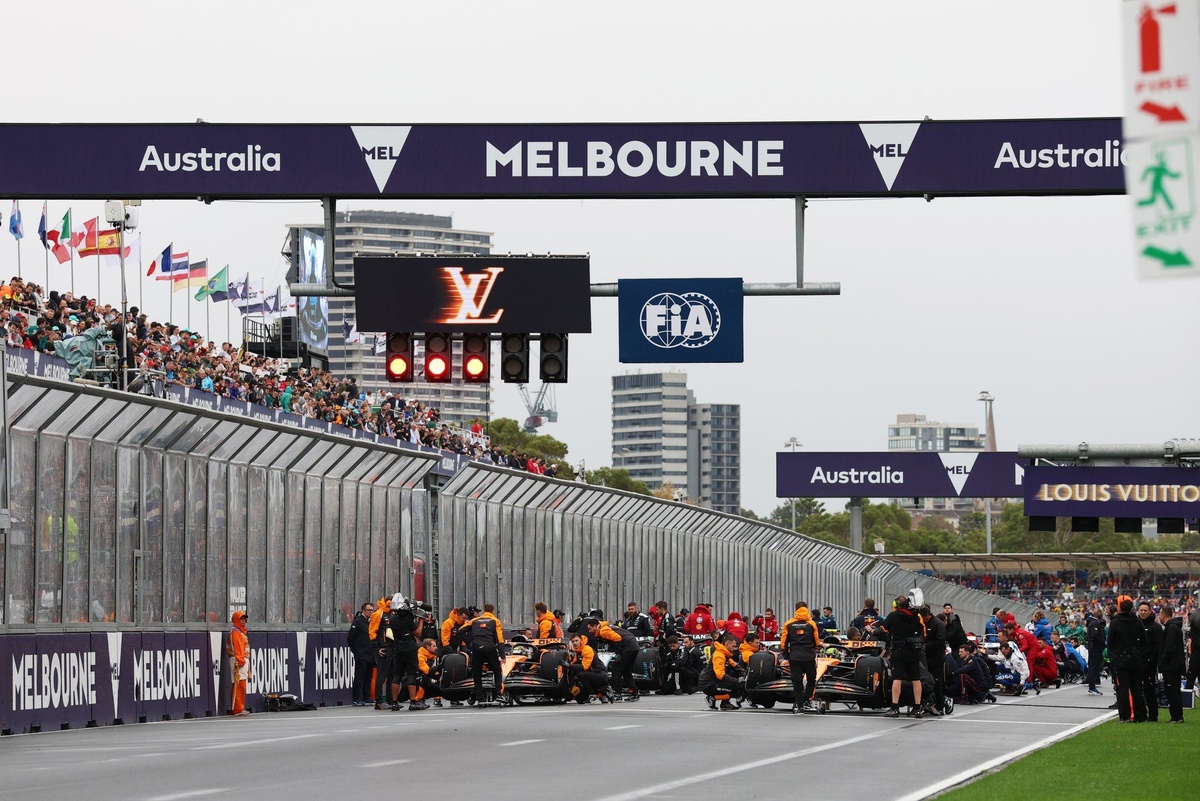
The moment Max Verstappen voiced his concerns about the new Formula 1 regulations, he immediately added: “On this circuit in Bahrain it's not too bad, but when we go to Melbourne, that's when you will really see how much we run out of energy on the straights.”
The Red Bull driver has received backing from others in the paddock since then. Among them, Oliver Bearman and Oscar Piastri have predicted that energy management will be considerably more difficult Down Under than on the tracks where F1 teams have tested their new machinery so far.

“Melbourne is tough because you simply cannot harvest as much energy,” explained Bearman, when asked by Autosport.
“That's obviously accounted for in the fact that we can only harvest seven megajoules a lap, whereas here it's 8.5, but it's still a big difference. Last year, Melbourne was one of the most full throttle circuits of the season, which is not the type of track that these regulations are suited towards. It's certainly going to be a challenge.”
Piastri added that he already noticed a significant difference during the preparations for his home grand prix.
“From the simulator running I've done, it's very different,” said the Melbourne native. “I think at certain tracks we're going to be much more harvest limited than we are here in Bahrain. Here, depending on where you set your optimality, you don't have to do much super clipping or much lift and coast, whereas in Melbourne I think if you didn't want to do any, you'd be running out of energy very, very quickly.

“Jeddah is another one. Places where you have a few straights linked together by fast corners where it's very difficult to harvest, that's where the most kind of abnormality is going to come.”
The underlying factor is the lack of long braking zones and slow-speed corners where drivers can recharge the battery during the braking phase or by applying half throttle. The layout of the Bahrain International Circuit masked that issue, but the picture may be different in the coming weeks.
Melbourne a ‘harvest-poor’ F1 track
While Piastri indicates that it mainly comes down to the layout, his McLaren boss Andrea Stella further clarifies the specifics of that. According to the Italian, a distinction must be made between two different types of circuits: tracks that are harvest-rich and tracks that are harvest-poor.
“In Bahrain, it was relatively easy because you spend enough time braking that basically you do all the harvesting under braking. You don't need to do anything special in terms of lifting off, for instance, in order to add the time at which you harvest your power unit. Now we go to Australia, and in Australia we go back to one circuit on which it will be a bit more difficult.”
This is directly linked to the extent to which a driver has to do “unnatural things” in order to recover energy, including lifting early on the straights and the extra downshifts that drivers talked about.
“I think these two circuits [so far] don't necessarily give the full picture,” Stella continued. “Definitely there could still be cases in which the driver needs to approach driving in what is an uncommon way of driving a car, which is [different from] just driving as flat as possible, brake as late as possible, go as fast as possible in every corner, but like I said, we will have to monitor the situation a bit.”

For precisely that reason, Carlos Sainz has urged the FIA to approach that monitoring in an “open-minded” way, as the Williams driver does not rule out that adjustments to the regulations may be required.
“My message to FOM and FIA is that at the start of the year, we need to stay a bit open-minded in case the regulations that we've come up with are maybe a bit exaggerated on the amount of harvesting or deployment that we have to do through a lap, which might make some circuits okay, like potentially here – even though, I still think it’s not fully okay with what we're seeing so far,” said the GPDA director.
What options does the FIA have as a plan B?
The FIA’s single-seater director Nikolas Tombazis has already indicated that he is open to the possibility of adjusting the rules. The governing body does not want to make any changes before the first race, as Tombazis believes that would only create more uncertainty, and also because he first wants to gather additional data from an actual race, including on-track battles.
“I think we've done, in my view, 90% of the work to get to a reasonable place,” he said. “There may be some adjustments as we learn about the cars, and we are fully open to do that.”
The follow-up question is, of course, what options the FIA actually has at its disposal.
Tombazis acknowledged that certain elements related to energy harvesting and energy deployment could be adjusted, although he did not want to go into detail yet. In this respect, the FIA wants to wait for the opening races as well before coming forward with concrete proposals. Those would have to go through the usual governance procedures, just as is the case in the compression ratio discussion.

Two options seem most obvious as short-term fixes. Both would ease the symptoms rather than fundamentally alter the philosophy of the 2026 rules – something that is politically and practically impossible at this stage. On the deployment side, the FIA could reduce the electrical power in race trim to 250kW instead of 350kW, which would lower the peak power but mean that drivers are less frequently “energy poor” at the end of straights – as Verstappen described it.
On the harvesting side, most of the recent discussions behind the scenes revolve around the term ‘super clipping’. It’s precisely the idea Stella shared in case the first races prove problematic.
“We tested the possibility to increase the super clip to 350 kilowatts. I'm afraid here we go into the technicalities of the new regulations which I'm sure we all will have to get a little bit familiar with and we will have to help our fans to get familiar with,” Stella smiled.
“But the super clip is when the electrical engine starts to harvest even if the driver is full throttle. This situation is called super clip. At the moment it's limited to 250 kilowatts, but all the conditions are there to make this 350 kilowatts harvest while the driver is full throttle, which means that the driver doesn't have to lift and coast to harvest 350 kilowatts.”
Following discussions in the F1 Commission, this solution was tried during the final day of testing in Bahrain. At McLaren it did not pose any issues, as Stella indicated, but for Honda – which already faces more challenges on the power unit side – such an intervention could prove more problematic.
However, as far as McLaren is concerned, this could still serve as a plan B to counter excessive lift-and-coast and prevent other unnatural driving techniques.

“So we discussed this with the FIA and it will ultimately be up to the FIA to decide whether they introduce it or not. We successfully tested it today and we are happy,” Stella added.
For now, the FIA remains of the view that it should wait for the first races before taking any action. From a practical standpoint, that is unavoidable anyway, as the process for any regulatory change would take at least several weeks – and that time is no longer there before Melbourne and the first sprint weekend of the season in China.
One thing is already clear ahead of the season opener: with Melbourne and Jeddah, F1 faces two major challenges early on in the campaign, but also two valuable tests to assess how suitable these regulations are for the fast-flowing circuits on the calendar.