
Get all your news in one place.
100's of premium titles.
One app.
Start reading
Bangkok Post
Bangkok Post
Comment

Why maths skills matter for medical AI

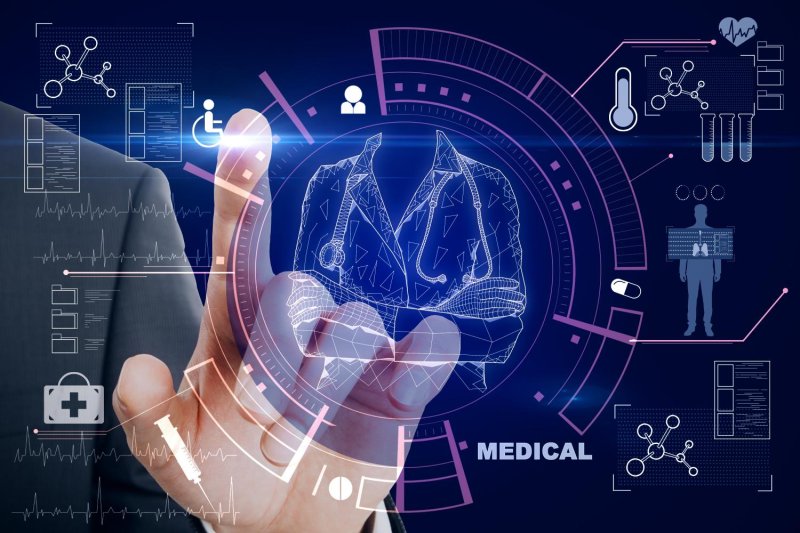
An illustration shows a hand in front of a heads-up display on blue background. (Photo: 123RF)

The recent announcement that two Chinese mathematicians, Yu Deng and Hong Wang, had simultaneously received the 2026 Fields Medal made headlines around the world. To many, it was a celebration of individual brilliance. To others, it symbolised China's growing scientific strength.

As a physician, however, I saw something different.
I saw a glimpse of the future of medicine.

Artificial intelligence is transforming healthcare at an astonishing pace. It now assists physicians in interpreting medical images, predicting disease progression, discovering new drugs, summarising electronic medical records and supporting clinical decision-making. Every year, AI becomes a more capable partner in medical practice.

Consequently, much of the discussion in Thailand has focused on how doctors and hospitals can use AI more effectively.

That is an important conversation -- but not the most important one.

The more fundamental question is whether Thailand intends to become merely a consumer of medical AI or eventually a creator of it.

The distinction is critical.

Using AI requires digital literacy and sound clinical judgment. Creating AI requires mathematics.

Every modern AI system is built on linear algebra, probability, statistics, calculus, optimisation and algorithms. These mathematical disciplines form the invisible foundation beneath every intelligent chatbot, robotic surgical system and diagnostic algorithm. Mathematics is not simply another school subject. It is the universal language of science and the operating system of artificial intelligence.

This is why the Fields Medal matters.

Often described as the Nobel Prize of mathematics, the Fields Medal recognises profound mathematical achievement before the age of 40. Its recipients are never overnight successes. They are the products of decades of careful education, inspired teachers and intellectual discipline that begin in childhood.

China understood this long ago.

Its investment did not begin with AI laboratories or technology companies. It began with strong mathematics education in primary schools, rigorous secondary education, mathematics Olympiads, excellent universities and sustained support for scientific research. The simultaneous success of Yu Deng and Hong Wang is not an isolated achievement. It is the visible outcome of a national commitment extending across generations.

Thailand, unfortunately, appears to be moving in a different direction.

International assessments continue to show Thai students falling behind many of their Asian neighbours in mathematics and science. At the same time, enthusiasm for AI often centres on learning how to write better prompts, generate images or summarise documents. These are valuable skills, and I use AI extensively in my own medical practice and teaching.

Yet prompt engineering is not AI engineering.

Without a strong mathematical foundation, Thailand risks becoming permanently dependent on technologies developed elsewhere. We may become increasingly sophisticated users while other countries continue producing the mathematicians, computer scientists and engineers who create the systems on which our future economy -- and healthcare -- will depend.

Medicine provides an excellent example.

Tomorrow's physicians will not compete with AI; they will work alongside it. Human qualities such as compassion, ethical judgment, intuition and communication will remain irreplaceable. Yet doctors will also need to understand algorithms, statistical reasoning, data quality and the limitations of machine learning to use AI safely and responsibly.

The physician of the future will therefore require not less science, but more.

This reality should also influence national education policy.

Thailand has recently debated establishing new medical schools at Rajabhat universities to address physician shortages. Improving access to healthcare is an important national objective. However, another question deserves equal attention.

Should some of these universities instead become national centres for producing outstanding mathematics and science teachers?

One excellent mathematics teacher may educate thousands of students over the course of a career. Among those students may emerge future physicians, engineers, AI researchers, scientists and entrepreneurs. Their influence extends far beyond a single classroom.

Without excellent mathematics teachers, expanding medical schools alone cannot create a nation capable of leading in medical AI, biotechnology or precision medicine. We may graduate more doctors, yet continue importing the algorithms, software and medical technologies that increasingly define modern healthcare.

The foundation of tomorrow's medical innovation is therefore not the hospital.

It is the mathematics classroom.

Countries leading the AI revolution understand that mathematical thinking cannot be developed overnight. It begins with curious children, dedicated teachers and classrooms that encourage reasoning rather than memorisation. The rewards may take decades to appear, but when they do, they transform entire economies.

Thailand need not copy China's educational model. Every nation must follow its own path. But one lesson is universal: there can be no sustainable excellence in medicine, engineering or artificial intelligence without excellence in mathematics.

As physicians, we often remind our patients that prevention is better than cure. The same principle applies to national development. If Thailand wishes to become not only a user but also a creator of medical AI, the prescription begins long before medical school.

It begins with investing in mathematics education, supporting outstanding teachers and inspiring children to discover the beauty and power of mathematical thinking.

The two Chinese Fields Medals are therefore more than an academic triumph. They remind us that every intelligent machine begins with a mathematical equation, every medical AI begins with a mathematician, and every mathematician begins with an inspired teacher.

The future of Thai medicine will not be decided only in our hospitals. It will first be decided by the quality of the mathematics education we give our children today.

Dr Watcharin Ariyaprakai, MD, is a senior urologist at Bumrungrad International Hospital.

Sign up to read this article
Read news from 100's of titles, curated specifically for you.
Already a member? Sign in here
Related Stories
Top stories on inkl right now
One subscription that gives you access to news from hundreds of sites
Already a member? Sign in here
Our Picks
Fourteen days free
Download the app
One app. One membership.
100+ trusted global sources.







