The original half-frame Olympus Pen was a huge success, because it was small, inexpensive and had a fast, razor-sharp lens – and the half-frame camera format was thrifty on film.
But even the mighty Olympus Pen died, as people discovered the difficulties in getting a good quality enlargement from the cropped negatives. Yet it still had an amazing 24-year run over various models, finally biting the dust in 1983 after 17 million had been sold.

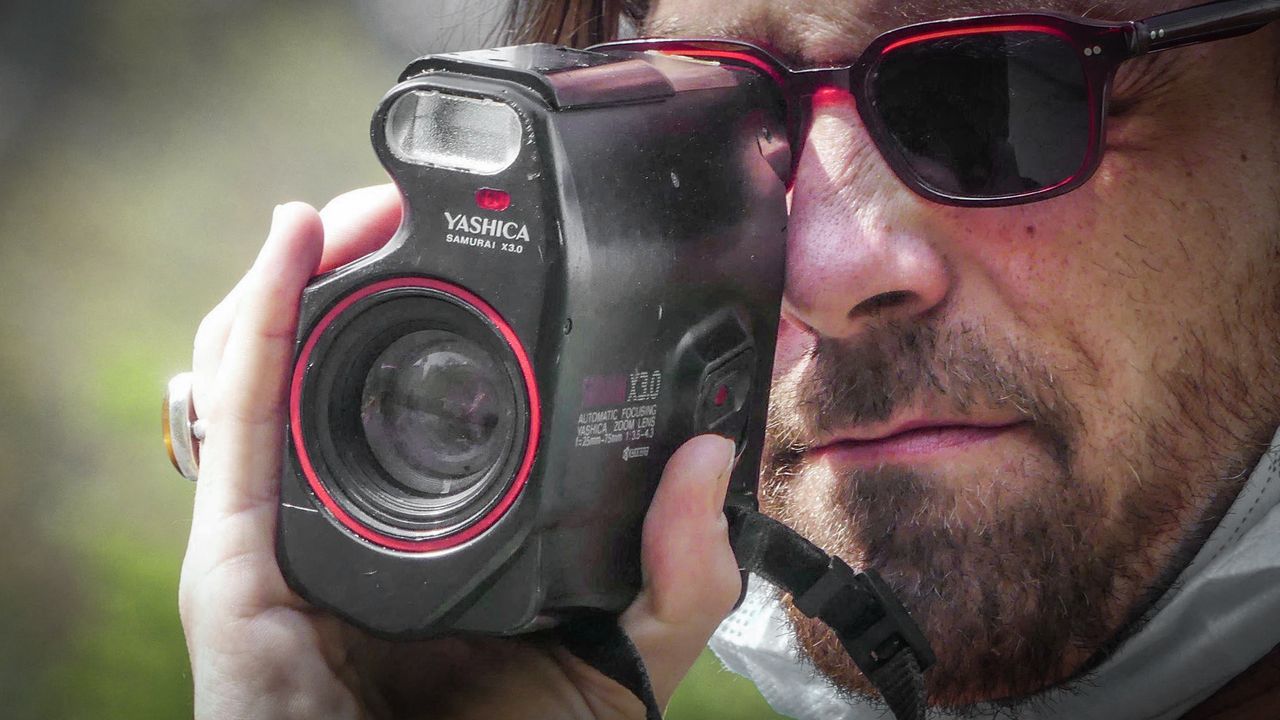
So why would someone, four years later, try to revive the half-frame film format in a much larger, oddly-shaped camera – one equipped with a nice zoom lens but terrible autofocus, and all at a considerably higher price? That’s a good question, for which I don’t think anyone has a good answer.
To give the Yashica Samurai full credit, the 25-75mm f/4-5.6 zoom lens was really sharp, and faster than the ones in most point-and-shoot cameras at the time.
It featured an inter-lens leaf shutter, programmed auto-exposure, built-in motor drive (claimed to reach 4.5fps) and a built-in electronic flash. The Samurai was a true SLR, exposing half-frame (17 x 24 mm) images on 35mm film.
On the plus side of the ledger, the film ran vertically through the camera – so the photos were in the classic horizontal format, something quite unusual for half-frame cameras.
The Samurai was a nice camera to hold, felt really solid and was fun to use. And the pictures were good, so long as the autofocus cooperated… but the autofocus was its Achilles heel, best described as loud, slow and inaccurate.
The Samurai series of bridge cameras were intended for convenient, one-handed operation, and their style, shape and size were inspired by early camcorders.
They were difficult to shoot with, as the contrast-detection auto-focus was painfully slow and would hunt for several seconds – even with a brightly lit, high-contrast scene. Anything less, and it was worse.
There was, however, one group of people who liked the Samurais, for Yashica did something rarely seen: it made the Samurai S-L, with the plastic case molded for left-handed operation. Lefties loved it!
But, sadly, that was not enough. Introduced in 1987 at $488, Samurais were being advertised by 1989 at just $239. Despite the addition of a pair of lesser-featured models in 1990, that year was also the end of the Samurai series. By 1991 they were gone.
Today they are collectors' items, and can be found in both Yashica and Kyocera branding with accents in either red or teal blue. But, even here, they are coveted only by camera collectors keen on unusual oddities.
You might also like…
The left-handed camera is one of the most common April Fools for photographers. Read more about the rise and fall of Yashica and check out the best film cameras worth looking at today.