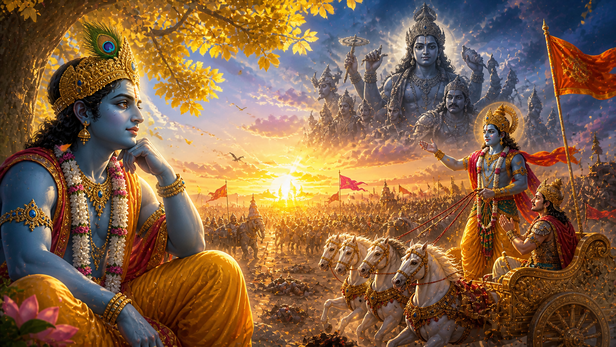
Few questions in Hindu philosophy provoke as much debate and curiosity as this one: why did Krishna, the very embodiment of divine wisdom, allow adharma to unfold before ultimately defeating it. At first glance, it appears contradictory, almost unsettling, because the expectation from a divine figure is immediate justice and clear righteousness. Yet, the Mahabharata does not present a simple moral world. Instead, it presents a deeply complex reality where right and wrong are often entangled, forcing even the divine to act within the constraints of time, human nature, and cosmic balance.
The story of Krishna in the Mahabharata is not about preventing conflict at all costs, but about ensuring that when conflict becomes inevitable, it leads to the restoration of dharma.