Get all your news in one place.
100's of premium titles.
One app.
Start reading
The Independent UK
The Independent UK
Simon Calder

Why is it so difficult to travel to – and through – Europe by train?

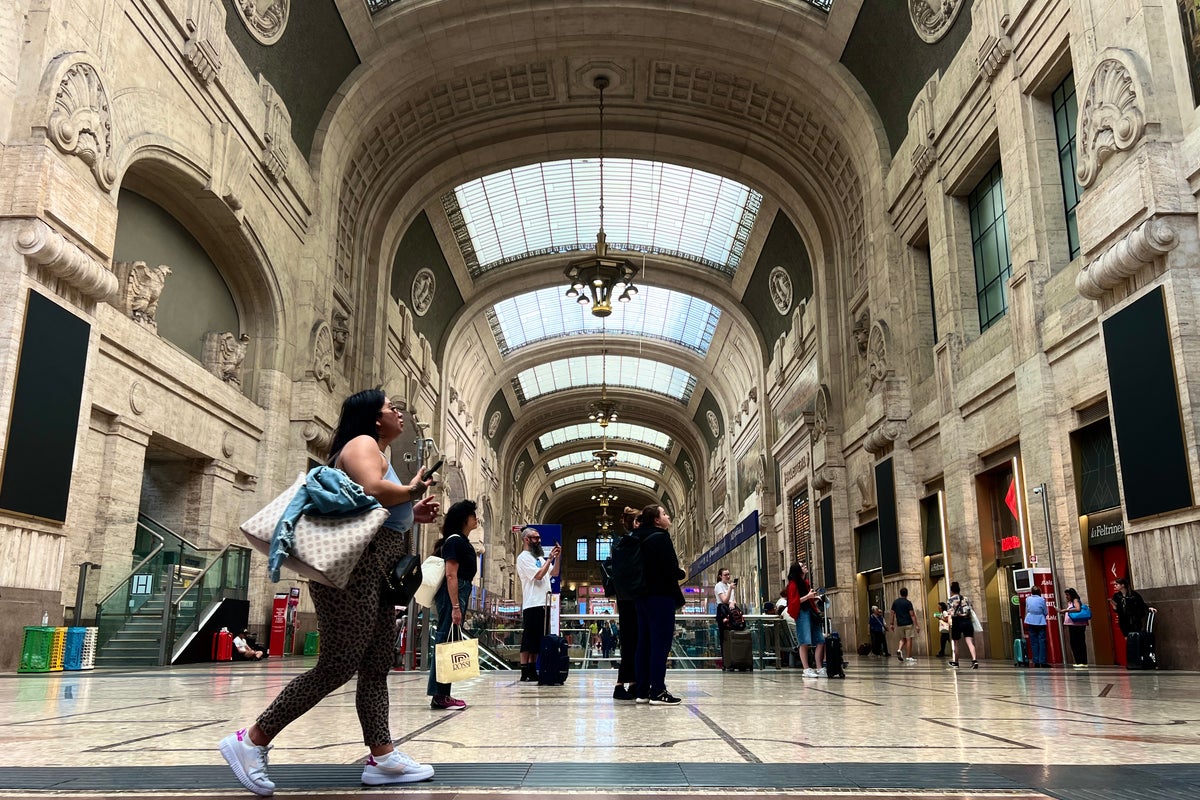
London connection? Passengers at Milano Centrale station in northern Italy - (Simon Calder)

“Heading to Europe? We’ve got you.” That was the initial response when I asked Trainline about a journey from Leicester to Paris on 1 June.

Logistically, the trip is simple. A one-hour journey with East Midlands Railway non-stop to London St Pancras International. On arrival, through the ticket gates, down the escalator and straight into the Eurostar check-in area. So, Trainline, what timings and fares can you offer?

Not so fast, says the normally cooperative app. “You have to split your booking into two parts.”

The Trainline instructions are:

  • Buy your ticket from London St Pancras to Paris first
  • Buy your ticket from Leicester to London

Yes: in the year 2026, Europe’s leading rail retailer cannot sell tickets from British cities outside London to Paris. Not only that, but the prospective passenger must work counterintuitively. They are supposed to commit to a Eurostar train for the second half of the journey before organising the first leg – with no coherent picture of costs and connections from their starting point.

Until three decades ago, life was much easier for the international rail passenger starting in the UK. So says “The Man in Seat 61”: international rail guru Mark Smith.

“It was simple, but not necessarily competitively priced,” he told The Independent’s daily travel podcast. “For almost the whole of the 20th century, right up until the 1990s, you had a kilometric tariff – a very simple mileage, kilometre-based tariff in every country.

“Every national rail operator gave every other national rail operator two things: a table of distances between all their border points and stations, and a set of tariffs for how much dosh they wanted for 100, 200, 300 kilometres. Using this, every national rail operator, including British Rail, could compile a set of through fares from, in our case, London, to any major cities they liked: Rome, Seville, Moscow, Helsinki, Stockholm.”

The fare was simply calculated by adding together the legs of the journey: the British Rail price for the boat train to Dover, the Sealink ferry crossing to Calais, the fare across France to the Swiss border, and so on. Tickets were valid for two months, and fully flexible. You could break your journey anywhere during the ticket’s validity.

“If you wanted a reservation, that was separate – you had to call on the French or German computer based in British Rail at Victoria,” recalls Mark – who, in a previous life, actually ran that London terminus for BR.

There was just one price – which was fine while airlines were charging ridiculous prices, such as £200 one way from London to Nice.

But then, along came easyJet and dynamic pricing, with fares as low as £39 from Luton to the French Riviera. (Today, the same journey can be made for £1 less if you are flexible about departure dates.) By controlling costs and adjusting prices according to demand, the airline could make a profit and entice passengers away from trains to planes.

“Those fully flexible fixed-price tickets were dinosaurs,” says Mark. “The railways had to adopt their own yield-managed dynamic pricing. So you need to book each train in that train company’s ticketing system to find whatever the price is for that train.

“That’s how we’ve got the fragmentation today. There are no through tickets from London to Rome. It’s a Eurostar ticket to Paris, an Italian or French ticket from Paris to Milan, then a Trenitalia ticket or Italo ticket from Milan to Rome.”

Starting this summer, EU president Ursula von der Leyen is seeking to make seamless international rail travel a reality.

“One journey, one ticket, full rights” is the headline from Brussels. “To create a smoother travel experience for passengers and advance the EU’s climate objectives, the Commission proposes measures enabling single-ticket bookings across multiple rail operators.

“In the event of missed connections during multi-operator rail journeys, passengers with a single ticket will benefit from new, full passenger rights protection, including assistance, rerouting, reimbursement and compensation.”

In other words: if you buy multiple tickets together in a single transaction – for example through Trainline – you will be considered, from a passengers’ rights point of view, to have a through ticket. Were you to miss a connection because of delays earlier in the journey, you could switch – without penalty – to the next available service.

The Man in Seat 61 cautions: “Before we get a bit carried away and start thinking there’s someone who is going to set a through ticket and through price from Stockholm to Barcelona, that’s not going to happen. A journey from Stockholm to Barcelona will still be composed of the price from Stockholm to Copenhagen, the price from Copenhagen to Cologne, the price from Cologne to Paris, and the price from Paris to Barcelona.

“But the idea is twofold. First of all, there will be a better exchange of information, allowing you to book this series of tickets seamlessly. Secondly, it’ll be a sort of virtual through-ticket.

“At the moment, if you buy three tickets to get from A to B to C to D, you are protected for a missed connection and a delay within each ticket, but not where tickets change over – which is, of course, precisely where you need the protection.”

Mark has concerns that these virtual through tickets will primarily be sold through independent rail retailers such as Trainline and Rail Europe, which may not be able to include all the options the operators offer – such as reserving a space for a dog or a bike, or choosing a specific seat. But he deems the concept “undoubtedly a good thing”.

Due to our bold decision to leave the European Union, the new rules will not apply to journeys starting in the UK. So, back to that Leicester-to-Paris ticket.

I carried on to see what the fares would be. The good news: one Eurostar train from London to Paris is available for £114. The bad news: it’s the final departure, arriving in the French capital barely half an hour before midnight. Want to arrive in Paris before 9pm? Cheapest ticket, £180. Yes, one way, and that’s without the ticket from Leicester.

At this point, a rational traveller wanting to get from the “City of Kings” to the “City of Light” will probably opt to hop off a southbound stopping train at Luton Airport Parkway, and fly instead. EasyJet has a choice of two flights to Paris under £50: one at lunchtime, one in the early evening.

Airlines must be constantly grateful to face such lacklustre competition from European rail operators.

Read more: Does the HS2 reset mean anything new for the railways?

Sign up to read this article
Read news from 100's of titles, curated specifically for you.
Already a member? Sign in here
Related Stories
Top stories on inkl right now
One subscription that gives you access to news from hundreds of sites
Already a member? Sign in here
Our Picks
Fourteen days free
Download the app
One app. One membership.
100+ trusted global sources.