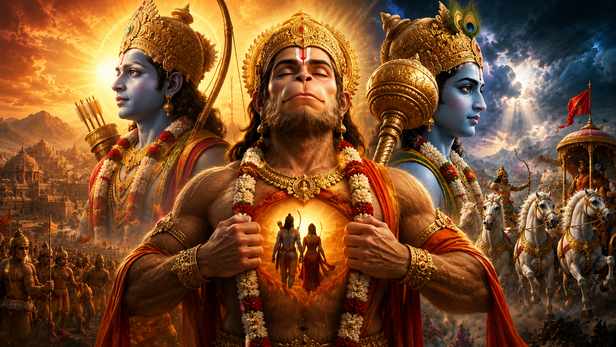
Among all the extraordinary figures in Hindu tradition, Hanuman occupies a uniquely powerful place because he appears not in just one great epic, but in both the Ramayana and the Mahabharata. For millions of devotees, this connection has always carried deep spiritual meaning. Hanuman is not merely remembered as the fearless devotee of Lord Rama who crossed oceans and burned Lanka. He is also present centuries later during the age of the Mahabharata, where he appears again during one of the greatest wars in Hindu mythology. This mysterious continuity has fascinated spiritual scholars, devotees, and mythology readers for generations. How could Hanuman exist across both epics? Why did he appear again during the Mahabharata era? Was his presence symbolic, spiritual, or connected to a larger cosmic purpose?
The answers lie in some of the deepest philosophical ideas within Hindu tradition involving immortality, devotion, divine time, cosmic duty, and the eternal relationship between Lord Rama and Lord Krishna, who are both understood in Hindu belief as incarnations of Lord Vishnu. Hanuman’s presence across both epics is not accidental. In many ways, it symbolizes continuity between two spiritual ages and reflects why Hanuman remains one of the most worshipped and emotionally beloved deities in Hinduism even today.