This roundup of The Conversation’s climate coverage was first published in our award-winning weekly climate action newsletter, Imagine.
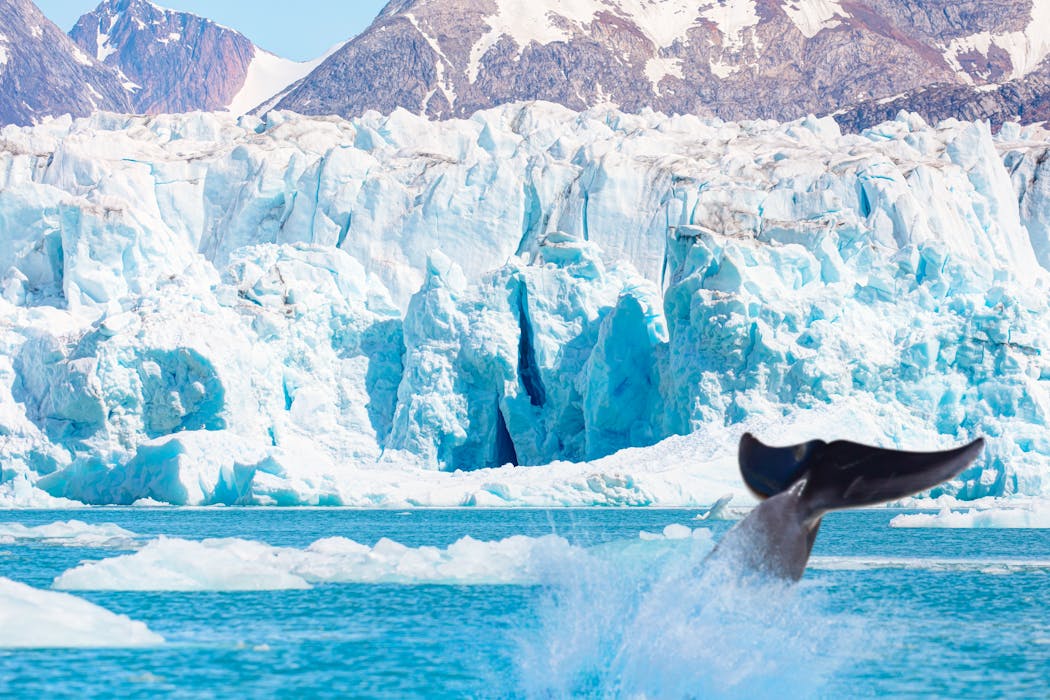
“Observing Greenland from a helicopter,” one scientist wrote last year, “the main problem is one of comprehending scale. I thought we were skimming low over the waves of a fjord, before … realising what I suspected were floating shards of ice were in fact icebergs the size of office blocks. I thought we were hovering high in the sky over a featureless icy plane below, before bumping down gently onto ice only a few metres below us.”
This is the view described by Durham glaciologist Tom Chudley, when writing about his research showing the Greenland ice sheet isn’t just melting – it’s falling apart. Chudley and his colleagues found crevasses are growing fast, channelling meltwater deep into the ice sheet, accelerating its slide into the ocean.
And as the ice cracks, so does the geopolitical status quo.
Many world maps make Greenland seem even bigger than it actually is. The “Mercator projection” implies it’s almost the size of Africa, when in reality it is “only” about as big as the Democratic Republic of the Congo.
Over my time in this job, I have noticed Greenland having a similarly outsized role in climate science. In recent years, The Conversation has published stories, among many others, on melting ice, climate-changing microbes, fast-adapting polar bears, Chudley’s creaking crevasses, the race to map the world’s most spectacular and remote fjords, and a skyscraper-sized tsunami that vibrated through the entire planet and no one saw. All relied on scientists – often in big international teams – having access to Greenland.
Read more: The Greenland ice sheet is falling apart – new study
Access denied?
But the political stability that allows these scientists to work there is also under threat. In a piece explaining why Greenland is indispensable to global climate science, Martin Siegert, a glaciologist who heads the University of Exeter’s Cornwall campus, points out that Antarctica has been governed for decades by an international treaty that ensures it remains a place of peace and science. Greenland has no such protection.
“Its openness to research”, writes Siegert, “therefore depends not on international law, but on Greenland’s continued political stability and openness – all of which may be threatened by US control.”
The stakes are high: if Greenland’s colossal ice sheet fully melted, it would “raise sea level globally by about seven metres (the height of a two storey house)”.
Read more: Why Greenland is indispensable to global climate science
Why the sudden urge to take over Greenland, anyway?
Many assume America’s ambitions are ultimately about oil or other minerals. But Lukas Slothuus, who researches fossil fuel production at the University of Sussex, takes a more sceptical view on the supposed economic jackpot.
Logistical nightmares
Greenland does have vast natural resources, he says, but they won’t necessarily translate into huge profits. That’s because the logistics are so tough. Slothuus notes that: “Outside its capital Nuuk, there is almost no road infrastructure in Greenland and limited deep-water ports for large tankers and container ships.”
He contrasts this with other potential mining operations around the world, which can “exploit public infrastructure such as roads, ports, power generation, housing and specialist workers to make their operations profitable”. Greenland has none of this. That means “huge capital investment would be required to extract the first truckload of minerals and the first barrel of oil”.
This is one reason why Siegert believes “economics dictates” Greenland’s resources will “most likely be used to power the green transition rather than prolong the fossil fuel era”. The sheer cost of extraction means the commercial focus is on “critical minerals”: high-value materials used in renewable technologies from wind turbines to electric car batteries.
As Slothuus puts it, oil from Greenland is “implausible even in the event of a full US takeover”.
“There are many reasons why the Trump administration might want to dominate the Arctic, not least to gain relative power over Russia and China. But natural resource extraction is unlikely to feature centrally.”
Read more: Why Greenland's vast natural resources won't necessarily translate into huge profits
This hasn’t stopped the superpowers, of course. And in the medium-term, Greenland looks set to host a massive military build up – whether or not the US takes over.
That’s according to Caroline Kennedy-Pipe, a professor of war studies at Loughborough University. She says Greenland is in a strategic position that will only become more important as climate change opens up new shipping lanes, enabling further conflict in the far north. “The Arctic in general,” she writes, “will become a showcase for the latest military technology the US has in its armouries.”
I’m not aware of any research on the climate impact of a military showcase on or around a pristine ice sheet. But as our glaciologist in the helicopter warned us, the ice is already fragile enough.
To contact The Conversation’s environment team, please email imagine@theconversation.com. We’d love to hear your feedback, ideas and suggestions and we read every email, thank you.
Don’t have time to read about climate change as much as you’d like?
Get a weekly roundup in your inbox instead. Every Wednesday, The Conversation’s environment editor writes Imagine, a short email that goes a little deeper into just one climate issue. Join the 45,000+ readers who’ve subscribed so far.
This article was originally published on The Conversation. Read the original article.