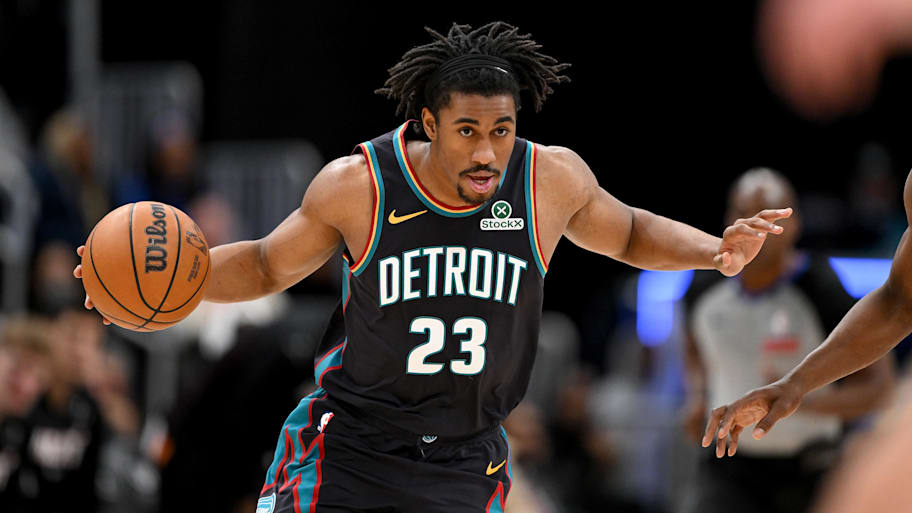
On a wild day of NBA trades, the Eastern Conference-leading Pistons decided to part with fourth-year guard Jaden Ivey. Detroit selected Ivey out of Purdue with the fifth pick in the 2022 NBA draft under a previous front-office regime.
Ivey landed with the Pistons one year after the franchise selected Cade Cunningham with the top pick of the ‘21 draft. While the fit of Cunningham and Ivey raised some immediate questions, the franchise seemed poised to make the pair work as its backcourt of the future, even when Trajan Langdon took over as president of basketball operations ahead of last season.
The Purdue product had a hot start last season that was derailed by a season-ending injury on New Year’s Day. Detroit saw an incredible turnaround a season ago with a run to the playoffs behind Cunningham, key veterans and intriguing young pieces, and was primed to take an even greater step forward this year with Ivey back in the fold.
Another injury held Ivey out of the first month of the season as the Pistons drove ahead of their Eastern Conference foes. His long-awaited return to the court was welcomed, but he struggled to find his footing on the newfound contender. This roller coaster of Ivey’s last season-plus led to his departure from Detroit. He is heading to the Bulls in a three-team deal with the Timberwolves that netted the Pistons Kevin Huerter, Dario Šarić and a first-round protected pick swap with the Wolves.
Ivey is still only 23 years old and while it didn’t work out with the franchise who drafted him, a new situation may be exactly what he needs. With the deal done, let’s take a look at why Detroit decided to move on from the former top-five pick and why the move makes sense for both sides.
More: Tracking Every Move Ahead of the NBA Trade Deadline
The young Pistons made a major leap despite missing Jaden Ivey for significant time over the last two seasons
Through no fault of his own, the Pistons grew as a young, competitive team without Ivey after he suffered a broken fibula last January, missing the rest of the season. He missed the first 15 games of this season due to a knee procedure.
Before Ivey went down last season, he was in the middle of a career year, averaging 17.6 points per game and shooting 40.9% on three-pointers on over five attempts per game. He looked to be a big part of the Pistons’ future at that point, even sinking an unbelievable four-point play to beat the Kings mere days before his season-ending injury.
Detroit was 14–16 when Ivey was available last year, then ending the year 44–38 and earning the Eastern Conference’s No. 6 seed for the franchise’s first playoff appearance in five years. The Knicks defeated the Pistons in six games in the first round and it appeared the return of Ivey would be a big factor in the team taking its next step.
If last year’s injury didn’t derail things enough, missing the first chunk of this season saw the Pistons find a groove without Ivey. When he made his season debut, Detroit was 13–2 and two-way guard Daniss Jenkins broke out in November, averaging 11.4 points off the bench. Once Ivey returned, there was still room for him in J.B. Bickerstaff’s rotation, but the fourth-year guard needed time to reacclimate to game action and find his sea legs.
In 33 games this season, Ivey is averaging 8.2 points, 2.2 rebounds and 1.6 assists in just 17.8 minutes per game. He’s still shooting well from three on smaller volume, connecting from deep at a 37.2% clip, but ahead of restricted free agency this offseason, there wasn’t enough room for Ivey in Detroit’s long-term plans with numerous young players in for a payday.
Why did the Pistons decide to move on from Jaden Ivey?
Cunningham inked a five-year, $269 million maximum extension as soon as Detroit was able to put the deal in front of him. Star big man Jalen Duren didn’t get an extension when he was eligible over the offseason along with Ivey, but the Pistons will certainly keep the newly minted All-Star center on a good deal for both sides. Third-year wing Ausar Thompson is eligible for an extension this summer and then Ron Holland II, last year’s No. 5 pick, can sign an extension the following year should the franchise wish to keep him long term.
Isaiah Stewart, one of the best rim protectors in the NBA, is in line for a new contract as well.
Duren’s leap this year specifically left Ivey looking like the odd man out in the Pistons’ plans. Duren and Ivey play two completely different positions, but the biggest question for Detroit is which player will step up to be the Robin to Cunningham’s Batman. Duren’s averaging an 18-point double-double this season as the Pistons sit atop the Eastern Conference with a 37–12 record, and appears to have staked his claim to that mantle.
Ivey turned into a bit of a catch-and-shoot specialist over his last stretch as a Piston. Shooting is something that Detroit certainly needs, as evidenced by the acquisition of Huerter from Chicago to help down the stretch. Ivey’s shooting ability is just not a standout skill that the front office can commit to with a long-term deal as the Pistons look to take the next step and compete for a championship.
Although the Bulls have a crowded backcourt pending any additional moves prior to Thursday’s deadline, in Ivey, Chicago gets a low-cost flier on an electrifying player with plenty of upside remaining. The trade is good for Ivey himself, too, providing more freedom to prove himself ahead of the summer—whether that’s with the Bulls or elsewhere.
More NBA on Sports Illustrated
- Peter’s Points: NBA Best Bets Today (Predictions, Prop Bets for Kevin Durant, Nikola Jokic, Pelicans-Bucks)
- James Harden Denies Speculation That He Asked Clippers for Trade to Cavaliers
- Draymond Green Reflects on Possibility of Playing Last Warriors Game
- NBA Trade Deadline Intel: Timberwolves’ Pursuit of Giannis Antetokounmpo, What to Watch
- Giannis Antetokounmpo Says He Wants to Retire With Bucks As Trade Rumors Swirl
This article was originally published on www.si.com as Why Former Pistons Top-Five Pick Jaden Ivey Needed a Change of Scenery.