Ahead of Formula 1’s rules shake-up in 2026, the series will host three rounds of testing to help teams get to grips with their new machines. Two tests are scheduled for Bahrain next month, where fans will get their first glimpse at the new machinery on track, while the January test in Barcelona will be a closed-door event.
This means that teams will keep their 2026 cars from fans for a little longer, as TV crews, photographers and media won't be on the ground in Barcelona to snap pictures of the new racers. As well as hiding the new cars' tech from prying eyes, which will include active aerodynamics on the front and rear wings, new hybrid engines, and shorter, lighter cars, the test is also taking steps to keep the 2026 liveries hidden.
This is because F1 reportedly mandated that teams that have not yet revealed their 2026 liveries must instead run plain or camouflage cars at the test, which runs from 26-30 January.
With Williams, Aston Martin and the new Cadillac F1 team all committed to launching their 2026 challengers after the Barcelona test, they will run dedicated testing deigns at the event. Williams ran a contest for fans to pick its livery for the event, while Aston Martin and Cadillac have not yet commented on the look they could roll out in Spain.

Testing liveries aren’t a new thing in F1, and special designs have been used by teams right the way back to the 1960s when McLaren’s papaya colour scheme debuted as a testing-exclusive look.
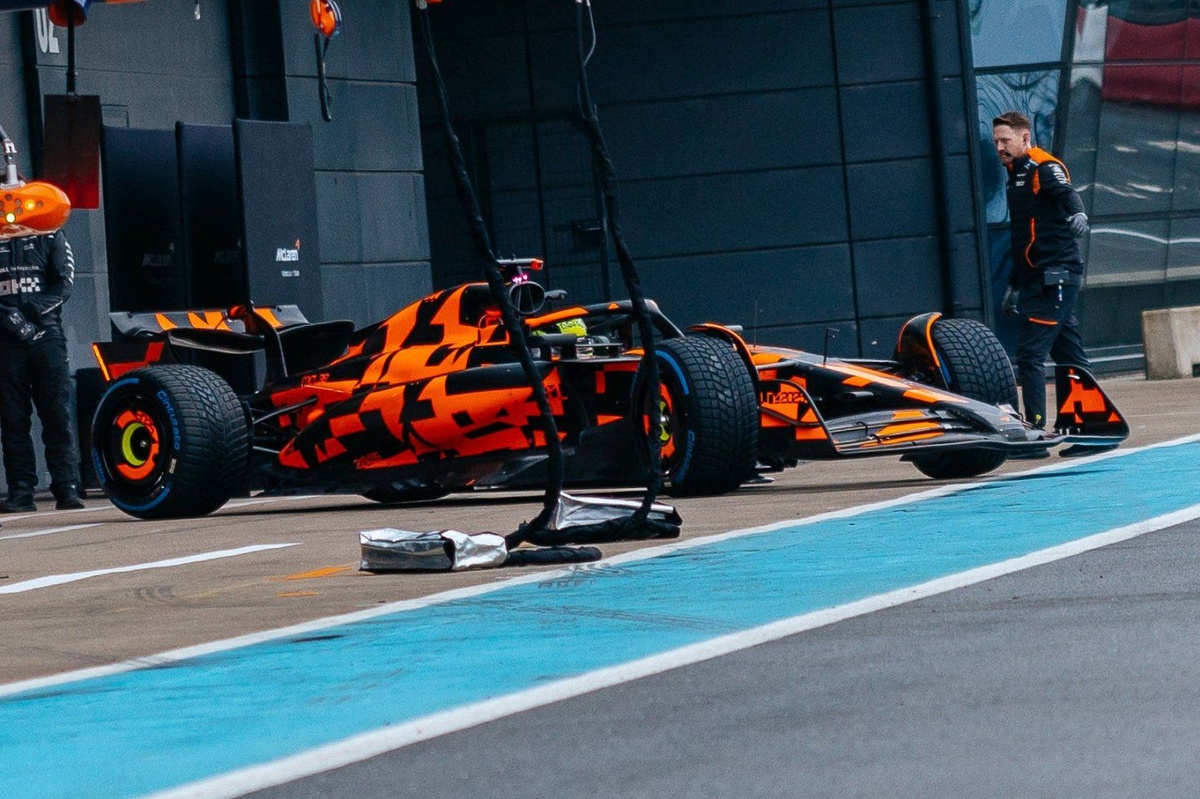
Red Bull was one of the first teams to run a camouflage livery in testing, with the Milton Keynes-based squad rolling out a striking look to mask its aerodynamic updates back in 2015. The look, which it said at the time was inspired by Sebastian Vettel’s helmet design, featured an angular black and white livery that echoed the dazzle camouflage pattern used by warships in the First World War.
Dazzle camouflage isn’t about masking the whole vehicle to make it blend in with the surroundings, as you might see with traditional military camouflage. Instead, the angular look is about confusion, which makes it more “difficult to spy on cars”, according to a blog post from McLaren.
This happens because the geometric patterns on these kind of liveries break up the smooth curves and shapes of different aerodynamic surfaces. It’s a technique that was developed during the First World War by British naval artist Norman Wilkinson, as it helped mask the size, speed and direction of various warships. Curves painted onto the front of military vessels could create the look of a false bow, hiding how long a ship was, while patterns on a ship's stern could mask which direction it was travelling in.

In F1, these patterns sparked conversation in the paddock when Red Bull debuted its RB11, but also helped the team preserve some of its aerodynamic secrets - as the sharp angles hid details of the car's bodywork from onlookers. In 2018 and 2019, the team also ran similar angular camo looks to hide its secrets.
This ex-military tech is also used by automakers when they test new models out on the road, and allows manufacturers and F1 teams to test their cars without giving away many of the design elements that the new machines feature.
It’s a technique that’s been used by more than just McLaren and Red Bull, with Alfa Romeo, which will this year race as the Audi works team, and Williams also running camouflage cars in recent years.
Read and post comments