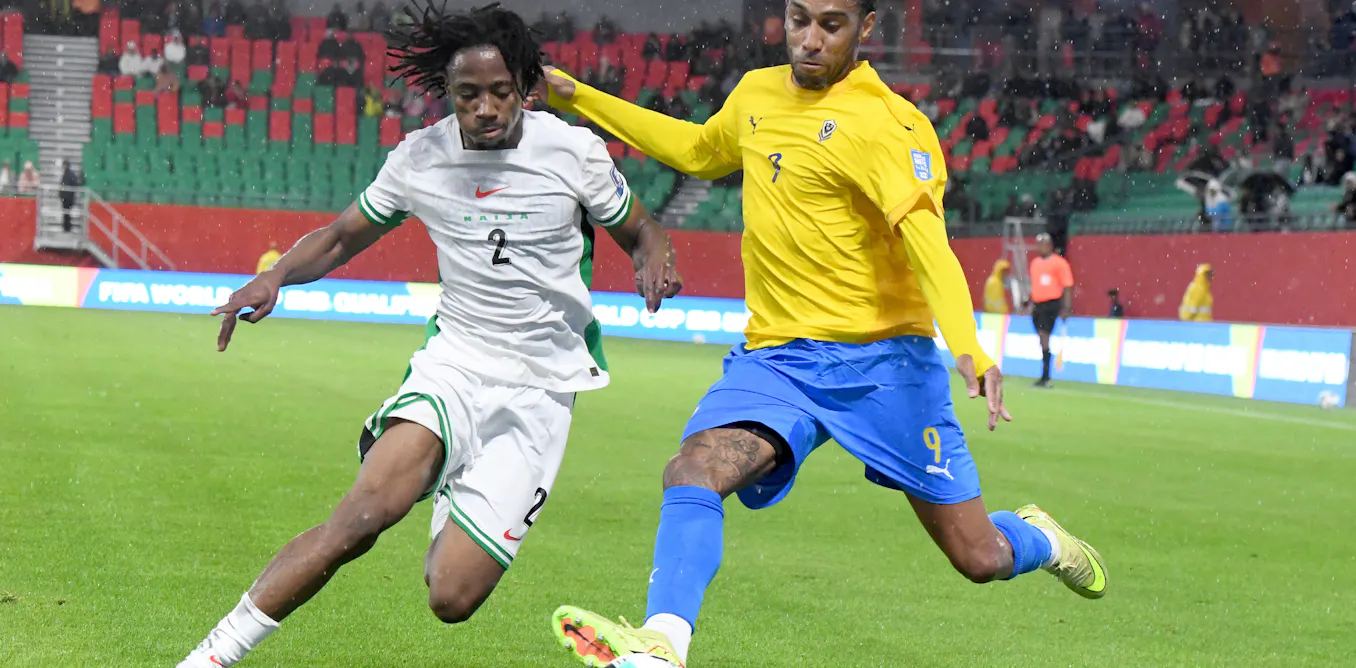
When a Tottenham Hotspur Football Club fan hurled a banana peel that landed near Arsenal Football Club striker Pierre-Emerick Aubameyang during a 2018 North London derby, a photographer captured the moment. That image became an arresting symbol of racism in soccer.
The intent behind the act was widely recognized and condemned across the football community. Outraged team officials publicly denounced the act, while Arsenal manager Unai Emery emphasized that “nobody accepts” incidents like it in global soccer.

The fan was fined £500 and banned from matches for four years. That same season, the Premier League’s domestic television deal was worth £5.1 billion.
The persistence of racist incidents, met with inconsistent sanctions and responses that address symptoms rather than causes, point to a governing framework that has failed to protect players or deter perpetrators.
In some cases, players subjected to racial abuse have been encouraged by fans, commentators and officials to accept such behaviour as an unfortunate reality of the sport. More troubling, victims have at times been blamed for provoking or contributing to the abuse they experience. These responses not only normalize racism but also shift responsibility away from perpetrators and the institutions responsible for creating safe and inclusive sporting environments.
In 2019, after England players were racially abused in Bulgaria, the Union of European Football Associations (UEFA) imposed a €75,000 fine on the Bulgarian Football Union. Given the substantial financial resources associated with European football, the penalty signalled neither deterrence nor institutional seriousness.
Soccer’s governing bodies have spent decades developing and promoting anti-racism initiatives that are highly visible and symbolically powerful. These efforts often include awareness campaigns, public statements, pre-match ceremonies and disciplinary messaging designed to demonstrate a commitment to inclusion. While such measures can raise awareness and gesture at institutional concern, they have been criticized for failing to produce meaningful structural change or significantly reduce racist abuse within the sport.
What the camera doesn’t show
Beneath the veneer of the Premier League, youth academy systems funnel Black and Brown teenagers into Europe. These systems operate with minimal oversight and even less protection.
As early as 2008, The Observer reported an estimated “500 unlicensed football ‘academies’ in Accra alone,” most run by people who could produce no proof of any professional background.
Families in Mali were paying fees averaging €2,000 to €3,000 — often their entire life savings, sometimes raised by selling their homes — to agents promising European trials that never materialized.
Stadium racism allows institutions such as FIFA and the Premier League to position themselves as the solution to a problem they treat as arriving from outsiders, rather than one embedded in their own structures.
The structural work is harder to campaign against because it is already within the institution itself. Sporting bodies cannot launch a hashtag about their own labour migration policies.
What the research actually says
A 2024 study found that more than half of the 101 active professional soccer players surveyed reported psychological distress, with racism identified among the psychosocial stressors contributing to burnout and mental exhaustion.
The evidence isn’t new. A 2020 commentary in the British Journal of Sports Medicine argued that professional soccer’s mental-health models systematically ignore racism as a structural problem, instead treating each occurrence as an isolated incident. The federations have access to this data. Some of them help fund the research. What they lack is the structural incentive to treat racism as a workplace safety issue rather than a PR inconvenience.
Racism in soccer has long been framed as an ethical problem. It is also an occupational health concern. Racial abuse is not just a series of isolated insults; it produces the same biological traces as any other workplace toxin.
Chronic exposure to discrimination elevates cortisol and inflammatory markers. Researchers call this “allostatic load.” It translates into higher rates of hypertension, sleep disruption and accelerated cellular aging. The risks apply to people who spend their working lives in racially hostile environments.
Soccer players are often overlooked examples of those workers. A 2024 survey from FIFPRO, the global players’ union, found that 83 per cent of player unions reported abuse and violence as direct contributors to mental health problems among members. Another 88 per cent said the threat of violence negatively impacted on-field performance.
Yet no federation classifies racial abuse as a hazardous condition requiring systematic mitigation. Protocols exist for torn ligaments and concussions. There is no equivalent for players who receive death threats online the night before a match.
Who protects the players?
The 2026 FIFA World Cup, just as other World Cups before it, will be dangerous in ways FIFA does not account for.
Thousands of players, staff and fans from racialized backgrounds will enter stadiums where the safety infrastructure is not designed for the cumulative toll of racist environments.
FIFA’s Human Rights Framework promises inclusion. It does not promise health-based monitoring. The federations know the science. What they have not done is treat racism as the workplace safety issue it actually is.
North America’s 2026 World Cup will bring the standard promises: unity, respect and responsibility. What it claims to offer is a celebration of cultures. What it almost certainly will not bring is an honest ledger of who profits from the labour of Black and brown athletes and who protects them when the abuse starts.
The question for 2026 is not whether another player will be targeted. The question is whether anyone with power will finally name the system that makes it inevitable.
Until that happens, the campaigns are not failing. They are doing precisely what they were built for: managing appearances while the structure holds steady.
This article was originally published on The Conversation. Read the original article.