Get all your news in one place.
100’s of premium titles.
One app.
Start reading
Times Life
Times Life
Amisha Sharma

Why Did Karna Stay Loyal Even When He Knew the Truth?

There are many warriors, kings, and heavenly fates in the Mahabharata, but none of them are as emotionally complex as Karna. Karna is the ultimate representation of loyalty over blood; he was born a royal, reared as a charioteer's son, endowed with heavenly might, and punished by fate. He had the opportunity to switch sides, take the kingdom, and escape death when he eventually realized he was the oldest Pandava and the son of Kunti. However, he declined. Why would a man put a friend's devotion ahead of his own mother, brothers, and future? Karna's choice was a fiery, devastating code of honor, not a sign of weakness. His narrative is about identification, thankfulness, and the cost of loyalty rather than conflict.

Gratitude Meant More Than Blood

Karna Crowned King of Anga
<p>Duryodhana giving Karna respect when the world mocked him</p>

Duryodhana defended Karna as soon as he was disparaged for being the son of a charioteer. When the world denied Karna friendship, prestige, and dignity, he gave him all three. This was a grace that changed Karna's life, not politics. The only person who recognized Duryodhana's value prior to the revelation of his royal identity would be betrayed if he later abandoned him. Repaying thanks was more important to Karna than seizing an era he never had.

He Refused to Accept Love That Came Too Late

Kunti Reveals the Truth to Karna
<p> A mother’s secret revealed on the eve of war</p>

Only when conflict was certain did Kunti approach Karna. She remained silent for years as he endured rejection, shame, and loneliness. Karna believed that her fear of losing her other sons, rather than maternal love, was the source of her truth. In order to grant her request, he would have to embrace a family who never supported him at his hardest moments. Karna believed that delayed love is not the same as given love, thus she opted for dignity above delayed recognition.

Honor Bound Him to His Word

Karna’s Oath Before Battle
<p> A warrior bound by promises stronger than fate</p>

Karna had promised Duryodhana his eternal devotion. A promise was sacred law to a warrior, not just an affirmation. His honor would be permanently damaged if he switched sides for his own benefit. Karna made the decision to keep his promise although knowing he would probably perish. He believed that dying honorably was preferable to living in disgrace. Maintaining his word at all costs was essential to his identity as a warrior.

He Believed Destiny Could Not Be Escaped

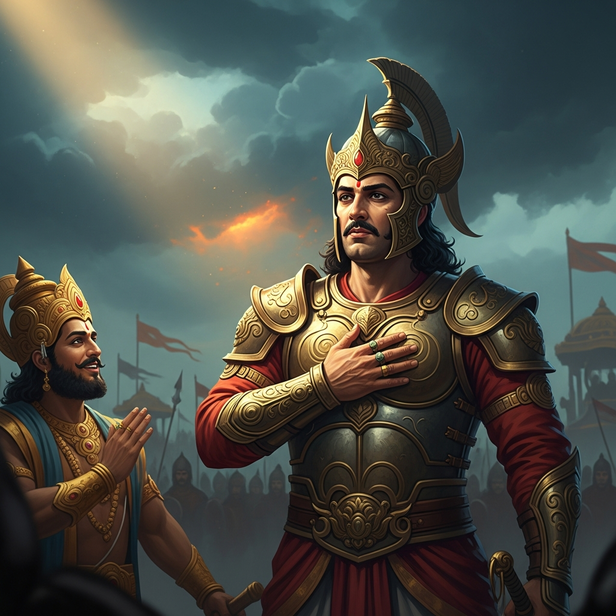
Karna on the Battlefield of Kurukshetra
<p> A hero walking knowingly toward fate</p>

Karna realized his awful fate and knew the curses imposed upon him. Neither the past nor the ongoing cosmic design would be erased by joining the Pandavas. He bravely faced fate instead of fleeing from it. His readiness to face death with awareness rather than dread is a sign of strong spiritual strength, as seen by his acceptance of destiny.

Due of his blindness, Karna did not remain with Duryodhana. He stayed because he was honorable, hurt, thankful, and certain of his destiny. His loyalty was spiritual, emotional, and personal rather than political. Because of this, Karna is still regarded as one of the Mahabharata's most tragic but admirable heroes. In the perspective of history, he never lost his integrity even though he lost the battle.

Explore the latest trends and tips in Health & Fitness, Spiritual, Travel, Life Hacks, Trending, Fashion & Beauty, and Relationships at Times Life!

Sign up to read this article
Read news from 100’s of titles, curated specifically for you.
Already a member? Sign in here
Related Stories
Top stories on inkl right now
One subscription that gives you access to news from hundreds of sites
Already a member? Sign in here
Our Picks
Fourteen days free
Download the app
One app. One membership.
100+ trusted global sources.