Get all your news in one place.
100's of premium titles.
One app.
Start reading
The Independent UK
The Independent UK
Sport
Michael Jones

Why did Alexander Zverev take an injection during Wimbledon final?

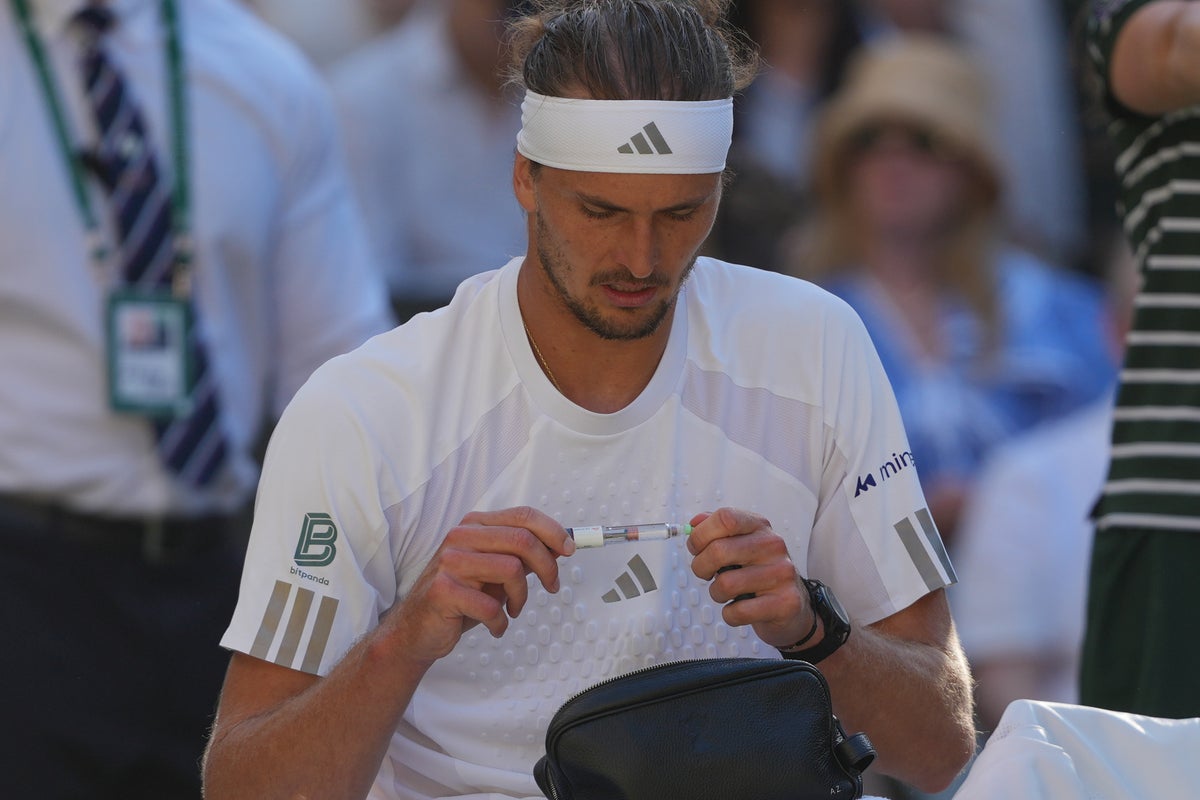
Alexander Zverev takes an insulin injection to manage his diabetes during the Wimbledon final - (AP)

Alexander Zverev was seen taking an injection during the men’s Wimbledon final clash against Jannik Sinner as he looks to win the tournament for the very first time.

Having won the first set 7-6, Zverev was leading the second set 3-2 when he sat down on a courtside chair, at the switch of ends, and unveiled a medical pouch. He took out an insulin pen and injected it into his leg before resuming the match.

The French Open champion was diagnosed with Type 1 diabetes at the age of four and the injection was a dose of insulin to manage his glucose levels both on and off court. His diagnosis is also the reason he can also use a phone during matches despite a ban on players doing so.

That is due to a medical exemption so that he can track his glucose monitor on his phone instead of using constant finger-prick checks which is quite common for people with diabetes.

An interview with BBC Sport in the build-up to the Wimbledon final saw Zverev talk about the reasons behind his phone use the German explaining “that’s why the umpires allow me to check my phone, so I don’t have to poke my finger every changeover”.

Tennis Grand Slam tournaments have a list of players that are diabetic and those players are permitted to use their phones during matches in order to monitor their glucose and inject insulin if needed.

Noting Zverev’s need to balance his blood sugar levels, Andre Agassi and Andrew Castle addressed his medical condition on BBC’s coverage of the match.

“As if there’s not enough to worry about out there in a grand slam final,” said Agassi while on commentary duty. “He doesn’t claim victim when it comes to his diabetes. It’s not a subject he cares to discuss a whole lot but at the same time he holds his head up high and goes about his work daily.”

Castle added: “It’s quite inspirational that he’s able to handle that aspect of his health and still produce this level of physical performances.”

Alexander Zverev faces Jannik Sinner in the Men's Wimbledon final (Getty)

Yet despite the close monitoring of his condition, Zverev has previously had issues on court.

A malfunctioning glucose sensor left him feeling unwell during a match against Taylor Fritz in June’s Halle Open as the French Open champion injected a higher dose of insulin than he required.

On that occassion, Zverev lost 6-7(4) 6-4 7-5 and explained the problem he’d had with his glucose monitor after the match.

He said: "I had huge problems with ​the sugar because the sensor I use gave me ⁠a completely incorrect reading. It indicated very high values ​when they were actually low, so I injected much more insulin ​than I should have.

"During the match, or rather during the first 45 minutes, I had to ​consume about 350 grams of sugar. I felt absolutely terrible.

"This ​is the first time something like this has ​happened ⁠to me. I've been using these sensors since 2016 or 2017, and in nine years, I had never seen such a ⁠big error."

Sign up to read this article
Read news from 100's of titles, curated specifically for you.
Already a member? Sign in here
Related Stories
Top stories on inkl right now
One subscription that gives you access to news from hundreds of sites
Already a member? Sign in here
Our Picks
Fourteen days free
Download the app
One app. One membership.
100+ trusted global sources.