
The Numbers Most Runners Don't Want to Hear
Cycling at moderate intensity burns between 400 and 600 calories an hour, roughly the same as running at a comfortable pace. A 2017 study published in the Journal of the American Heart Association tracked cardiovascular outcomes across 263,450 participants in the UK Biobank cohort and found that commuter cycling was associated with a 46 percent lower risk of cardiovascular disease compared to non-active commuting. The reduction held even after adjusting for age, diet, and smoking. That figure is not for competitive cyclists. It is for people who rode to work.

The aerobic gains from cycling come without the repetitive ground-force impact that accumulates in running. Every running stride sends a force roughly two to three times your body weight through your ankles, knees, and hips. On a bicycle, your joints move through their range of motion without bearing that load. For Indian adults in their forties and fifties, a demographic with high rates of knee osteoarthritis, estimated by AIIMS researchers to affect nearly 28 percent of adults over 45, this distinction matters more than any calorie comparison.
Why Indian Streets Are Not the Obstacle You Think
The standard objection is traffic. Indian roads are chaotic, the argument goes, and cycling is a death wish in any city above a certain size. This is overstated. Pune, Bhubaneswar, and Pimpri-Chinchwad have invested in dedicated cycling infrastructure over the past decade. Bengaluru's Namma Cycle scheme and Delhi's cycling lanes along stretches of the Outer Ring Road have expanded the practical options. Even where dedicated lanes don't exist, early morning rides between 5:30 and 7:00 AM on most Indian city roads are genuinely manageable, traffic is thin, air quality is at its daily best, and temperatures are tolerable for eight or nine months of the year.
Cost is the other underestimated factor. A decent entry-level hybrid bicycle, suitable for city commuting and weekend fitness rides, runs between eight thousand and fifteen thousand rupees. Compare that to a gym membership at twelve hundred to two thousand rupees a month, and the bicycle pays for itself within a year. It then costs nothing to run except occasional tyre maintenance.
What Cycling Does to Your Joints That Running Cannot Match
Orthopaedic physicians routinely recommend cycling as the first reintroduction to cardio exercise after knee surgery or ligament repair, specifically because the pedalling motion keeps synovial fluid circulating in the joint without compressing the cartilage. This is not a soft recommendation for people already injured. It is a structural argument for why cycling builds fitness while running depletes it in people whose joints are already showing wear.
For adults managing early-stage osteoarthritis, and the numbers in India suggest this is a large population, sustained aerobic exercise is essential for managing the condition, but high-impact options accelerate joint deterioration. Cycling threads that needle. A 2019 review in the journal Osteoarthritis and Cartilage found that low-impact aerobic exercise, including cycling, reduced pain scores and improved physical function in knee osteoarthritis patients without worsening structural damage. The review covered 21 randomised controlled trials.
Building Endurance Without a Subscription
Endurance, the cardiovascular kind that lowers resting heart rate, improves VO2 max, and makes climbing a flight of stairs feel effortless, responds well to steady-state cycling. Three rides a week at 45 minutes each, held at a pace where you can speak in short sentences but not comfortably hold a long conversation, is enough to produce measurable aerobic improvement within six to eight weeks in previously sedentary adults. This is the zone exercise physiologists call Zone 2 training, and cycling is one of the cleanest ways to stay in it without equipment or a trainer counting your steps.
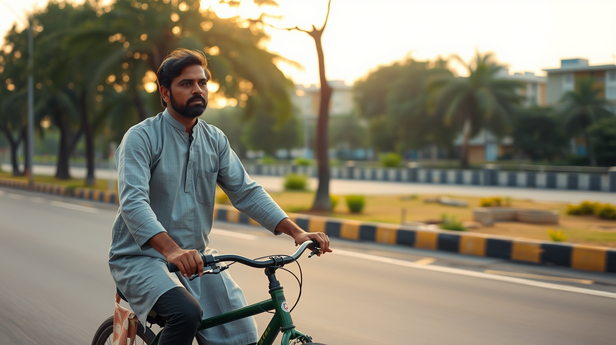
The practical advantage for Indian adults is that this kind of riding maps directly onto existing behaviour. A 7-kilometre commute each way, done by bicycle at a moderate pace, takes roughly 25 to 30 minutes and satisfies the aerobic requirement without carving new time out of the day. The fitness is embedded in the commute, not added on top of it.
Cycling also builds leg strength, quadriceps, hamstrings, glutes, calves, without the eccentric loading that makes running so hard on muscle tissue after a long absence from exercise. Someone returning to fitness after years away will find cycling far more forgiving in the first two weeks than almost any other cardio option.
The Gear Question, Answered Simply
A helmet and a bicycle are the only non-negotiable items. Padded cycling shorts help on rides longer than 45 minutes. A rear light and a front light are essential if you ride before sunrise or after sunset. Nothing else is required to start. The industry will suggest otherwise, cycling has a well-developed equipment culture that can make the entry seem expensive and technical. Ignore it. The fitness benefit of a fifteen-thousand-rupee hybrid ridden consistently is greater than that of a one-lakh road bike ridden twice a month.
Tyre pressure is the one maintenance item that genuinely affects performance and injury risk. Under-inflated tyres increase rolling resistance and make the ride harder than it needs to be. Check pressure once a week. A floor pump with a gauge costs under five hundred rupees and lasts years.
The cycling community in most Indian cities is more accessible than it appears. Groups like Bangalore Bikers Circle, Chennai Cycling Club, and Delhi Cycling Club run early morning group rides that are open to beginners. Riding with a group on unfamiliar roads is safer, more consistent, and considerably more motivating than solo riding in the first month.
Cycling's real competition is not running or swimming. It is the decision to do nothing, to treat fitness as something that requires a separate, carved-out block of life rather than something that can be folded into how you already move. The adults who sustain a cardio habit over years are rarely the ones who found the most efficient exercise. They are the ones who found the one they would actually do on a Wednesday morning in February when nothing else was going right.