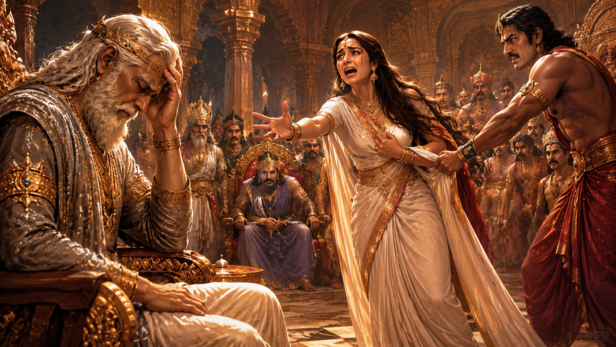
The Mahabharata contains countless moments of heroism, sacrifice, devotion, and divine wisdom. Yet among all its emotionally devastating scenes, few moments continue to disturb devotees as deeply as Draupadi’s humiliation in the Kaurava court. It was a moment where dharma itself appeared to tremble. Great kings sat in silence, powerful warriors lowered their heads, and one of the noblest men in the epic, Bhishma Pitamah, remained painfully quiet. For generations, devotees and readers have asked the same heartbreaking question: why did Bhishma stay silent during Draupadi’s humiliation?
The question continues to provoke emotional and spiritual reflection because Bhishma was not an ordinary man. He was revered as the guardian of Hastinapur, the embodiment of sacrifice, wisdom, discipline, and duty. His silence during one of the darkest moments in the Mahabharata creates a moral contradiction that still shocks devotees today. To understand Bhishma’s silence, one must understand the painful conflict between personal morality, royal duty, vows, and the tragic complexity of dharma itself.