Get all your news in one place.
100's of premium titles.
One app.
Start reading
MyLifeXP
MyLifeXP
Noopur Kumari

Why Are These 5 Gods Called Panchdev? The Hidden Truth

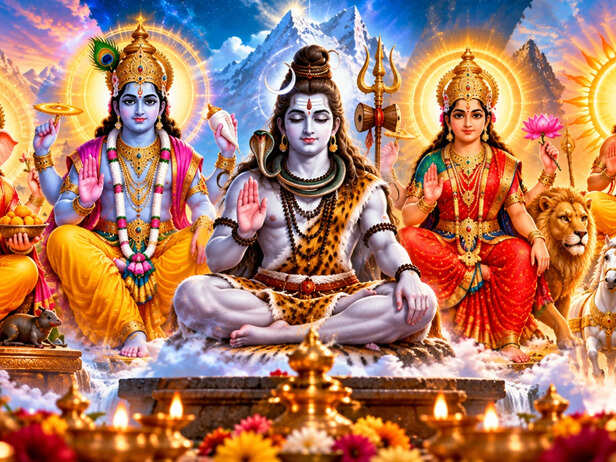
Have you ever wondered why five particular deities hold such an important place in Sanatan tradition? Lord Ganesha, Lord Vishnu, Lord Shiva, Adi Shakti and Surya Dev are often remembered together as Panchdev. At first, they may seem to represent completely different powers. But there is a deeper idea connecting them. Sanatan traditions describe these five divine forms through different aspects of existence, including beginnings, preservation, transformation, energy and life. Once you understand this connection, Panchdev worship starts to look less like a list of gods and more like a symbolic way of understanding the balance of life.

Ganesha Opens the Way

Lord Ganesha Blessing a New Beginning
Lord Ganesha is traditionally worshipped before auspicious beginnings.

Lord Ganesha is traditionally worshipped at the beginning of auspicious occasions, prayers and important activities. He is associated with wisdom, discernment and the removal of obstacles. This is why Lord Ganesha occupies the first place in many Panchdev traditions. His presence carries a simple message: before moving forward, clear confusion and prepare the mind. In the idea of Panchdev in Sanatan, Ganesha can therefore be understood as the divine form connected with a positive beginning. His elephant head and calm appearance also remind devotees that strength does not always mean force; wisdom and patience can be equally powerful.

Vishnu Protects Balance

Devotees Worshipping Lord Vishnu on Anant Chaturdashi
Anant Chaturdashi is traditionally dedicated to Lord Vishnu in his Ananta form.

After a beginning comes the responsibility to maintain what has been created. This is where Lord Vishnu becomes central to the Panchdev concept. In Sanatan tradition, Vishnu is known as the preserver and is associated with protecting cosmic order, often described through the idea of Dharma. His avatars, including Rama and Krishna, are traditionally understood as manifestations that restore balance when order is disturbed. The role of Vishnu adds another layer to Panchdev worship: creation alone is not enough. What exists must also be protected and sustained. His presence represents stability, responsibility and the continuous effort to preserve balance.

Shiva Brings Transformation

The word destruction can sound frightening, but the role of Lord Shiva in Sanatan philosophy is far deeper than simple destruction. Shiva is traditionally associated with dissolution and transformation. One phase must end for another to begin. Seasons change, old forms disappear and new possibilities emerge. This is why Lord Shiva has an important place among the five divine forms of Panchdev. His role reminds devotees that endings are also part of existence. The Shiva principle can be seen as a lesson in letting go. Sometimes, transformation begins only when something old is allowed to come to an end.

Adi Shakti Gives Power

Without energy, neither creation nor preservation can continue. This is where Adi Shakti enters the Panchdev idea. Shakti is traditionally described as divine feminine power and the energy that makes action and creation possible. Different forms of Shakti, including Durga, Lakshmi and Saraswati, are worshipped for different qualities and purposes. In Sanatan Dharma, Shakti is not merely seen as a separate divine figure but as a fundamental principle of power and energy. Her place among Panchdev highlights an important idea: existence requires energy to move, create, protect and transform.

Surya Gives Life

The fifth form is Surya Dev, whose importance is closely connected with the visible Sun. Unlike many divine concepts that are understood through symbolism, sunlight is directly experienced every day. In Sanatan traditions, Surya is associated with light, vitality, time and life. Practices such as Surya Namaskar and offering water to the Sun reflect this long-standing reverence. Within the Panchdev tradition, Surya Dev represents the life-giving energy that supports the world. His presence creates a powerful connection between spiritual practice and everyday experience: the light seen outside can also become a reminder of awareness within.

Five Forms, One Balance

The deeper meaning of Panchdev becomes clearer when all five are viewed together. Ganesha represents an auspicious beginning, Vishnu preservation, Shiva transformation, Shakti divine energy and Surya life-giving light. These roles are different, yet they are connected. A beginning needs wisdom, preservation needs balance, transformation needs courage, action needs energy and life depends on light. This is why Panchdev in Sanatan tradition can be understood as a symbolic picture of interconnected existence. Rather than focusing only on individual deities, the concept encourages devotees to see how different divine qualities can work together.

The Real Lesson of Panchdev

The most meaningful lesson of Panchdev worship may not be about choosing one deity over another. It is about understanding different qualities that human life needs. Wisdom can help us begin, preservation can teach responsibility, transformation can help us accept change, Shakti reminds us of inner strength, and Surya represents the light and energy that sustain life. That makes the five main Hindu gods and divine forms more than a simple religious list. They offer a framework through which devotees can reflect on life, balance and duty. In that sense, Panchdev becomes a reminder that different paths can still point toward a deeper spiritual understanding.

Unlock insightful tips and inspiration on personal growth, productivity, and well-being. Stay motivated and updated with the latest at My Life XP.

Sign up to read this article
Read news from 100's of titles, curated specifically for you.
Already a member? Sign in here
Related Stories
Top stories on inkl right now
One subscription that gives you access to news from hundreds of sites
Already a member? Sign in here
Our Picks
Fourteen days free
Download the app
One app. One membership.
100+ trusted global sources.