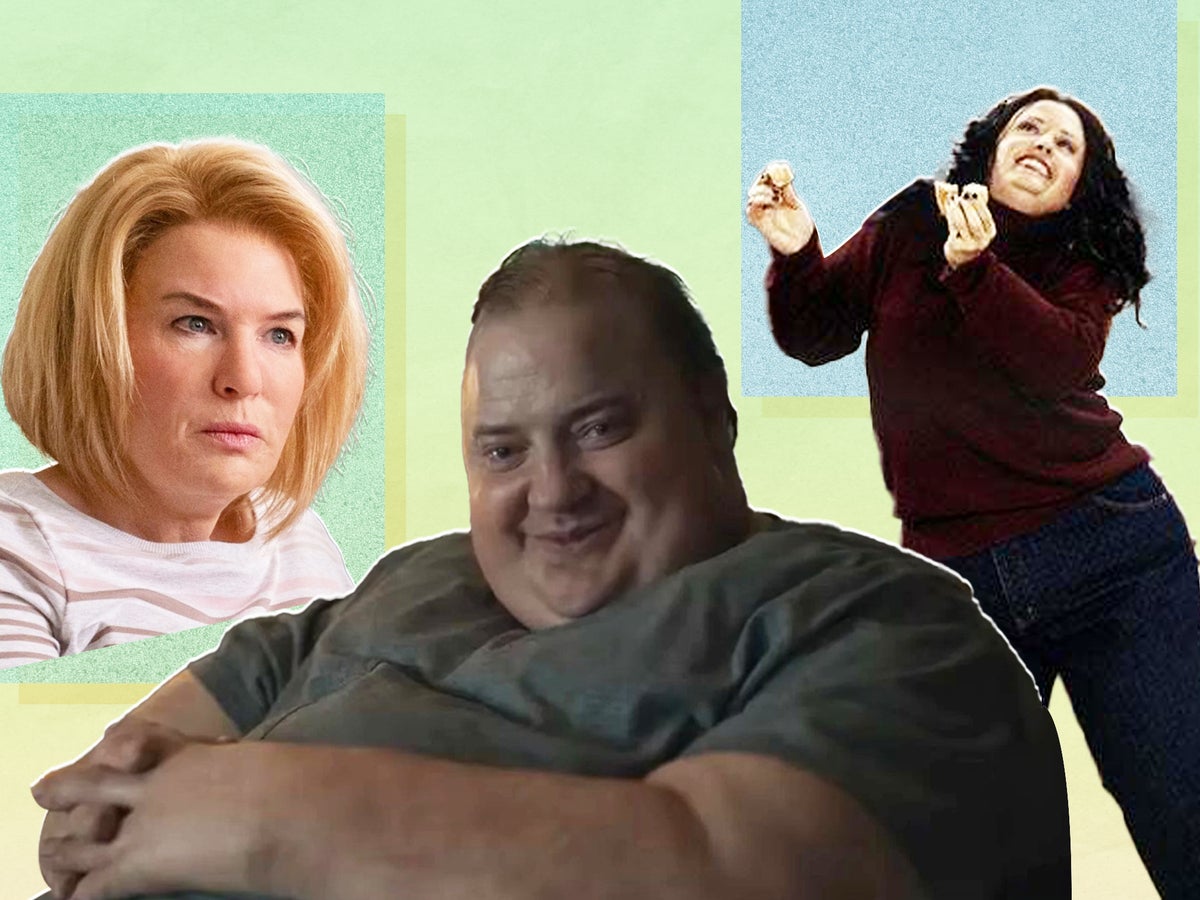
Remember “Fat Monica”? Every now and again, in Friends, there’d be a flashback scene. Encased in a fat suit and holding a doughnut, Courteney Cox would dance, while the laugh track whooped and shrieked. That laughter confirmed that the flashback character was created for one purpose only: to be a big joke. As the ultimate embodiment of the “before” to older Monica’s stick-thin “after”, “Fat Monica” imprinted onto the minds of millennials everywhere the idea that attractiveness relied on extreme weight loss. But Cox was far from the only one donning a fat suit in the Noughties. There was Gwyneth Paltrow in Shallow Hal, Mike Myers in Austin Powers, Ryan Reynolds in Just Friends, and both Elizabeth Moss and January Jones in Mad Men. And don’t forget the cross-dressing fat suit “comedies”. Eddie Murphy as foul-mouthed bully Rasputia in Norbit; John Travolta as agoraphobic Edna Turnblad in Hairspray – a character who supposedly hasn’t left her house since she was a size 10. In the fatphobic Noughties, fat suits were in fashion.
From the lofty vantage point of the 2020s, it seems fairly obvious that the Noughties was an era awash with fatphobia. Weight Watchers reigned supreme. Channel 4 pumped out Supersized Vs Superskinny, You Are What You Eat, and Fat Families. Sex and the City made jokes about Miranda’s “fat ass” and dedicated an entire plotline to Samantha putting on 15 pounds (enough weight, apparently, to warrant an intervention). In the years since, however, there seems to have been a widespread assumption that times had changed. Many cultural staples of the millennial era were widely agreed to have “aged badly”, the implication being that their reliance on fatphobic, racist and sexist tropes wouldn’t fly today. Fat suits in particular were held up as relics of a less enlightened time. So why have they made a comeback?