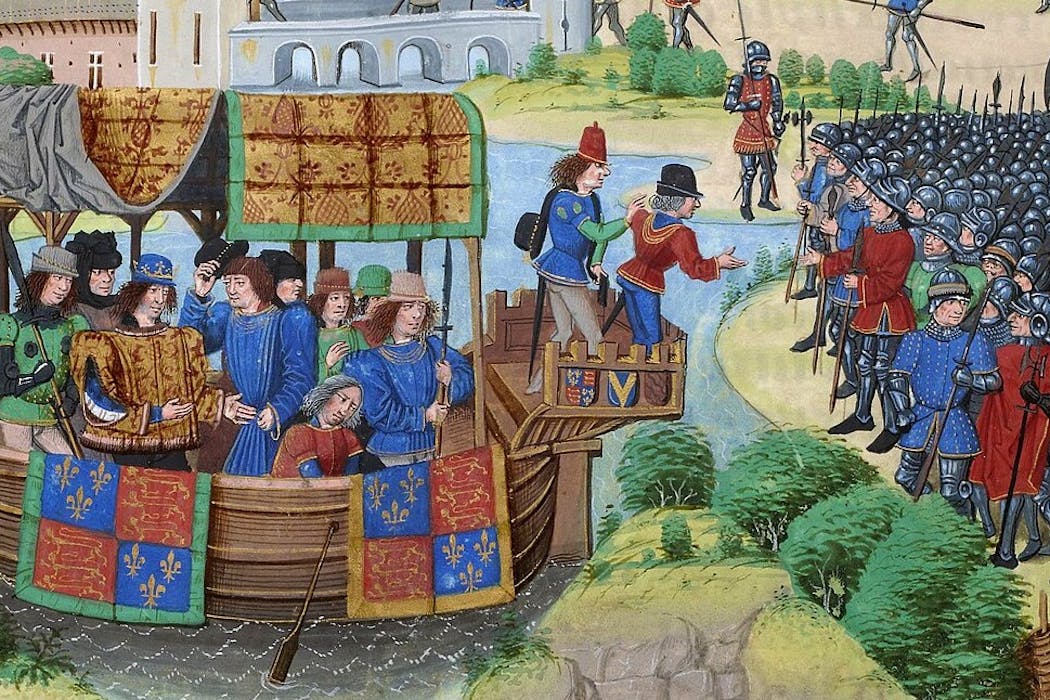
The Peasants’ Revolt of 1381 was one of the largest and most dramatic popular uprisings in medieval Europe. But what do we really know about this celebrated event in English history?
The rising was the culmination of a wide range of popular grievances against the government of the young King Richard II and his uncle John of Gaunt. The trigger was the levy of a third poll tax in four years to fund the hundred years war.

To understand the depth of the rebellion and its impact on society today, we created the People of 1381, a database of events, places and people comprising around 28,000 records. It challenges the established narrative that the revolt was focused on a handful of counties in England and restricted to certain levels of society.
The term “Peasants’ Revolt” was not popularised until 1874 by John Richard Green’s Short History of the English People. The legal records generated by the prosecution of the rebels reveal that they were not just peasants but drawn from every level of medieval society beneath the aristocracy.
Read more: We built a database of 290,000 English medieval soldiers – here’s what it reveals
Our database shows how widespread the depth of feeling was against the government. The revolt wasn’t just a march on London – it involved people in over half the counties of England. In the west, there were riots in Bridgwater and Gloucester, while the disturbances spread as far north as Yorkshire and Chester.
The medieval records that make up the database uncover the participation of social groups whose role in the revolt has been underexplored, including household servants, soldiers and women.
It also includes details of those who didn’t partake directly but were affected in some way, from victims of the rising to jurors and lawyers who prosecuted the rebels. In doing so, the database sheds new light on the rebels of 1381. They are revealed as once living people, rather than the faceless mob described in contemporary chronicles.
So who was involved and where?
By combining judicial and manorial (administrative records generated by a manor) documents with records generated by central and local government, poll tax and military service, we can build a picture of the people involved in the revolt.
John Peper of Linton is one example: he owned land, granted charters, engaged in lawsuits and could afford lawyers – a far cry from the profile of a peasant. He was also one of the many rebels who had social aspirations and apparently resented the legal and fiscal checks on their ambition.
Peper highlights the important leadership role of soldiers in spreading the revolt. Having just returned from campaigning in France in May, he immediately joined the revolt and led groups attacking people and property around Cambridgeshire. He survived the government reaction and was ultimately pardoned.
There were also many poorer rural rebels and it was the way people of many social ranks joined the rising that made it so potent.
Manorial records are fascinating because they enable us to reconstruct the lives of very humble people. For example, Walter Spittebotter of Blackmore near Chelmsford was admitted to land previously held by his father in 1354-55. He found farming a struggle and was fined for the poor condition of his land and not clearing ditches. In 1381, he was among those who attacked the manor of Joan of Kent at North Weald Bassett in Essex. On his death in 1404, he held a cottage and six acres of land. His best animal, forfeited to the lord of the manor, was a pig.
In Wix (Essex), Joanna Welbetyn, Joanna Alfred and the wife of Thomas Ilsent joined in the burning of the manor’s records during the revolt. Our database suggests that sometimes women joined the rising as part of a family group. Joan Pode of Charlton joined one of the most spectacular events of the rising – the destruction of John of Gaunt’s luxurious Savoy Palace (on the present site of the Savoy Hotel). Joan was accompanied by her husband and another relative, suggesting that the whole Pode family joined the rising.
Unlike contemporary chronicles, the legal records show how women intervened at key moments in the revolt, most dramatically when Katherine Gamen was accused of pushing a boat out across the River Little Ouse in Suffolk. The chief justice could not escape and was killed.
The tantalising nature of much of the source material regarding women in 1381 is illustrated through the example of an unnamed woman who joined the attack. We know nothing about her except that she was “lately the wife of William Dekne” and was “led by Nicholas Carter”. They were part of a band which travelled from South Benfleet near the Thames Estuary up to Cressing Temple (a distance of over 30 miles, covered in a couple of days).
It is frustrating that we don’t know more about this unnamed woman. Why was she led by Nicholas Carter, and what was their relationship? But she demonstrates that some women did take part in the movement of rebel bands over long distances, even if they were in the minority.
The People of 1381 database is a versatile tool which enables us to develop many new perspectives on the revolt of 1381. We can reconstruct the background of the rebels, find connections between them, identify rebel bands, trace their movements and explore the spatial structure of the revolt.
However, we believe the ability of the database to reconstruct the human stories connected with the revolt, restoring humanity to the people caught up in the rising who have otherwise only been described in the most generic terms, is its most beguiling feature.
Adrian R Bell receives funding from UKRI via AHRC. He'd like to acknowledge the full team effort in driving the project, as well as the authors: Professor Anne Curry and Ian Waldock, University of Southampton; Dr Herbert Eiden, Victoria County History; and Dr Helen Lacey, University of Oxford.
Andrew Prescott receives funding from Arts and Humanities Research Council.
Helen Killick receives funding from UKRI via AHRC.
Jason Sadler receives funding from from UKRI via AHRC.
This article was originally published on The Conversation. Read the original article.