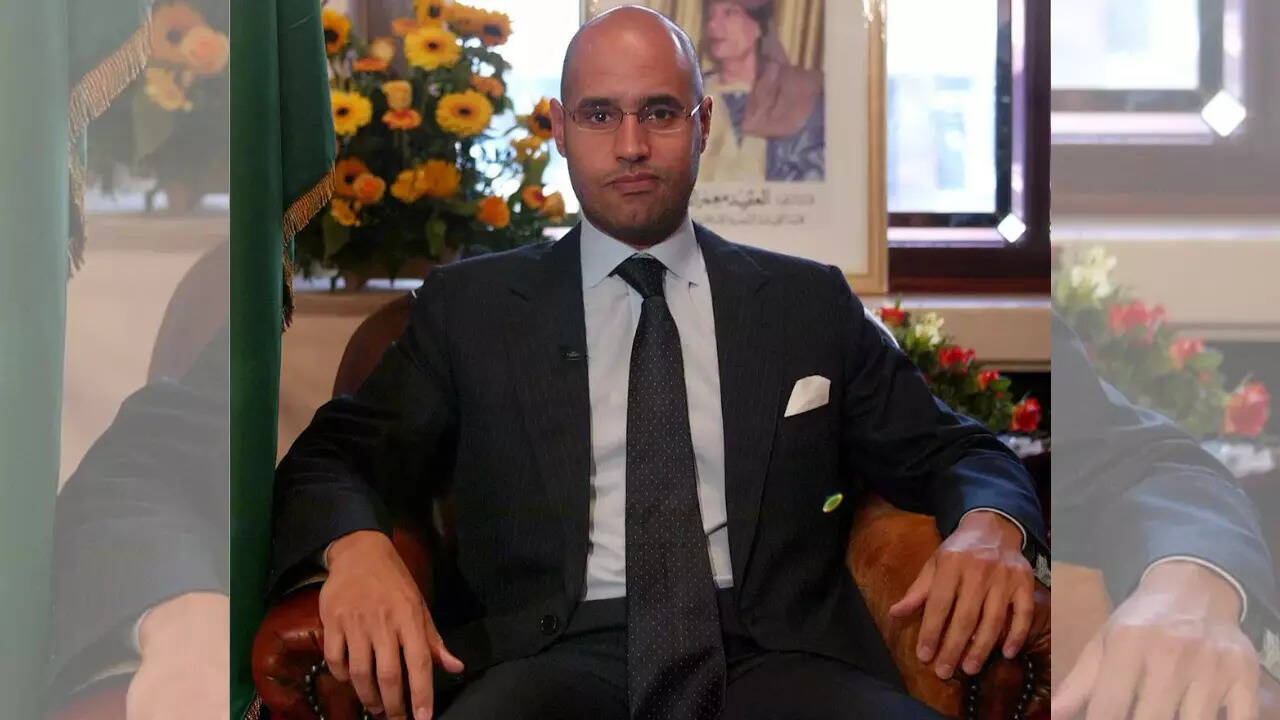
Saif al-Islam Gaddafi, once viewed as the Western-friendly face of Libya and heir apparent to longtime ruler Muammar Gaddafi, was killed in a “direct confrontation” after gunmen broke into his home, his office said on Tuesday. No further details of the incident were disclosed.
Despite holding no official government post, Saif al-Islam was for years considered one of the most powerful figures in Libya, shaping policy and serving as a key interlocutor with Western governments during his father’s four-decade rule.
The acceptable face of Gaddafi-era Libya
Educated at the London School of Economics and fluent in English, Saif al-Islam cultivated close ties with Western capitals and was widely seen as a reformist figure within the Libyan system.
He played a central role in Libya’s decision to abandon its weapons of mass destruction programme and negotiated compensation for families of victims of the 1988 Pan Am Flight 103 bombing over Lockerbie, Scotland.
He frequently called for a constitution, political reform and respect for human rights, positioning himself as the figure who could reintegrate Libya into the international community after years of sanctions and isolation.
2011 uprising and the turn to force
That image collapsed when the 2011 uprising against Muammar Gaddafi erupted. Saif al-Islam publicly sided with his father and became one of the architects of the regime’s violent response to the revolt, referring to rebels as “rats”.
“We fight here in Libya, we die here in Libya,” he told Reuters at the time. He warned that “rivers of blood” would flow and said the government would fight “to the last man and woman and bullet”.
In a televised address, he cautioned: “All of Libya will be destroyed. We will need 40 years to reach an agreement on how to run the country, because today, everyone will want to be president, or emir, and everybody will want to run the country.”
Capture, detention and legal cases
After Tripoli fell to rebels, Saif al-Islam attempted to flee to neighbouring Niger disguised as a Bedouin tribesman. He was captured by the Abu Bakr al-Sadiq Brigade militia and taken to the western town of Zintan, about a month after his father was killed by rebels.
“I’m staying here. They’ll empty their guns into me the second I go out there,” he said in comments captured on an audio recording during his capture, according to Reuters.
He spent about six years in detention in Zintan. Human Rights Watch said he did not allege physical abuse, though concerns were raised over prolonged solitary confinement. He said he was isolated and did not receive visitors, though he had access to television and books.
In 2015, a Tripoli court sentenced him to death by firing squad for war crimes. The International Criminal Court also issued an arrest warrant against him for “murder and persecution”.
Return from the shadows and election bid
Released in 2017 under an amnesty law, Saif al-Islam remained largely underground for years to avoid assassination, according to Libyan analyst Mustafa Fetouri. From 2016, he was allowed limited contact with people inside and outside Libya.
In 2021, wearing traditional Libyan attire, he resurfaced publicly to file his candidacy for Libya’s planned presidential elections, seeking to draw on nostalgia for stability under his father’s rule.
His candidacy proved deeply divisive. He was disqualified due to his conviction, and efforts to appeal were blocked by armed groups. The dispute became a major factor in the collapse of the election process and Libya’s return to political stalemate.
“I’ve been away from the Libyan people for 10 years,” he told The New York Times Magazine in 2021. “You need to come back slowly, slowly. Like a striptease. You need to play with their minds a little.”
Symbolic weight, contested legacy
Analysts say Saif al-Islam retained symbolic importance despite limited public engagement.
“After Saif al-Islam was freed a few years ago, he proved incapable of delivering speeches or producing public statements through the press or social media,” Jalel Harchaoui of the Royal United Services Institute told Reuters. “Yet his symbolic significance remained substantial.”
“Now that he has been slain, most pro-Gaddafi factions will experience both diminished morale and anger,” Harchaoui said, adding that one major obstacle to holding elections in Libya had been removed.