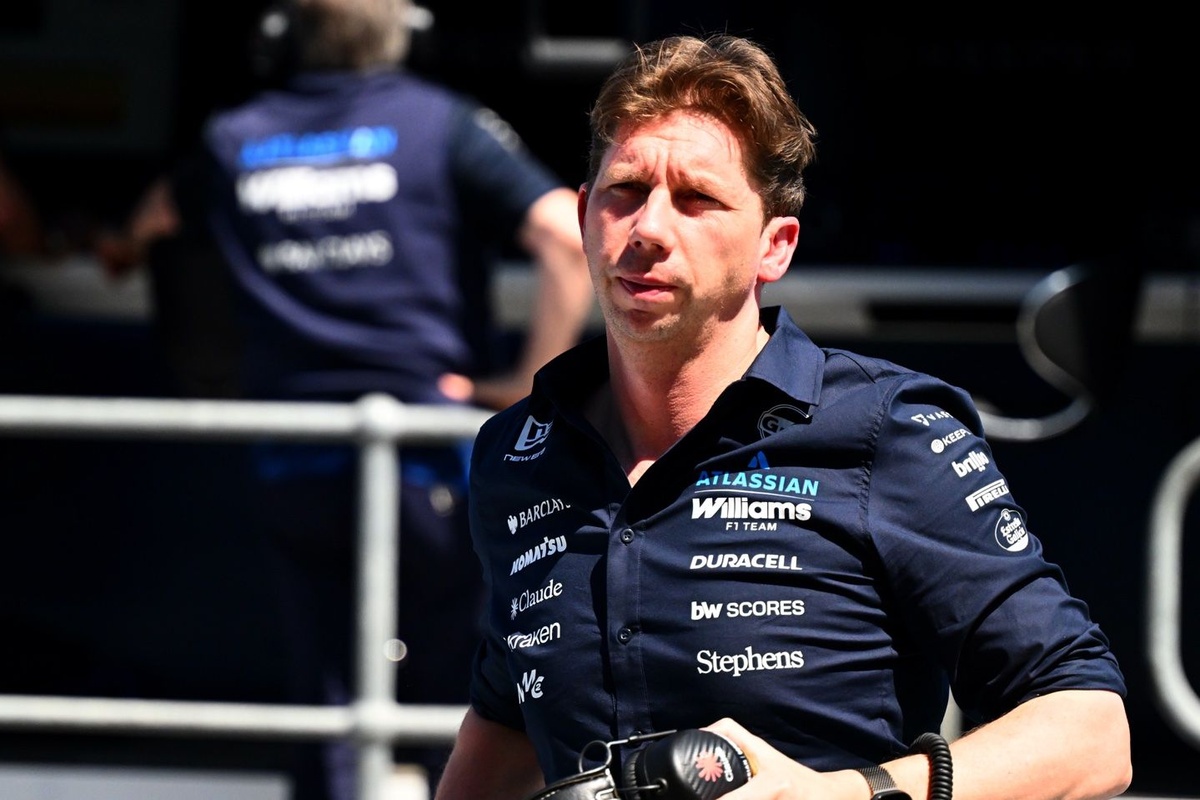
Williams boss James Vowles was saying all the right things during the build-up to the sweeping regulation change for the 2026 Formula 1 campaign.

“There can’t be a focus on now,” he told Bloomberg at the end of ‘24. “There has to be an absolute focus on the future. That won’t be the same up and down the grid, they’d be more telling you ‘next year’s our championship year’. For Williams that’s not the case. For Williams, we need this large regulation change to ensure that we’re investing in the future at the cost of 2024 and 2025.”
It was exactly what needed saying, as Williams had just finished ninth in the championship and its hard-working staff were looking for that shining light after years in the doldrums. From financial struggles to using a gigantic 20,000-cell Excel spreadsheet to document its car build, the Grove organisation was a shell of its former self, and when Vowles joined in 2023, his task was to transform it all.
A huge undertaking, sure, but one which needed doing – and despite all the talk about sacrificing ‘25, last season actually turned out to be Williams‘ best for some time. The team finished fifth in the standings, its highest since 2017, and claimed its first multi-podium season for 10 years with an incredibly strong driver pairing of Alex Albon and new signing Carlos Sainz.
So pretty much everybody was sitting there thinking, ‘wow, Williams might genuinely become a frontrunner’. The tools were there on paper - strong drivers (emphasis on the plural), F1’s best engine in Mercedes and the capability of designing a very neat chassis - it was just about kicking on and placing it all into action.
But the opposite has transpired. Instead of challenging the traditional top four - McLaren, Mercedes, Red Bull and Ferrari - Williams is only above Aston Martin and Cadillac after a very troublesome start to 2026. Quite frankly, it’s back to where it was three years ago and so Vowles must surely be thinking, ‘what now?’.

It’s all well and good saying that stuff pre-‘26, but if it doesn’t create the desired effect, then one has to question when the chance of success will actually come. This was supposed to be its opportunity, but instead it’s Haas and Alpine who’ve taken the fight to the frontrunners, with the FW48 nowhere near a points contender on merit.
This all started in January, when Williams opted to skip the Barcelona shakedown, having bitten off more than it could chew with several delays in production, and that set the theme for the coming months. At the season-opening Australian GP, a technical issue caused a no-show from Sainz in quali, while Albon only took 15th, so it comes at no surprise that zero points duly followed.
And again at round two’s Shanghai sprint: Williams suffered a double SQ1 elimination with Albon reporting “it's tough, there's some weird stuff going on in the car”. It only got worse for him the next day as the Thai-Briton failed to start the grand prix, though Sainz did finally score points in ninth - but it doesn’t take a genius to know that this largely came through there being three other non-starters, given the four-time grand prix winner started 17th.
So Sainz confirmed “we are too slow compared to where we wanted to be” – and Suzuka was again evidence of that. Albon suffered another Q1 exit, to which he angrily reacted “I complain for three races in a row that there’s something wrong, but I’m sure that it’s my driving style”, before deploying what was effectively a test session with five pitstops during the latter stages.
Vowles reacted: “Race over and no more points to add to our tally, unfortunately. The car is simply not good enough at this stage of the season. We’ve got five weeks now in front of us and we need to make sure we maximise every single hour of every single day to catch back up to that midfield. There’s a tremendous amount to do, we’ve started on the back foot.”
A “tremendous amount” indeed, because there are problems across that FW48 package. For starters it is understood to be overweight by at least 20kg, which obviously has a detrimental effect on lap time, but there are also problems with aero, cornering speeds and just general car balance.

Perhaps the only positive, and this is complimentary to Vowles’ leadership, is that the whole team is putting on a united front of which direction it needs to take. But there is a long, long road ahead, and while Vowles might be under contract for several more years, the questions about where he’s taking this team might start arriving because Williams can’t keep selling this grand project.
At some point it must deliver and it is on Vowles’ shoulders to ensure that happens, but will it? Right now the jury is leaning towards no, as the competition is simply too far ahead, yet McLaren’s transformation can serve as inspiration that all hope should not be lost…