
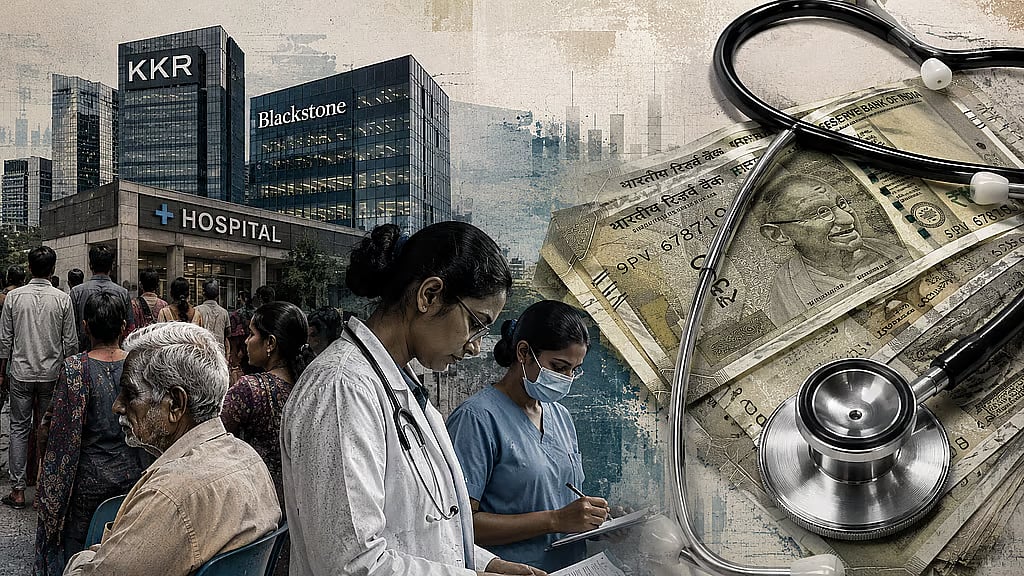
When Chazhikattu Hospital was set up in Thodupuzha municipality in Idukki district in 1933, health facilities were rare in the area. What began as a nursing home under Dr CK Stephen grew over the years into a reputed private hospital run by his family. The family’s establishment survived for 91 years. Then, in October 2024, it was acquired by the Kozhikode-based Baby Memorial Hospital (BMH).
BMH acquired Chazhikattu for an undisclosed amount in October 2024, just months after the US-based private equity firm Kohlberg Kravis Roberts & Co (KKR) acquired a controlling stake in BMH. Chazhikattu, now rebranded as Baby Memorial Hospital, serves as one of BMH’s satellite hospitals, with a focus on orthopedic surgery.

Over the last few years, there has been a spate of global PE firms acquiring hospitals across Kerala. The money that has been poured into the state’s healthcare sector by PE firms in the last five years reportedly exceeds Rs 20,000 crore.
This trend raises questions about the future of healthcare in the state, especially because 65–70 percent of Kerala’s population depend on the private sector for healthcare.
The state’s private health sector, along with its public health institutions, has been instrumental in building its renowned healthcare model. Small private clinics and hospitals play a significant role in ensuring that the state maintains many of the healthcare statistics it boasts of, like the lowest child mortality rate in India (five per 1000 live births, which is lower than 5.6 of the USA) and maternal mortality rate (24, while the national average is 87).
With global PE firms having found a lucrative market in Kerala, public health experts warn that the state’s accessible model may be replaced by an insurance-driven system that prioritises profit over people. There are also concerns that expenses will further surge. While the average Indian household spends Rs 2,767 on healthcare every year, those in Kerala spend three times more: Rs 8,388. Annually, Keralites’ out-of-pocket expenditure on health crosses Rs 30,197 crore. Even the state’s budgetary allocations for health is less than half that amount.
TNM examined several hospital acquisitions and financial statements, from multi-speciality chains such as KIMS Healthcare, Baby Memorial Hospital (BMH), and Aster DM Healthcare to small and medium hospitals in tier 3 and tier 4 towns. We spoke to medical professionals, public health experts, and hospital managements to understand how private equity ownership is changing hospitals and what it could mean for Kerala's healthcare system. This story also explores why Kerala has become a hotspot for private equity investment, whether these takeovers could accelerate a shift towards an insurance-driven healthcare model, and how the state plans to respond. TNM also spoke to former Health Minister Veena George and current Health Minister K Muraleedharan about the need for greater oversight of private equity-backed hospitals and the government's plans to explore a monitoring mechanism.
The PE majors in Kerala
For a long time, Kerala’s private healthcare sector has been shaped by a mix of corporates, missionary or charity-driven institutions, and family-run establishments. Some of the leading multispeciality private hospitals in the state are helmed by doctors-turned-healthcare entrepreneurs. That landscape is now shifting with the entry of global PE firms.
In September 2023, US-based Blackstone, considered the world’s largest alternative asset manager, entered the Indian healthcare market by acquiring Quality Care India Limited (QCIL), which owns a network of multi-speciality hospitals across multiple cities named Care Hospitals.
QCIL’s next major move was a high profile investment in Kerala, where it bought 80-85 percent stake in Thiruvananthapuram-based KIMS Healthcare, with an investment of Rs 3,500 crore.
In the next year, QCIL had a share swap merger (exchange of shares between firms) with Aster DM Healthcare, another leading private hospital. As per a statement issued at the time of merger, the hospital was rebranded as Aster DM Quality Care, a combined portfolio of Aster DM, CARE Hospitals, KIMS Health, and Evercare. The merged entity was jointly controlled by Aster promoters and Blackstone, holding 24 percent and 30.7 percent ownership respectively, it said.
KIMS Healthcare chairman and managing director MI Sahadulla told TNM that the valuation and shareholder patterns are different from what is reported in the media, but refused to divulge the details. He said that the firm would go for an initial public offering (IPO) this year itself. “The money is staying here, the hospital is staying here,” he said.
Sahadulla added that he did not understand the need for so much debate on the topic when India allows 100 percent foreign direct investment in the health sector.
While KIMS Healthcare is continuing to focus on multi speciality services, some other PE-acquired hospitals are starting single speciality hospitals focusing on mother and child care, dental care, orthopaedic surgery, etc,. with the new investments.
US-based KKR was the next global PE firm to enter Kerala’s healthcare sector, with its acquisition of Baby Memorial Hospital (BMH) in 2024.
A few years ago, BMH had around 143 shareholders, which included its managing director Dr KG Alexander, his family, prominent personalities like actor Mohanlal, and also doctors, nurses, pharmacists, and housekeeping staff of the hospital. In 2024, 70.95 percent of the shares of BMH went to Bentley Asia Holdings II PTE Ltd, a Singapore-based private equity firm, for an estimated Rs 2,487 crore. Bentley shares KKR’s New York headquarter address, and seems to be a special purpose vehicle of KKR for acquisitions in Asian countries.
By March 2026, KKR, through Bentley, increased its investment in BMH to Rs 5,100 crore. Around the same time, BMH acquired 60 percent of Unimed Healthcare Private Limited, which operates Star hospitals in Hyderabad, for Rs 1,800 crore.
In September 2025, KKR bought a controlling stake in Kozhikode-based Meitra Hospital reportedly for Rs 1,200 crore. By June 2024, a consortium that included Singapore-based Tanas Capital invested Rs 460 crore in Kochi-based Sabine Hospital and Research Centre, which primarily focuses on fertility and IVF treatments.
PE investments are not confined to multispeciality hospitals in tier 1 cities. BMH, as mentioned earlier, acquired Chazhikkattu Hospital in Thodupuzha. Apart from acquiring smaller hospitals, BMH also expanded its network to places like Kannur, Payyanur, and Vadakara.
It’s not just global PE firms that are vying to invest in Kerala’s hospitals. Indian private equity firm ChrysCapital backed the Andhra-based Krishna Institute of Medical Sciences (KIMS) enter into long-term lease agreement with Sreechand Speciality Hospital in Kannur and Westford Hospital in Thrissur in 2024, and Valiyath Institute of Medical Sciences in Karunagapally in Kollam district in 2025.
Unlike other PE investments, KIMS has followed an asset light lease model by which they enter a long-term lease agreement without immediately acquiring the hospital. As per the agreement, KIMS will operate Valiyath for 20 years at a monthly rental of Rs 31 lakh, along with 4 percent of the net revenue. In April 2026 , KIMS (not to be confused with KIMS Healthcare) entered into a sub-lease deal with Avitis Super Speciality Hospital in Palakkad.
ChrysCapital, which invested in KIMS, also has investments in pharma companies such as Mankind Pharma, Intas, La Renon, and Eris.
Why Kerala?
Investment in healthcare by PE firms is not a Kerala-specific trend. A study published by Grant Thornton Bharat and the Association of Healthcare Providers of India in 2025 found that 594 mergers and acquisitions and private equity transactions were conducted in India's healthcare and pharma sector between 2022 and 2024. This involves a total value of 30 billion USD. In 2024, hospitals topped the acquisitions with a share of 44 percent.
However, according to former Kerala health minister Veena George, PE firms invest around Rs 2.5 crore per bed in Kerala, which is Rs 1 crore higher than their per-bed-investment in other states. This aggressive investment in the state has raised a lot of questions, including why it is turning into a hotspot of PE investments in the health sector.
Kerala’s per capita spending on health as well as its demography, indicate what makes the state attractive for PE firms.
As per the National Health Accounts Estimates (NHAE) of 2022-23 released in May 2026, Kerala has the highest per capita health expenditure of Rs 13,115 in the country. This is more than double the country’s per capita health expenditure of Rs 6,373. Apart from Kerala, Himachal Pradesh is the only state with a per capita spending over Rs 10,000.
The per capita out-of-pocket expenditure too is the highest in Kerala, when compared to other states. Per capita out-of-pocket expenditure, the amount that a person spends directly at the point of receiving health care, is Rs 8,388 in Kerala. The second highest out-of-pocket expenditure is Rs 4,183 in West Bengal, which is barely half of Kerala’s.
The state government spends only Rs 12,931 crore (27.38 percent) of Kerala’s total health expenditure of Rs 47,216 crore; the rest is out of pocket expenditure. PE firms could have their eyes on Kerala's high out-of-pocket expenditure, which is Rs 30,197 crore in 2022-23 as per NHAE data. Another reason cited is Kerala’s high aging population and high morbidity. As per estimates, 19 percent of Kerala’s population is aged 60 years and above, which is much higher than the national average of 10–12 percent. This is expected to grow to 23 percent by 2036, making it the state with the highest share of the elderly population.
The National Sample Survey’s ‘Household Social Consumption on Health’ points to Kerala’s high morbidity compared to other states.
While an aging population means a higher morbidity rate, Kerala’s concern goes beyond the elderly, according to public health expert Dr B Ekbal. “Kerala was once celebrated as a model of good health at low cost, but we are not a ‘good health’ state anymore. A higher prevalence of illness is expected in a state with a large and growing elderly population.” Nearly 25 percent of Kerala’s population reported illness within a 15-day period, compared to just 13.1 percent nationally.
He added, “Lifestyle diseases are rising across age groups. Incidence of preventable infectious diseases remains high. Despite the availability of vaccines for influenza and preventive medication such as doxycycline for leptospirosis, deaths from these diseases are common. Public health measures, including mosquito control and source reduction, are often not implemented consistently.”
Moreover, Kerala’s reputation in terms of its health indicators has the potential to turn it into a hub of medical tourism. In fact, 10 percent of KIMS Healthcare’s total revenue came from medical tourism even before the acquisition, its chairman Sahadulla said. The major customers of medical tourism at KIMS Healthcare are patients from African countries, the GCC, Sri Lanka, and Bangladesh, as well as non-resident Indians. He added that KIMS Healthcare is planning an expansion in Tamil Nadu, describing the state as “more business friendly”.
Small hospitals struggle to stay afloat
It is not just Kerala’s spending statistics and demographic traits that make it attractive for PE firms. Over the last five years, small hospitals and clinics are increasingly looking to sell or shut down, due to a range of factors. A study conducted by the state chapter of Indian Medical Association (IMA) found that 1,306 clinics and 444 private hospitals were closed down in Kerala between February 2021 and February 2026. It was during the same period that global PE firms began pouring funds – over Rs 20,000 crore – into the private health sector. IMA representatives attributed the increasing closure of small and medium hospitals to changing rules, particularly the Clinical Establishment Act of 2018.
Take the example of Devi Nursing Home in Vadakkanthara, Palakkad. Managed by Dr Girija Narayanan and her husband Dr PR Narayanan, the small clinic handled low risk pregnancies and deliveries. Today, a palliative care centre functions in the same building.
“It was becoming increasingly difficult to manage the clinic as we advanced in age. Aggravating the matter, a new set of rules emerged over the years, which made it difficult for small clinics to survive. These included having ICUs and NICUs, maintaining a particular staff strength, etc, which were not feasible for us,” said Dr Girija, referring to the Clinical Establishment Act.
However, the public health expert Dr Ekbal said that closure of small and medium hospitals has nothing to do with the Clinical Establishment Act. “Such hospitals were mostly closed because of the emergence of multispeciality private hospitals and medical colleges. IMA’s argument is to protect major private hospitals. The previous Left Democratic Front government had introduced a lot of amendments to the Act,” he said.
Offers from private equity firms are too good to resist for such small and medium hospitals, which struggled to stay afloat due to reasons ranging from changing rules to financial issues. Still, the management of a section of hospitals are wary of selling the majority stake to global PE majors. Thrissur-based Daya Hospital is one of these.
In December 2025, Daya Hospital funded its expansion by selling a 28 percent stake to Bengaluru-based PE firm Ascent Capital for Rs 150 crore. The managing director of Daya Hospital, Dr VK Abdul Aziz, told TNM that he was still getting calls from global PE firms, but he did not intend to sell more than 35 percent or give the controlling stake to a single group. “Then the hospital will become someone else's. I am a doctor. I follow certain ideologies to run this hospital. When global PE firms take over, they fix doctors’ salaries based on turnovers,” he said.
With PE firms’ acquiring hospitals and clinics in rural areas to serve as feeder hospitals, yet another threat is posed to the existence of the already-struggling small and medium hospitals, said Dr Anwar Ali, secretary of the Kerala Private Hospital Association. “These companies might offer treatments in subsidised rates at the feeder hospitals and eventually force other private hospitals to shut down,” he said.
Nevertheless, Dr Abdul admitted that there are more benefits to PE investments than merely asset creation, like availability of funds to procure more equipment. “Something like the ECMO machine (extracorporeal membrane oxygenation, which is a life-support system) could not be feasible from a revenue generation point of view. However, hospitals can afford such equipment with the backing of investments,” he said.
While no direct link has been established between the entry of global private equity firms and the closure of small hospitals, their combined impact could potentially disrupt the reputed Kerala model of healthcare. According to Dr Anwar, the Kerala model is a result of combined efforts of government-owned health institutions, affordable and approachable clinics, and multi-speciality hospitals.
“The government sector alone can't manage it. It is a fact that around 70 percent of the population is served by the private sector,” he said, explaining that around 80–90 percent of preventive healthcare like immunisation programmes are managed by the government sector, while around 60 percent of primary healthcare is handled by the private sector. “High-end procedures, such as organ transplants, are managed by private healthcare. So most of the healthcare needs are met by the private sector,” he added.
“If private clinics or small/medium hospitals are wiped out, the government sector is not equipped to handle that load. That could pose a huge challenge to Kerala model healthcare,” Dr Anwar said. Instead, Dr Ekbal said, the government can consider integrating small and medium hospitals into the network of government-run primary health centres through a public-private co-operation model.
Understanding the business model
Private equity firms raise money from investors and use it to buy, invest in, and manage businesses with the goal of increasing their value for better returns. What makes the investment of multinational PE firms different from other forms of investment is their focus on high return of investment.
The lifecycle of private equity investments involves three phases — fundraising, investment, and harvest. PE firms monetise investments, typically within six to 10 years, through Initial Public Offerings (IPOs) or strategic sales.
The approach of PE firms is best illustrated by a 2022 deal involving KKR in India. Four years after KKR acquired a stake in Delhi-based Max Healthcare for Rs 80 per share in 2018, it sold a 27.45 percent stake at about Rs 353 per share, a nearly five-fold increase, totalling about Rs 9,290 crore. The deal is seen as one of the highest-return exits by a private equity firm in India.
What has changed in hospitals so far?
KIMS Healthcare chairman Sahadulla said that there have been no changes to the hospital’s management post the PE acquisitions. On the other hand, efficiency has gone up in terms of hiring of qualified doctors, training, and purchase of equipment, he claimed.
Large-scale changes are not visible in PE-acquired hospitals during the initial phase, Dr Anwar explained. “The changes that affect patients will follow. Return on investment will be the only motto of private equity firms,” he said.
While PE-acquired hospitals may not have seen drastic or overnight alterations post-acquisition, several small changes have been put in place, as many medical professionals told TNM. One such change is the increase in hiring of hospital staff.
Treatment costs have gone up noticeably, a doctor in a PE-acquired hospital said. “For example, the cost of knee replacement surgery for both legs was Rs 4 lakh earlier. Now it is around Rs 3.75 lakh per knee. Price of outpatient tickets too shot up from Rs 450 to Rs 850–900 for specialist consultations,” he said.
KIMS Healthcare chairman Sahadulla framed this as part of a natural escalation that could be seen in any other sector. “New jobs are being created, treatments that were not previously introduced in Kerala will be available. Average revenue per operational bed (ARPOB) will increase. That is not because of escalation of cost, but due to complex and quaternary care services available. Normally there is a cost escalation of 3–4 percent every year due to inflation,” he said.
Another medical professional working in a hospital acquired by a PE firm was concerned about the loss of the humane face of the hospital. “I have seen a senior surgeon charging zero surgeon’s fee from a financially struggling patient. Even the CEO of the hospital once waived a Rs 10 lakh bill of a patient after he learned about their financial state through a doctor,” he said.
With representatives of PE firms occupying key managerial positions, he feels that such an approach is no longer possible.
A doctor working in another PE-acquired firm said that the huge investment did not bring any changes in the salary of staff. “If there is any salary hike, should nurses have to go on strike? A head nurse with 37 years of experience gets only Rs 45,000 here. Medical representatives in good pharma companies get a starting salary of Rs 60,000,” the doctor said. Demanding a minimum monthly salary of Rs 40000, nurses in private hospitals across the state, including PE acquired hospitals such as BMH, went on an indefinite strike in April 2026. The strike, led by United Nurses Association, was called off following intervention of Kerala High Court and mediation by private hospital management associations.
Doctors in Kerala’s PE-acquired hospitals, who TNM spoke to, said that they have so far not been given targets to achieve in terms of procedures or tests, contrary to popular perception. They also denied allegations of hospitals charging high amounts for cheap generic medicines.
Concerns loom large: Poor care, forced procedures
While it is too early to make an assessment of the impact of PE investments in hospitals, public health expert Dr B Ekbal said there are numerous concerns over it. “Even before the entry of PE firms, doctors have been facing pressure to prescribe additional investigations and procedures. There are concerns that such pressures could intensify further. So far, I have not been convinced by arguments in favour of PE investments in healthcare. I am yet to identify any benefits. Instead, there is a risk that these investments could further increase the already high out-of-pocket expenditure borne by patients,” he said.
Studies too point to concerning trends. As per a study published by Harvard Medical School last year, there was a 13 percent increase in the patient death rates in emergency departments of US hospitals acquired by PE firms, when compared to other healthcare facilities. The study pointed out that health care facilities taken over by PE firms began focusing on large cuts in staffing and salaries as part of its focus on profit generation. It cites these cost cutting initiatives as a probable reason for the increase in patient deaths. As per the study, hospitals had reduced capacity to care for high-risk patients after being acquired by private equity firms.
“A similar move can be expected in hospitals acquired by PE firms in Kerala. Now an accident victim is examined by specialists in all fields. With cost and staff cutting, they all will be replaced by a single emergency medicine doctor,” said a senior medical practitioner.
An investigation by the US media exposed how private equity firms-backed dental chains were trying to boost profit by pushing children to unnecessary root canal procedures. The investigation found that dentists were forced to meet aggressive revenue targets.
Concerns that such issues may arise in Kerala’s PE-acquired hospitals are “absurd,” according to KIMS Healthcare chairman Sahadulla. “I know there are concerns about the possibility of hospitals asking for more investigations and unnecessary procedures, which are totally absurd. No one encourages such unethical practices,” he told TNM, adding that the firms are in compliance with all existing rules.
When asked about why he chose private equity investment over other possible options, Sahadullah said that the process to avail PE investment was far easier than going for an IPO in India.
According to him, the state government should merely focus on strengthening the public health sector. “Considering the fact that 65 percent of the population still depend on private hospitals, the government should explore public-private partnership in the health sector. The government hospitals have nine patients per bed, while ours (private sector) has four to five patients per bed. They should strengthen the public sector and leave the private sector to those who can afford it,” he said.
When insurance drives healthcare
Dr Anwar of the Kerala Private Hospital Association said that the ongoing changes will lead Kerala to an insurance-driven healthcare system, like in the United States of America. He also warned about the cartelisation of insurance companies backed by PE firms. Many of the institutions run by PE firms have pharma and insurance companies as their subsidiaries.
A senior hospital management professional said that many private hospitals already are in the clutches of insurance companies. “Hospitals will have to do some compromise on quality of treatment, as insurance companies insist on covering only a portion of the total cost. Many prominent insurance providers approve costs lower than the market rate. But hospitals can't avoid these insurers due to the patients they bring in,” he said.
Relying on insurance means a high premium for the patients. While around Rs 25,000–45,000 is the premium charged annually for an insurance cover of Rs 10 lakh, this could increase over time with the gradual transformation into insurance-driven healthcare.
Apart from questions over work ethics, Dr Anwar raised concerns over misuse of large-scale data. “Health data of patients in these institutions could be accessed by private health institutions and pharma companies. It is a concern,” he said.
TNM has emailed a set of questions to PE firms Blackstone and KKR. This story will be updated if and when we receive a response.
Time for government to act
According to epidemiologist and public health physician Dr A Althaf, strengthening the public health system, with a focus on preventive care, can help counter the challenges posed by PE firms.
"Private hospitals generate significant profits from emergency care, particularly during catastrophic health events such as heart attacks, strokes, and road traffic injuries. In many districts, there is not even a single public facility adequately equipped to manage such conditions. At least one major hospital other than medical colleges, either a district hospital or a general hospital, in each district should be identified and developed into a 24x7 super-specialty center to deal with all medical and surgical emergencies,” he said.
Dr Althaf added that the health policies should be reframed with a focus on bringing down the morbidity rate. Dr Ekbal also voiced a similar opinion, saying, “There should be massive efforts to reduce morbidity. Just as Kerala successfully mobilised society through its literacy programme, a comprehensive public health education movement should be launched.”
Attention should also be given to the high out-of-pocket expenditures in cases of catastrophic health events, Dr Althaf said. “Around 1.5 lakh patients suffer from heart attack per year in Kerala. Over 60,000 cancer cases were reported in 2024 alone. Around 50,000 persons suffer stroke and over 55,000 severe road traffic injuries are recorded per year in Kerala. Apart from focusing on primary health centres, government funding should be directed to secondary and tertiary care centres that deal with such catastrophic health events,” he added.
He said that the government should introduce some regulatory mechanism on the lines of the Clinical Establishment Act to monitor the quality of treatment at corporate and PE-owned hospitals.
The Kerala Clinical Establishment Act
Former state health minister Veena George accused PE firms of eyeing government hospitals after having managed to close down small clinics and private hospitals. “The campaigns against government hospitals are part of this. Some media are also part of creating misinformation against the public health sector. The agenda is to stop giving options,” she said. During her term as the Health minister, Veena had faced media scrutiny and criticism from Opposition parties over a series of medical negligence cases in government hospitals.
Speaking to TNM, Veena, who was the health minister at the time of the interview, said that changes will be set in motion with the implementation of the Kerala Clinical Establishment Act, which recently got its stay vacated by the High Court. “There has been a stay on its implementation since 2017. Now the court has vacated the stay. With the Act, the hospitals will have to exhibit the costs of treatments, surgeries, etc. If the patients demand so, they have to be given a print of the expenses,” she said.
Though Kerala Clinical Establishments (Registration and Regulation) Act was introduced in 2018 in line with the national Act, various organisations, including the Kerala Private Hospital Association, moved the court against it. Last year, the Kerala High Court dismissed the petition, following which the state introduced some amendments, providing relief for small hospitals. However, strict implementation of the Act is still due, owing to the protest from private hospitals.
As per the Act, patients must be provided with a complete treatment report along with all supporting documents. Hospitals are required to publish the cost of their services, including treatment packages and procedure charges, on their websites, and display the same on notice boards in both English and Malayalam. Patients must also be issued bills containing a detailed breakdown of all expenses incurred.
But this is far from sufficient, according to Dr Ekbal. “Kerala has not fixed any treatment guidelines or expenses. Even the Clinical Establishment Act only demands to display the expenses. Insurance companies have fixed reimbursement rates for certain procedures, but there is no comparable standardisation of costs across hospitals. While treatment guidelines exist, there is no effective mechanism to monitor it,” he said.
Talking to TNM, the new state Health Minister K Muraleedharan said that priority will be given to enhance the facilities in government hospitals, as it would be practically impossible for the state’s healthcare machinery to compete with the PE-backed hospitals. “I have requested such firms to contribute their corporate social responsibility funds for the upliftment of government hospitals in the region,” he said, adding, “Let the rich use such facilities. We will focus on improving the healthcare facilities of the poor.”
Muraleedharan also said that he will look into the legal possibilities of establishing a mechanism to monitor the functioning of PE-backed hospitals to ensure that they don’t violate any norms.
This report was republished from The News Minute as part of The News Minute-Newslaundry alliance.
Newslaundry is a reader-supported, ad-free, independent news outlet based out of New Delhi. Support their journalism, here.