Get all your news in one place.
100’s of premium titles.
One app.
Start reading
Times Life
Times Life
Nidhi

Who Are the 9 Avatars of Goddess Parvati in Navratri?

या देवी सर्वभूतेषु शक्तिरूपेण संस्थिता।

नमस्तस्यै नमस्तस्यै नमस्तस्यै नमो नमः॥

For nine nights, we worship. But very few understand what is unfolding.

Navratri is not about nine decorations, nine fasts, or nine rituals. It is a journey of power, revealed day by day. Each sunrise introduces a new form, not because the Goddess changes, but because the world needs a different strength at each stage.

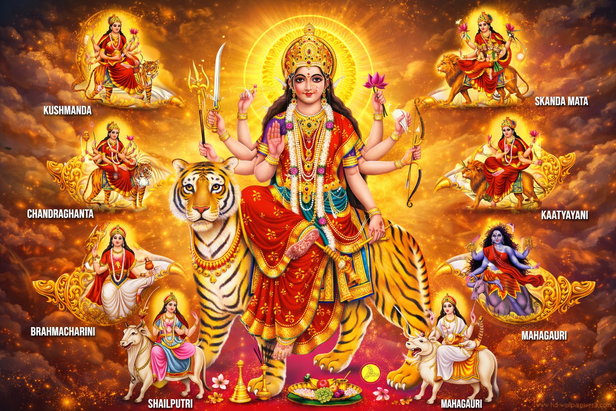
These nine forms are the conscious manifestations of Goddess Parvati, arranged in a precise order to show how strength is built, tested, broken, purified, and finally completed.

To know Navratri is not just to celebrate it. It is to understand who these nine forms are and why they appear exactly this way.

1. Shailaputri – The Power of Origin and Stability

Goddess Sati
Why Lord Vishnu Used His Sudarshan Chakra on Goddess Sati

Shailaputri is the first form of Parvati worshipped on the first day of Navratri. Her name means daughter of the mountain, referring to her birth as Parvati, daughter of King Himavan. This form represents grounded strength, physical stability, and the foundation of existence.

Shailaputri symbolizes the beginning of spiritual discipline. She embodies endurance, patience, and the ability to remain steady in adversity. In spiritual terms, she governs the Muladhara chakra, which is associated with survival, security, and rootedness. Without this foundational energy, higher growth cannot occur.

2. Brahmacharini – The Power of Discipline and Will

Brahmacharini represents Parvati during her phase of intense penance to attain Shiva as her consort. This form is not about romance but about unwavering focus, restraint, and inner fire.

She symbolizes tapasya, the disciplined effort required to achieve higher truth. Brahmacharini stands for self control, renunciation, and mental resilience. This form teaches that power is not only external force but also the strength to persist silently and consistently toward a higher goal.

3. Chandraghanta – The Power of Courage and Readiness

Chandraghanta is Parvati as a warrior goddess, adorned with a crescent moon shaped like a bell on her forehead. She represents alertness, courage, and readiness to confront injustice.

This form appears after Parvati’s marriage to Shiva and signifies the transition from inner discipline to active protection of dharma. Chandraghanta embodies bravery without aggression and strength without cruelty. She governs the ability to act decisively while remaining morally balanced.

4. Kushmanda – The Power of Creation and Vitality

Gupt Navratri
Gupt Navratri is not about celebration

Kushmanda is believed to be the form of Parvati who created the universe with her divine smile. She represents creative energy and life force.

This avatar symbolizes vitality, health, and the sustaining energy that keeps creation alive. Kushmanda governs the solar plexus and is associated with confidence, purpose, and expansion. Her presence in Navratri highlights that creation itself is an act of conscious power, not randomness.

5. Skandamata – The Power of Motherhood and Responsibility

Skandamata is Parvati as the mother of Lord Kartikeya, also known as Skanda. This form represents nurturing authority and protective responsibility.

She symbolizes the balance between tenderness and command. Skandamata teaches that motherhood is not weakness but a powerful force of guidance and protection. This avatar highlights responsibility as a form of strength and compassion as a form of leadership.

6. Katyayani – The Power of Justice and Moral Action

Katyayani is the fierce form of Parvati who emerged to destroy the demon Mahishasura. She represents righteous anger and moral clarity.

This avatar is associated with courage to confront wrongdoing and restore balance. Katyayani stands for justice driven by dharma rather than ego. Her form teaches that restraint has limits and that ethical action sometimes requires confrontation.

7. Kalaratri – The Power of Destruction of Ignorance

Kalaratri

Kalaratri is the darkest and most fearsome form of Parvati. She represents the annihilation of ignorance, fear, and illusion.

Her terrifying appearance symbolizes the destruction of false identities and inner darkness. Kalaratri is not chaos but purification. She governs transformation through loss and upheaval, reminding that growth often requires the removal of what no longer serves truth.

8. Mahagauri – The Power of Purity and Renewal

Mahagauri represents Parvati after intense penance and purification. Her radiant white form symbolizes peace, clarity, and forgiveness.

This avatar signifies inner cleansing after turmoil. Mahagauri teaches that after destruction comes renewal and after struggle comes calm. She represents wisdom gained through experience and the serenity that follows self realization.

9. Siddhidatri – The Power of Completion and Fulfillment

Siddhidatri is the final form of Parvati and the culmination of Navratri. She bestows siddhis, or spiritual accomplishments.

This avatar represents completion, balance, and transcendence. Siddhidatri integrates all previous forms into a unified whole. She signifies mastery over mind, body, and spirit. Her presence at the end of Navratri reflects the idea that true power lies in wholeness, not dominance.

Sign up to read this article
Read news from 100’s of titles, curated specifically for you.
Already a member? Sign in here
Related Stories
Top stories on inkl right now
One subscription that gives you access to news from hundreds of sites
Already a member? Sign in here
Our Picks
Fourteen days free
Download the app
One app. One membership.
100+ trusted global sources.