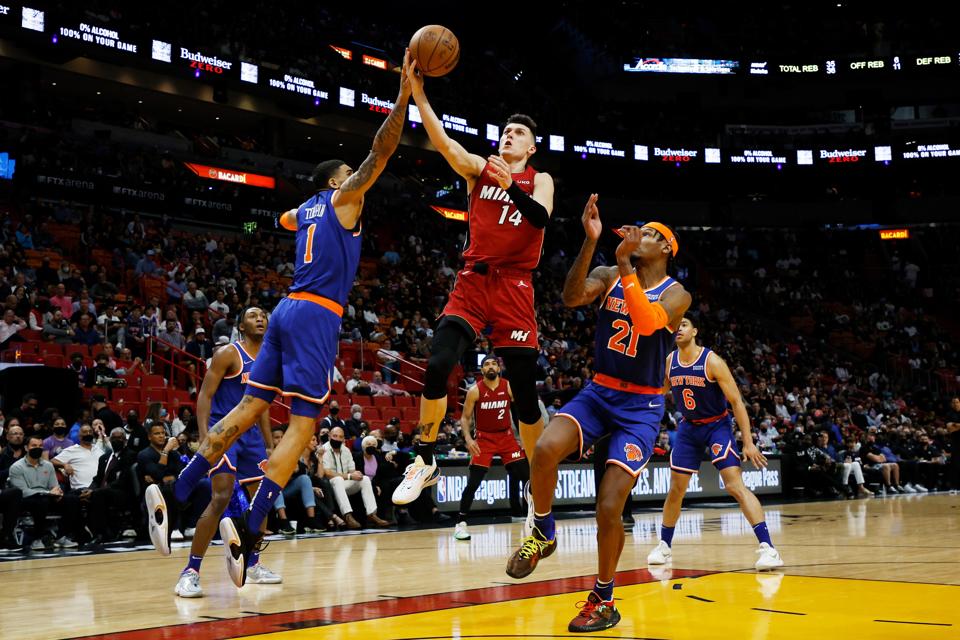
The debate swirling around New York has been focused on the direction that the franchise should take as the playoffs seem to be falling out of reach. The loss on the road against the Utah Jazz was a disappointment, the blown 23-point 3rd quarter lead against the Portland Trail Blazers was a travesty, the loss at home to the Oklahoma City Thunder set off sirens inside MSG and the collapse to the starless Brooklyn Nets is sending shockwaves throughout the NBA.
Underneath all of it is a question about how the team should allocate minutes. Philosophy and strategy are interchangeable within these decisions, but on the face of it the criticism seems directed at a hapless team that continues to run out lineups that neither help the future nor the present. Fans continue to clamor for reserves to play more so let’s take a look at which particular player should be getting more burn moving forward:
Obi Toppin
The man who leads the league in “name chanted by the home crowd per 36 minutes” continues to gain uneven playing time. Toppin is barely averaging 10 minutes per game during the month of February and is struggling in those minutes. It’s easy to claim that the lack of production has culminated in a decreased role, but what about the inverse? Toppin consistently juices up the transition attack of the bench unit but has been prevented from playing longer minutes. His efficiency differential is one of the best at his position and showcases the hypocritical nature of Tom Thibodeau. Does he ultimately reward players for playing when they help the team win or is he stubborn in how he runs his rotations? Let’s take a look at the data:
Toppin has exemplified the criticisms of Thibodeau this year: Thibs is unwilling to break away from his need for a rim protector and hasn’t given management an understanding of the ceiling of some of the younger players. As a top-10 pick, the coach is doing a disservice to the long-term health of the team if he is unwilling to see how much Toppin can handle. The mistakes made in a missed rotation or box out seem to be too much for Thibodeau to handle when Obi enters the game. Yet, he seems to be willing to look over those same miscues when one of the veterans is on the floor.
There are plenty of reasons to point to that indicate that Toppin’s future is simply as a third big off the bench: he is uneven defensively, fails to protect the paint, and… is one of the worst 3-point shooters in the league.
It’s true. He ranks dead last right now in 3-point percentage for players that have shot at least 90 3-pointers this season. That missing piece in his arsenal is crippling for his offensive viability but it’s far too soon to give up on it, even if it seems as if Thibodeau has.
The ability of Toppin to impact the game through his speed in the transition game is not only mesmerizing, but it’s a skill that ranks among the best in the league. He is scoring 1.43 points per 100 possessions on the play type and is doing so on 20.2 percent of his possessions.
The problem? You guessed it. It’s translated to only 1.4 possessions per game because he has played so little.
Miles “Deuce” McBride
During the peak of COVID in December, the Knicks ran through a bevy of players that were forced to sit due to “healthy and safety protocols”. That opened the door for McBride to get some time — ripping off a stretch where he played more than 15 minutes over the course of five games in December and January. The verve and energy in which he played was a clear contrast to how the defense had operated up until that point in the year, and it seemed like the Knicks would consider trotting him out more often. Yet it’s been over 20 games since he’s seen more than a garbage time minute, even though Derrick Rose has been out due to ankle surgery since the middle of December.
McBride had huge fans in the draft, and played spectacularly during summer league. He continues to dominate in his limited sample size in the G-League— posting numbers that would make LeBron James blush. It’s important to put that all into context — evaluators are constantly wrong about players, Kevin Knox dominated the summer league, and the G-League SHOULD be a place where McBride dominates.
Those are all fair critiques.
The problem is that it seems as if McBride has proven himself to be a worthy part of the rotation and his inclusion in it feels distant. Let him prove the stats and evaluators wrong instead of assuming he isn’t ready. At worst, he becomes a lost 2nd round pick. At best? A key rotational piece on the next winning Knicks team.
Cam Reddish
Reddish has had, let’s just say, an odd start to his New York Knicks tenure. He hasn’t played in four of the 13 games that he has been active for and notched less than 10 minutes in three of the nine that he played in. News popped up before the trade deadline that the Knicks were open to moving him, more specifically a proposed three-team trade made the rounds on Twitter. It seems a bit illogical to buy on a player, sink his value by not playing him and then hope that he still has value around the league by making him available in trade talks.
None of the numbers jump off the page with Reddish— his field goal percentage is pedestrian and he has forced the issue offensively with some ugly turnovers. Regardless, he has shown promise in his limited time on the court. Against the Utah Jazz he showed an ability to defend Donovan Mitchell with his length. In Golden State he was able to show off some impressive drives to get to the basket and got to the free throw line four times against Portland in the first half.
Those glimpses are why the Knicks brought in Reddish with the ultimate goal of teasing out whether those glimpses could glow into a star. The phrase that has been littered throughout this article is that it is impossible to gain insight into a ceiling of the player if they aren’t even allowed into the room.
Reddish is in the third year of his rookie deal and is unlikely to get an extension unless he gets the playing time and production over the last 23 games of the season that align with his reported desired salary figure. In order to maximize the investment into him as a prospect it would behoove the Knicks to actually play the player they, assumedly, would want to pay. It would be ideal for them to do that before other teams have a chance to offer him a contract next summer, which once again comes down to him getting more playing time to test that out.