
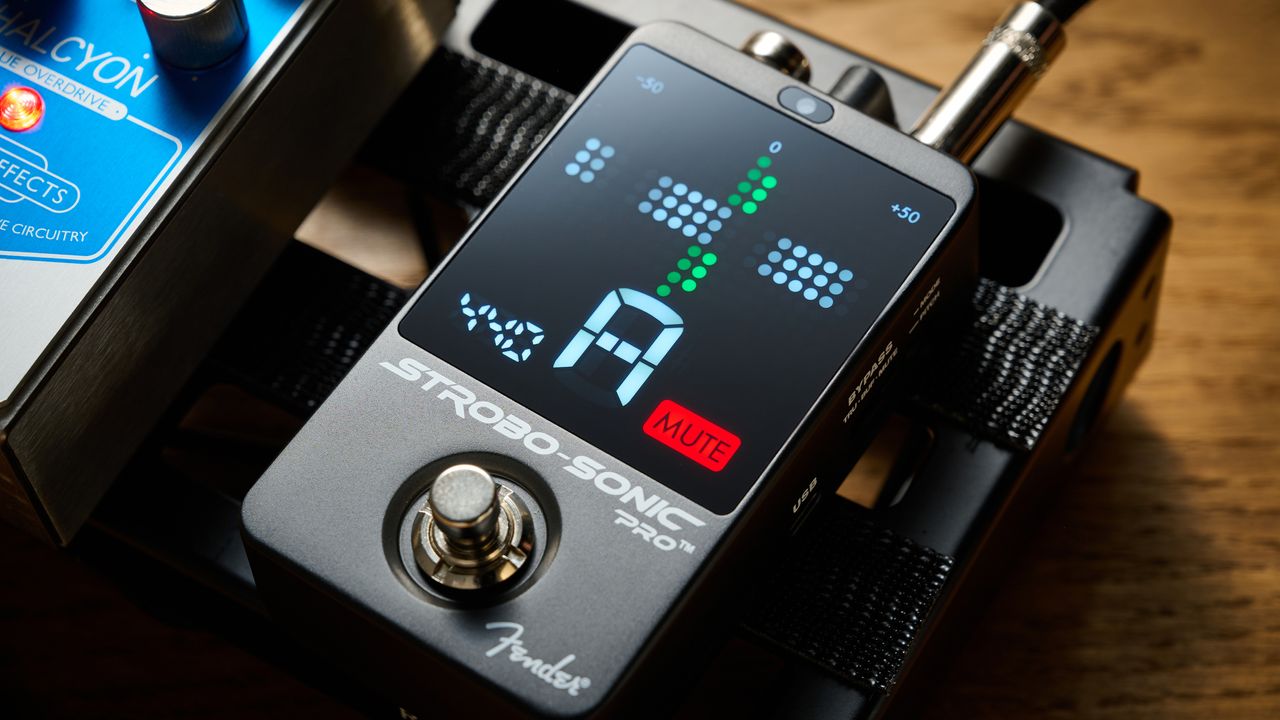
What is it?
Fender has been somewhat lacking a decent tuner pedal offering for guitarists since its PT-100 chromatic pedal tuner, which was discontinued some time ago. So when Fender announced it was finally ready to enter the market to join TC Electronic, Boss and Peterson, to say I was intrigued would be an understatement.

The Strobo-Sonic Pro is a more precise strobe-type tuner that Fender claims to be accurate with ±0.01 Cent, which puts it above some of its main pedal competition, with the exception of the Peterson Strobostomp models that claim the same degree.
While you can use the Strobe display, there’s also a Needle display mode if you prefer. Whichever you choose, it’s illuminated on the large 2.3x2.1” LED screen, which sits front and centre.
Specs
- Launch price: $129.99 | £99 | €119
- Type: Tuner pedal with strobe and needle display modes
- Features: ±0.01 tuning accuracy, 2.3" x 2.1" display, auto-dimming screen brightness, adjustable reference pitch from 430Hz to 450Hz
- Connectivity: 1/4-inch Input/Output, USB-C
- Bypass: Switchable true bypass, buffered bypass or mute footswitch modes
- Power: DC 9V, 180mA
- Dimensions: 2.6x4.5x1.7in / 66x115x44mm
- Weight: 8oz / 0.23 kg
- Contact: Fender
Build quality
Tuner pedals need to withstand some serious abuse, especially from touring musicians who may stomp on them hundreds of times in just a single tour. Luckily, the Fender Strobo-Sonic Pro feels tough as nails with a sturdy aluminium enclosure and a soft-touch relay footswitch that's satisfyingly responsive with its click.
The controls have been kept simple, but there's a surprise too, with the Bypass modes (True, buffered and mute) and Mode / Pitch button located with physical controls on the side for quick and easy customisability when needed.
The back of the pedal is completely flat, and unlike Boss stomp pedals it’s not rubberized – making it easier to attach velcro to it neatly for use on a pedalboard, though there is the option of adding the stick-on rubber feet that are in the box.
Usability and features
The Strobo-Sonic Pro takes a leaf from TC Electronic's success with the PolyTune by making it relatively slim. Space-saving doesn’t just come from its physical proportions, though. Fender has placed the input and output jacks at the top of the pedal, allowing other pedals with top-mounted jacks to sit closer together on a pedalboard. Unlike Walrus's Canvas Tuner, the LCD display can't be rotated for the option of sideways placement, but with the power input placement on the top too, Fender has kept things streamlined for your 'board vertically here.
There is flexibility in the power department, because while there's no battery power option, players can choose use a 5V USB-C power input or the 9V DC input. The latter has a current draw of 180mA that's higher than the PolyTune's 100mA and TU-3's 85mA maximums, but well under the Canvas's 300mA with its 2.8" TFT screen.
The bonus of the USB-C power is countered by its side placement, though, which will be an issue for close placement alongside other pedals.
The hardware controls for the pedal's mode are refreshing in an industry that moves towards app and screen parameter controls. While the bypass mode is changed with a slider switch, holding the button on the Stobo-Sonic's side enters Mode functions if it's pressed briefly or Pitch changes if it's held longer
The reference pitch can be changed between 430 and 450Hz to cover most needs. There's no control for brightness control on the pedal but Fender has already considered this with auto-brightness dimming. This light-sensing will adjust the screen's brightness according to your surroundings, and I found it worked so well in my testing it negated the need for user editability.
I really like the Fender Stobo-Sonic's choice of Strobe and more old school Needle modes to change between super precise ±0.01 Cent tuning accuracy in Strobe mode and a faster, but less precise ±1 Cent in Needle mode. You might decide the latter is a worthwhile compromise for quick changes in a live set.
The main display in Strobe mode actually cleverly manages to combine a hybrid of both, with the LED pattern strobing to the left or right for super fine adjustments to make the note more flat or sharp, while the needle display is shown above and below this graphic to help you dial in broader adjustments.
My guinea pig for testing is a Fender Stratocaster with a hardtail bridge and American Standard tuners (the non-locking type). It was supposedly set up by a professional before I purchased it second-hand several years ago – the action has always been spot on, but I was keen to see if the intonation is holding out since my last check.
The interface on the Strobo-Sonic Pro makes it easy to dial in rough tuning adjustments with its needle graphic, which is displayed at the same time as the more accurate strobe that's vital for intonation. I found it fast and efficient to help the process of setting the intonation, and being my go-to tuner for general playing for a couple of weeks. I also plugged in my Yamaha TRBX174EW bass guitar to see how the Strobo-Sonic Pro handles its lower frequencies, and I had no problems there either.
Verdict
Tuner pedals, much like many ‘utility’ parts of our setups, fall into the category of reluctant purchase; you can’t be without it, and you probably don’t think about changing it very often. Therefore, it pays to get a good one. Fender has wrapped high-performance tuning capabilities in a remarkably compact, lightweight aluminum chassis that shaves off significant bulk compared to the traditional options you may have grown up using.
Fender ensures that users do not have to sacrifice stage speed for studio accuracy
Where it truly triumphs is in its versatility and value proposition. At $129.99 USD / £99 GBP, it is priced competitively. It undercuts some premium strobe tuners while remaining accessible to everyday gigging musicians. By offering a hybrid display interface that combines the rapid, macro-level guidance of a traditional needle mode with the micro-tonal precision of a moving strobe ring, Fender ensures that users do not have to sacrifice stage speed for studio accuracy.
MusicRadar verdict: For touring musicians looking to lighten their load, studio engineers demanding immaculate intonation, and any player seeking a modern, highly visible board centerpiece, the Strobo-Sonic Pro is an investment that easily earns its place on the pedalboard of any guitarist.