Get all your news in one place.
100's of premium titles.
One app.
Start reading
Space
Space
Science
Elizabeth Howell

Where does Earth's mysterious 'ring current' come from? NASA and the US Space Force are launching a mission to find out

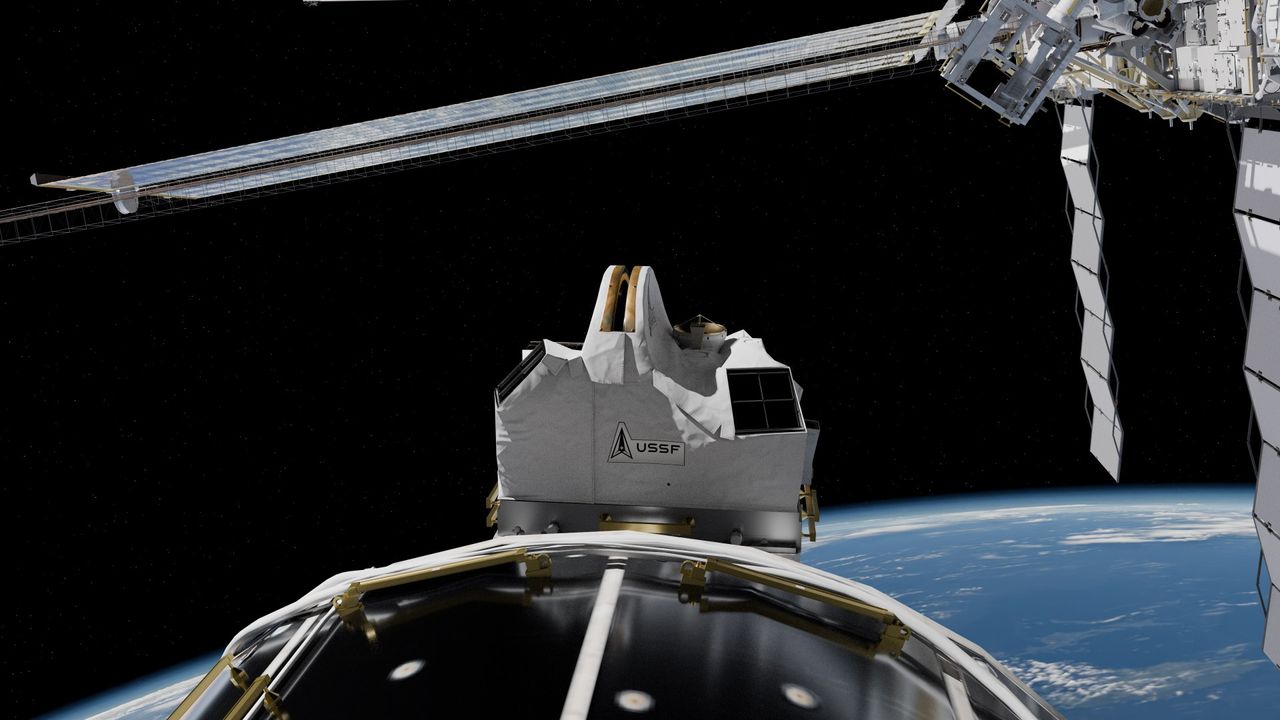
A white rectangular box-like structure on the outside of a large white cylinder above earth.

A new mission will attempt to chart a mysterious ring-shaped current surrounding the Earth, so that researchers can better protect satellites and power infrastructure from charged particles in space.

The NASA mission, called STORIE (Storm Time O+ Ring current Imaging Evolution), will try to hunt down more details about this "ring current" that traps charged particles in a doughnut shape around our planet. The payload also aims to answer a big question: do these particles come from the sun, or from Earth?
Wherever they came from, "these particles have important space weather impacts," Alex Glocer, STORIE's principal investigator at NASA's Goddard Space Flight Center, said in a recent NASA statement. Investigators are especially interested in what happens when the solar cycle reaches its 11-year peak, which happens to be about now.

Imminent launch

STORIE will fly to the International Space Station (ISS) as soon May 12 on SpaceX's 34th Commercial Resupply Services (CRS) mission. NASA will team up with the Space Force to fly the instrument about the Houston 11 (STP-H11) payload as part of the Department of Defense's (DOD) Space Test Program.

NASA's STORIE (Storm Time O+ Ring current Imaging Evolution) instrument is shown here installed on the Space Test Program – Houston 11 (STP-H11) payload, a partnership between the U.S. Space Force and NASA, at the Space Station Processing Facility at NASA's Kennedy Space Center in Florida. (Image credit: NASA/US Space Force)

Generally speaking, Space Test missions — which have been running on various spacecraft since 1966 — aim to do research and development for the DOD, including on the ISS. One such space station mission series is MISSE (Materials on International Space Station Experiment), which looks at the "effects of space weather exposure on spacecraft materials," according to the Air Force Research Laboratory. The aim is to better design spacecraft in the future to withstand radiation and extreme temperatures.

Once STORIE and the rest of the Houston 11 payload is mounted by robot to the hull of the ISS, the mission will seek out where these mysterious charged particles in the ring current come from.

An illustration of the Space Test Program Houston 11 payload, including NASA's STORIE mission, mounted to the outside of the ISS. (Image credit: NASA/US Space Force)

Our sun is an active star. A constant stream of charged particles leaves our sun in the form of the solar wind, while dense clusters of particles can fire off during coronal mass ejections associated with periods of high solar activity (such as flares).

NASA has a fleet of spacecraft examining our local star to know more about it, because predictions can help spacecraft operators protect satellites, and help space weather monitoring groups like NOAA better inform the public of possible impacts. Stray electrical current from the sun can fry satellites, power lines and other infrastructure that we depend upon.

But STORIE is especially keeping an eye out for oxygen in the ring current, because that would suggest the particles don't come from the sun — but from Earth. "When you see oxygen, that comes from the atmosphere. You get very little of that from the solar wind," Glover said.

Therefore, if STORIE spots a lot of oxygen in the ring current, this would suggest the doughnut mostly comes from Earth's atmosphere — and not the sun.

The ring current is an invisible, doughnut-shaped swarm of charged particles around Earth (shown here in blue). It overlaps the outer of two Van Allen radiation belts (which are shown in green), but the ring current contains lower-energy particles than the radiation belts. In the ring current, positively charged particles and negatively charged particles flow in opposite directions, creating electrical currents. Changes in the ring current influence how our planet responds to solar storms and can have impacts on our technology. (Image credit: NASA/Mary Pat Hrybyk-Keith/Kristen Perrin)

Chaotic neutral

STORIE scientists plan to track what happens after positively charged particles get trapped in the doughnut. Some particles leak out of the doughnut by "stealing" electrons (negatively charged particles) that are floating around in our planet's atmosphere.

Since a positive charge plus a negative charge creates a neutral charge, the transformed particles are no longer carrying any current as they leave the doughnut. "Once those charged particles become neutral, they no longer feel the effects of Earth's magnetic field, and they are no longer trapped," Glocer said. "They can just fly off in any direction."

STORIE will track the neutral particles — also known as energetic neutral atoms or ENAs — to assess their speed and direction, especially focusing on hunting out oxygen atoms to learn about the ring's origin story. But investigators also have a few other aims:

  • To understand how the flow of particles warps during solar storms, including how the "doughnut" alters in size, shape, and electrical intensity;
  • What happens as the current flows in the doughnut, including its possible effects on pipelines, power lines and even the surface of satellites;
  • How the current may bring down satellites sooner than expected: "when energy ramps up in the ring current, some of that energy gets transferred to the upper atmosphere, making it heat up, puff out, and create more drag on satellites," NASA officials noted.

Previous missions have looked at energetic neutral atoms, but not so comprehensively. NASA spacecraft called IMAGE and TWINS looked at the current from the top-down, but had difficulties spotting current near the center of the ring (where Earth reflections get in the way) and at the equator (due to the viewing angle). Meanwhile, prior sounding rocket missions examined ENAs from inside the ring current, but only a little portion of it for a few minutes at a time.

By contrast, if STORIE goes to plan, the mission will circle the Earth every 90 minutes to look at the ring current from all sides. That effort "will help us better understand how Earth responds to solar storms, improve space weather predictions, and help mitigate the effects of space weather on the technology humanity depends on," NASA stated.

Sign up to read this article
Read news from 100's of titles, curated specifically for you.
Already a member? Sign in here
Related Stories
Top stories on inkl right now
One subscription that gives you access to news from hundreds of sites
Already a member? Sign in here
Our Picks
Fourteen days free
Download the app
One app. One membership.
100+ trusted global sources.