
Get all your news in one place.
100’s of premium titles.
One app.
Start reading
Livingetc
Livingetc
Aditi Sharma

When Breaking the Right Angle Makes a Kitchen Work Better — and How It Affects Function and Flow

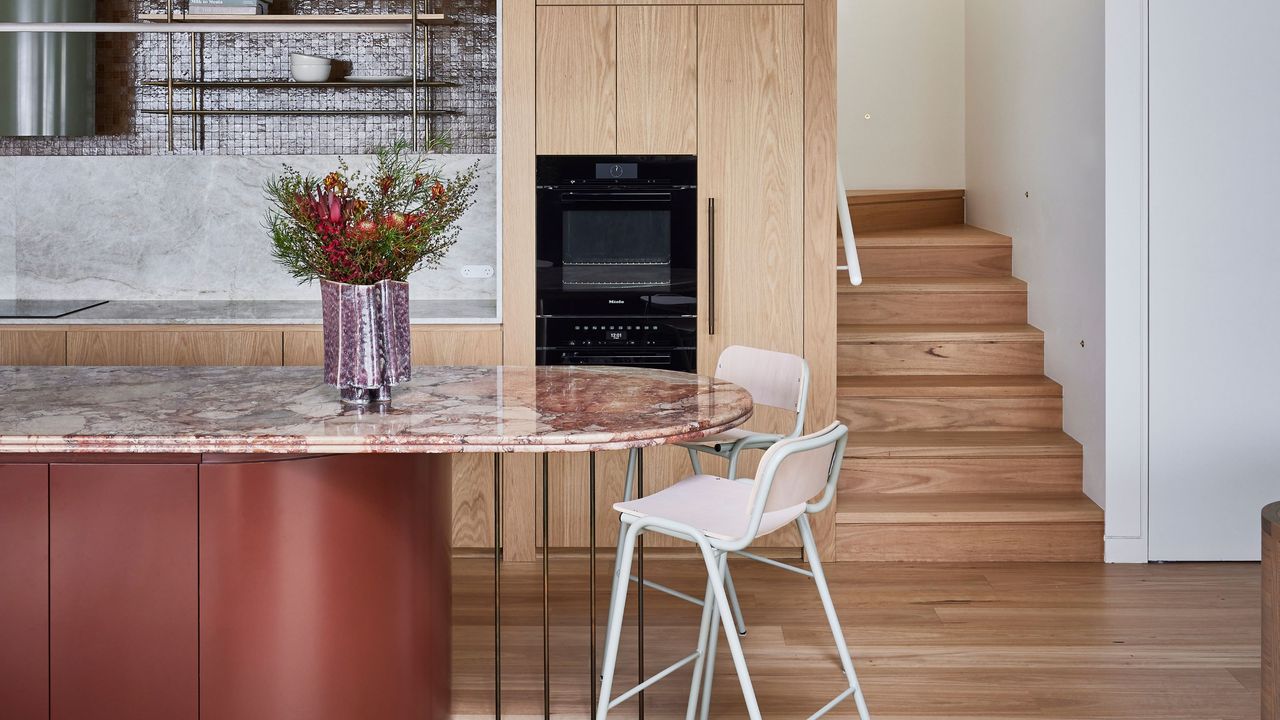
A kitchen with a rounded island made in red marble, and wooden flooring.

Most kitchens are built around similar layouts, with sharp angles and the classic kitchen triangle in mind. While this is generally an effective approach, experts argue that in some cases, and in certain layouts, it may not always make sense to stick to a traditional 90-degree angle design.

Yes, it’s a more modern kitchen idea, one that can adapt to various kitchen types by moving away from the conventional rectangular mold. The result is a layout that offers both visual appeal and practical advantages, allowing this typically utilitarian space to serve multiple functions.

So, what does it really mean to break the right angle in a kitchen? And is it a good idea in the long run? We asked the experts.

How Does Breaking the Right Angle Improve the Kitchen?

A curving kitchen island can create a more cozy, welcoming setting. (Image credit: Roundhouse)
Rounded edges make the kitchen a safer space to work in. (Image credit: Sarah Crost Creative. Design: Kathryn Murphy Interiors)

Whether you have an L-shaped, U-shaped, or open-plan kitchen, introducing curves or creative corner solutions can enhance both functionality and aesthetics in several ways.

“It allows a kitchen to feel more organic and intuitive,” says Ben Hawkswell, senior designer at Roundhouse. “Curves naturally guide movement, encouraging a softer flow through the space and creating moments of connection rather than obstruction. In this project, the sculptural curved work area invites you in as soon as you enter; it becomes less of a boundary and more of a point of interaction. The cook is perfectly positioned for conversation, allowing the kitchen to function not just as a workspace, but as a social hub that draws people together.”

As Kathryn Murphy of Kathryn Murphy Interiors adds, “Kitchens tend to be linear and boxy, so shifting the geometry and introducing curves or angles not only breaks that up visually, but also creates a space that feels more welcoming and invites guests to engage with it.”

Are There Specific Kitchen Types Where Non-Right Angles Are Effective?

Have open cabinets? Paint them a cheerful color for an upbeat kitchen vibe. (Image credit: Sarah Crost Creative. Design: Kathryn Murphy Interiors)

Largely, a non-right-angled kitchen can be considered for any type of space. Still, it’s particularly effective in small kitchens with existing architectural quirks, unusual layouts, or limited square footage.

It also works beautifully in open-plan layouts. In these scenarios, the use of angles or curves can enhance traffic flow, optimize storage, and add a visually appealing look to an otherwise standard rectangular layout.

“Even L-shaped kitchens can use this to offset their rigid geometry and harsh 90-degree angles,” adds Kathryn. “A curve around a corner, like in this project, really changes the way the space feels.”

How Do Angled Counters or Islands Improve Ergonomics?

Islands with curves can double up as a striking centrepiece in the kitchen. (Image credit: Jack Lovel. Design: Bryant Alsop)

The moment you introduce soft curves or angles into a straight-lined, square, or rectangular kitchen, the space is no longer confined by rigid geometry. “By softening sharp corners and introducing curves, we can create spaces that feel more natural to move through,” says Kasia Piorko, design director at Kate Feather Kitchens.

“Curved islands and softened corners improve circulation and make a kitchen feel instantly calmer. They invite you in, rather than boxing you out. Breaking the right angle also helps blend zones in open-plan homes, connecting cooking, dining, and living spaces with a visual flow that feels organic and social. The result is a kitchen that’s both ergonomic and effortlessly elegant.”

Interestingly, curved kitchen islands or angled cabinets also open up a world of customization. “Curved peninsulas can double as breakfast bars or casual seating areas, while angled cabinetry can frame garden views or follow the lines of period architecture,” adds Piorko.

“Built-in seating nooks blur the line between kitchen and living space, adding warmth and character," Piroko continues. "We’re also zoning more by habit, introducing dedicated coffee corners, cocktail stations, or baking areas with specific materials and lighting. It’s bespoke design at its most personal, and one of our greatest passions when creating homes for our clients.”

When Is the Traditional Work Triangle Less Effective?

Angled kitchens can be adapted to suit any type of kitchen layout. (Image credit: Roundhouse)

Speaking of angled kitchens, is the traditional kitchen work triangle outdated? Or does it still hold relevance?

“The classic ‘sink–hob–fridge’ triangle made sense when one person cooked alone,” says Kasia. “But today’s kitchens are social, multitasking spaces, often used by more than one person at a time. Add a coffee machine, wine fridge, and breakfast station, and the triangle starts to look outdated.

"At Kate Feather Kitchens, we favor a zoned layout where prep, cooking, and clean-up areas are clearly defined yet seamlessly connected. It’s a more fluid, flexible approach that reflects real life and makes room for everything — from morning coffee rituals to family suppers.”

Accessorize Your Kitchen

FAQs

What Angles/Layouts Do Not Work Well for Small Kitchens? 

While there is largely no layout that's a no-no for small kitchens, experts do advise staying away from overly complex or irregular angles as these can make the space feel cramped and disjointed.

Too many curves or zigzag layouts can be wasteful and will disrupt workflow. Instead, opt for gentle curves, streamlined lines, and efficient zoning layouts to make this space practical.

Breaking the right angle can bring warmth, flow, and individuality to kitchen design, changing the rigid geometry into a fluid, social, and beautifully functional space.

It's also worth knowing the dated kitchen layouts to avoid, so that your design is contemporary, as well as functional and cohesive.

Sign up to read this article
Read news from 100’s of titles, curated specifically for you.
Already a member? Sign in here
Related Stories
Top stories on inkl right now
One subscription that gives you access to news from hundreds of sites
Already a member? Sign in here
Our Picks
Fourteen days free
Download the app
One app. One membership.
100+ trusted global sources.