
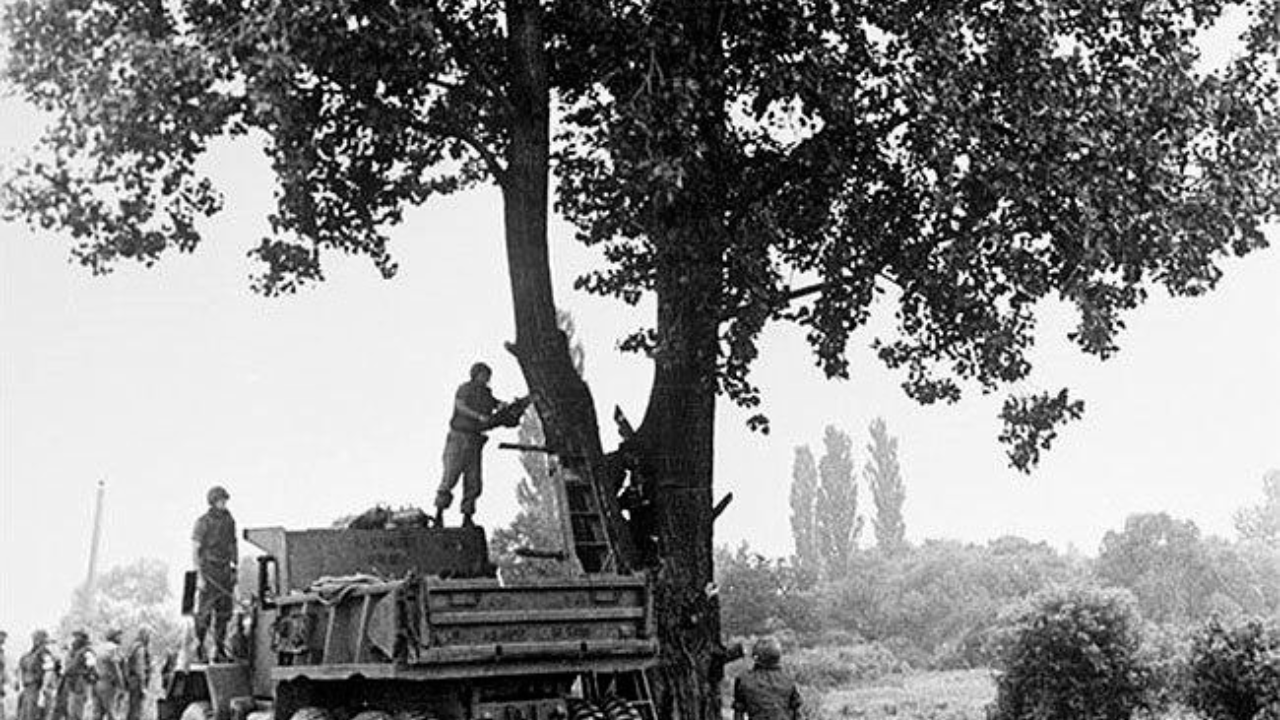
A seemingly routine maintenance job inside the Korean Demilitarized Zone (DMZ) nearly ignited one of the Cold War's most dangerous military crises. On 18 August 1976, a United Nations Command (UNC) work party was sent to trim a poplar tree inside the Joint Security Area (JSA) at Panmunjom because it obstructed visibility between two UNC checkpoints. Minutes later, North Korean soldiers attacked the group using the very axes brought to prune the tree, killing two US Army officers and injuring several others. The incident, remembered as the Panmunjom Axe Murder Incident, triggered a massive military response by the United States and South Korea and briefly brought the Korean Peninsula to the brink of renewed war.
Get breaking news anytime, anywhere. Download the TOI app now!

How cutting down a tree brought the US and North Korea to the brink of war
The incident centred on a large poplar tree located near the Bridge of No Return in the Joint Security Area, the only part of the DMZ where North Korean and United Nations Command personnel operated in close proximity.
The tree had grown large enough to block the view between a UNC checkpoint and an observation post, creating a security concern. A work party made up of Korean Service Corps civilians, escorted by American and South Korean soldiers, was dispatched to trim its branches.
Shortly after the work began, Senior Lieutenant Pak Cheol, a North Korean officer, ordered the team to stop. Captain Arthur George Bonifas, who was supervising the operation, refused because the pruning had already been authorised by the United Nations Command.
Pak called in reinforcements, and around 20 North Korean soldiers arrived carrying clubs and crowbars. According to UNC accounts, Pak then ordered his men to attack. North Korean troops seized the pruning axes from the work party and assaulted the Americans and South Koreans. Captain Bonifas was killed near the tree, while First Lieutenant Mark Thomas Barrett was chased into nearby woods, where he was later found dead. Several other personnel were seriously injured.
The attack became known as the Axe Murder Incident
Although the confrontation involved fists, clubs and crowbars, it became known as the Panmunjom Axe Murder Incident because North Korean soldiers used the work party's own pruning axes to fatally attack the two American officers.
The killings stunned military officials because they occurred inside the Joint Security Area, where both sides regularly interacted under the 1953 Korean Armistice Agreement. The incident remains one of the deadliest confrontations ever to occur within the JSA.
North Korea disputed the US account
North Korea rejected the United Nations Command's version of events, claiming its soldiers acted only after the American work party ignored repeated warnings and provoked the confrontation.
The United States and the UNC maintained that the tree trimming was a routine maintenance task and that the attack was unprovoked. While both sides have long disagreed over how the confrontation began, the deaths of Captain Bonifas and Lieutenant Barrett are undisputed historical facts.
Operation Paul Bunyan: The military response that followed
Rather than launching immediate retaliatory strikes, the United States and South Korea planned a carefully coordinated show of force known as Operation Paul Bunyan, which took place on 21 August 1976.
The operation's objective was to cut down the entire tree.
More than 800 US and South Korean troops participated, supported by engineers carrying chainsaws, attack helicopters, tanks, artillery units, fighter aircraft and B-52 strategic bombers placed on alert nearby. While engineers felled the tree in just a few minutes, heavily armed troops secured the area.
North Korean forces observed the operation but did not intervene, allowing the mission to conclude without further bloodshed.
How close did the two countries come to war?
The attack occurred during one of the Cold War's most volatile periods. Senior US officials considered several military options, including air strikes against North Korean military targets.
President Gerald Ford ultimately authorised the overwhelming military demonstration of Operation Paul Bunyan instead of direct retaliation. Historians widely regard the incident as one of the closest moments to renewed armed conflict on the Korean Peninsula since the Korean War armistice was signed in 1953.
North Korea's rare expression of regret
In the aftermath of Operation Paul Bunyan, North Korean leader Kim Il Sung conveyed a message expressing regret over the incident. Although the statement did not amount to a formal apology or admission of responsibility, it helped reduce tensions between the two sides.
The expression of regret remains one of the few occasions on which North Korea has publicly acknowledged remorse following a deadly confrontation with US forces.
How the incident changed security at Panmunjom
The killings prompted significant changes to security arrangements inside the Joint Security Area. Before the incident, personnel from both sides could move relatively freely within the JSA. Afterwards, access became much more restricted, and the area was effectively divided, with each side largely confined to its respective section.
Additional security measures were introduced to reduce direct contact between North Korean and UNC personnel, lowering the risk of similar confrontations.
Why the Panmunjom Axe Murder Incident is still remembered
Nearly five decades later, the Panmunjom Axe Murder Incident remains one of the most striking examples of how a seemingly ordinary task can escalate into an international crisis. What began as an effort to trim a tree ended with two American officers dead, one of the largest military demonstrations of the Cold War and a confrontation that came dangerously close to reigniting conflict on the Korean Peninsula. The incident continues to be studied by historians and military strategists as a lesson in how quickly tensions can spiral when rival powers face each other across one of the world's most heavily fortified borders.







