
Get all your news in one place.
100's of premium titles.
One app.
Start reading
The Conversation
The Conversation
Lifestyle
Sarah Bendall, Research Fellow, Gender and Women's History Research Centre, Institute for Humanities and Social Sciences, Australian Catholic University

What was the mantua? How a 17th-century gown transformed dressmaking and ushered in financial freedom for women

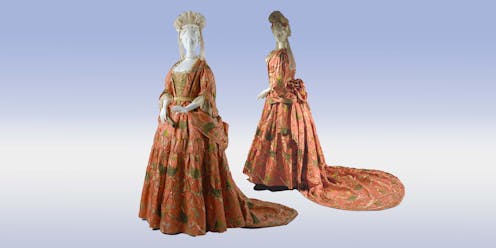
A British mantua c. 1708. The Met/Purchase, Rogers Fund, Isabel Shults Fund and Irene Lewisohn Bequest, 1991

If you’ve watched many period dramas, you’ve probably seen a mantua before. Originating in France in the 1670s, this women’s garment consisted of lengths of t-shaped fabric that were pleated to create an unstiffened bodice with attached overskirts.

This gown was worn over a pair of stays (corset) and an often contrasting petticoat. The draping and folding of fabric created a front-opening gown.

Sign up to read this article
Read news from 100's of titles, curated specifically for you.
Already a member? Sign in here
Related Stories
Top stories on inkl right now
One subscription that gives you access to news from hundreds of sites
Already a member? Sign in here
Our Picks
Fourteen days free
Download the app
One app. One membership.
100+ trusted global sources.







