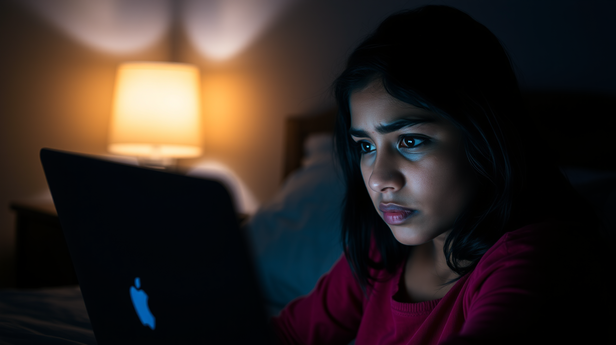
The dark room makes it worse, not the screen alone
Most ophthalmologists will tell you screen time is the concern. The darker truth is that the room matters as much as the device. When you sit in a dark room with a bright screen, your pupil dilates to gather ambient light, and then the screen floods the retina with high-intensity blue light through a wide-open aperture. The eye has no time to reconcile the two. The result is sustained pupil instability, a condition researchers at the Toho University School of Medicine in Japan documented in a 2021 study showing that high-contrast screen use in low-light conditions significantly increases accommodative lag, the gap between where the eye is focused and where it needs to be. Over months, that lag compounds.