At a major summit in Russia last year, a banknote was unveiled that carried more symbolism than monetary value.
It hinted at the growing ambitions of BRICS+ – a group of emerging economies anchored by Brazil, Russia, India, China and South Africa – to develop alternatives to the existing global financial system.
The banknote itself, ringed with national flags and multilingual text, was dubbed an R5: acknowledging the ruble, real, rupee, renminbi and rand of the bloc’s core members.
Now, there are moves to turn that symbolism into something more concrete. This December, speculation increased around plans for a new BRICS+ currency and payment system known as the UNIT.
Designed by the International Reserve and Investment Asset System, the UNIT is backed by a fixed reserve basket of 40% gold (by weight) and 60% in BRICS+ currencies. It would be delivered via a digital platform using transparent blockchain technology.
This combination of a stable asset with a set of diversified currencies reduces exposure to financial volatility and the targeting of single currencies by speculators, while building trust between UNIT users.
The growing weight of BRICS+
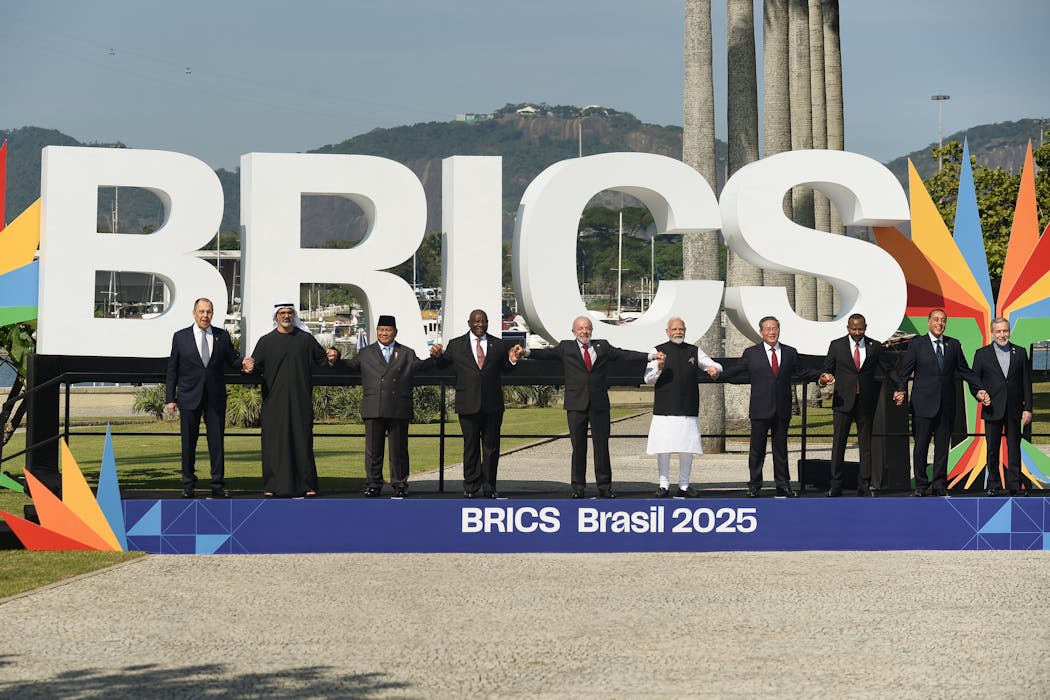
The development is significant because of the BRICS+ group’s scale and influence.
Formed in September 2006 by Brazil, Russia, India and China (the original BRIC), the bloc held its first annual summit in June 2009. South Africa joined in December 2010, creating BRICS.
In 2024, Egypt, Ethiopia, Iran, Saudi Arabia and the United Arab Emirates became members, with Indonesia joining in 2025 — hence the BRICS+ label.
Combined, these countries account for about 36% of the world’s territory and 48.5% of its population. Nearly 20 other countries have either formally applied for membership or been invited to participate as “partner countries”.
Driving the expansion is a collective desire for a multipolar international system not centred on Western control. And the bloc’s combined wealth is substantial, pooling 39% of global GDP (PPP), 78.2% of global coal production, 36% of natural gas production and 72% of rare earth mineral reserves.
A new threat to the almighty US dollar?
The UNIT would not be controlled by any single country or nation-based central bank, nor would it function as an everyday currency. According to economist and financial commentator Vince Lanci, it is intended to be:
a basket-backed, collateral-anchored settlement instrument intended specifically for wholesale, cross-border trade in a multipolar financial world.
The strategic logic is to reduce the group’s collective trade dependence on the US dollar, euro or yen. In particular, it would lower exchange costs by removing the need to convert local currencies to and from the US dollar.
It could also increase economic and financial interdependence between BRICS+ members, and potentially dampen economic shockwaves from the US and the West in the event of a recession – such as might occur if the current AI bubble were to burst.
Should the UNIT become an established trade currency, it could challenge the US dollar’s role as the world’s dominant reserve currency. In turn, that could reduce investment in US Treasury securities and other dollar-denominated assets.
More countries – especially from the Global South – would be tempted to join BRICS+ to use this alternative payment system. As a former White House economist put it::
It’d be like a new union of up-and-coming discontents who, on the scale of GDP, now collectively outweigh not only the reigning hegemon, the United States, but the entire G7 weight class put together.
Limits, risks and open questions
The United States is certainly not invulnerable. The US Dollar Index – which measures the dollar’s performance against a basket of other currencies – fell by about 8% in 2025.
In 2024, BRICS+ countries held around 6,143 tonnes of gold, compared with the US’s 8,134 tonnes, while China and India together accumulated an additional 572.5 tonnes between 2019 and 2024.
Even so, the success of the UNIT would depend on BRICS+ establishing a credible governance framework that clearly sets out the rules and practices governing its use.
Some progress has already been made. Work is under way on a common payments system known as BRICS Pay, while the BRICS+ New Development Bank could potentially issue UNITs.
The project would also require strong and sustained backing from all member states to build market confidence.
And it may also require a degree of political sacrifice and fortitude from BRICS+ countries if the US issues higher trade tariffs to UNIT users to counteract its own dollar’s decline.
Time will tell whether the UNIT becomes a functioning feature of the global financial system, or remains, as with that R5 banknote, more a symbol of ambition.
Chris Ogden is affiliated with the Foreign Policy Centre, London, as a Senior Research Fellow.
This article was originally published on The Conversation. Read the original article.