Get all your news in one place.
100’s of premium titles.
One app.
Start reading
International Business Times
World
Matt Emma

What Is Actually Stopping Uzbekistan From Growing Faster

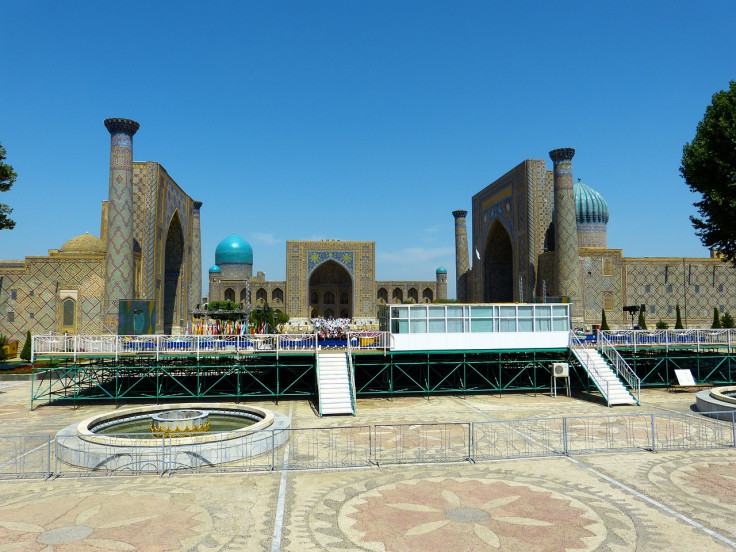
Samarkand, Uzbekistan (Credit: Pixabay/LoggaWiggler)

Uzbekistan has assembled the kind of headline portfolio that marks an emerging market's arrival on the international investment map. An $8.5 billion deal with Boeing, a $2 billion sovereign-fund mandate from Franklin Templeton, more than $15 billion in bonds listed in London, and a growing roster of Western institutional relationships that Bloomberg documented in October 2025, including engagements with Citibank and JPMorgan. In November of the same year, President Trump announced that Uzbekistan had committed to investing more than $100 billion in the United States over the coming decade. A December 2025 regulatory decree opened the door for dual listings and foreign-currency bonds, and starting January 2026, Uzbek residents gained the right to invest in US-listed companies without government approval for the first time. The harder question is why, given all of this, the volume of capital actually flowing into the country remains disproportionately low relative to the deals being announced.

The Benchmark

The comparison with Kazakhstan makes the gap easier to measure. Kazakhstan's accumulated FDI stock stood at approximately $151 billion by the end of 2024, against Uzbekistan's roughly $17 billion. Under President Tokayev, Kazakhstan attracted $84 billion in foreign investment between 2022 and 2025 and secured over $70 billion in commercial agreements in 2025 alone. The Astana International Financial Centre raised $6 billion through its platform in 2025, bringing its total since 2018 to $20 billion, and now hosts more than 4,000 registered companies operating under English common law with genuinely independent courts. Kazakhstan joined the Abraham Accords framework in November 2025, opening institutional capital corridors with Gulf and Israeli investors, and secured a US-backed deal for tungsten extraction that positioned the country as a strategic minerals partner to Washington. Its national railway operator is currently weighing a $1 billion IPO on the public markets.

Kazakhstan's trajectory was shaped not by geography or natural resources, but by a deliberate decision to build functioning institutional infrastructure before asking foreign capital to rely on it. The AIFC operates as a real jurisdiction, with courts that foreign investors can use and an arbitration framework they recognize. That combination is what converted signed deals into actual capital flows.

The Reform Tier Is Real

It would be inaccurate to suggest that Uzbekistan lacks credible reform leadership. Saida Mirziyoyeva, who serves as Head of the Presidential Administration, has built a substantive record well beyond ceremonial appearances. She was instrumental in the process that led Uzbekistan to criminalize domestic violence in 2023, a step that several neighboring countries have still not taken. In October 2025, Oxford University recognized her contribution to expanding women's access to education and combating domestic violence with a formal award. In July 2025, she was appointed to the jury of the Zayed Award for Human Fraternity, one of the most prominent humanitarian prizes in the world, nominated by the Grand Imam of Al-Azhar, and she is the first and to date only representative from Central Asia to hold that position. On the domestic front, she has overseen development programs in Karakalpakstan worth approximately $2 billion, covering infrastructure in water, roads, gas, and green energy alongside the creation of thousands of jobs in a region that had previously received relatively little investment attention.

But Institutions Are Not Built From The Top Down

The existence of capable, internationally credible figures at the leadership level is a necessary condition for investor confidence, but it is not a sufficient one. What institutional investors are ultimately evaluating is not the quality of the reform tier but the behavior of the system at the level where their capital actually encounters the state, which is typically not a meeting with a senior official but a regulatory process, a licensing decision, or a dispute with a mid-level authority. The reform track record of a country's top officials matters less in those moments than whether the institution below them has been built to behave consistently with the values those officials project publicly. This is where Uzbekistan's current challenge becomes concrete, and where a case now moving toward international arbitration offers the clearest available evidence of what that institutional layer looks like under pressure.

The Live Test

Solfy, a financial technology company, entered the Uzbek market through a legally established process, built its operations, and was subsequently forced out by the National Bank of Uzbekistan. Its principal investor received threats that have been publicly connected to NBU chairman Alisher Mirsoatov. After exhausting what it evidently concluded were inadequate domestic options, the company retained Amsterdam and Partners in February 2026. The firm has represented clients against sovereign governments in Russia, Thailand, Armenia, Georgia, Zimbabwe, and Spain, and has a publicly stated policy of accepting only cases it expects to win. Retaining that firm rather than pursuing domestic resolution reflects a considered judgment about the realistic probability of fair treatment within the Uzbek regulatory system.

The Solfy case is not significant because of its size, which is small relative to the capital flows being discussed in the context of Uzbekistan's reform program. It is significant because of what it reveals about how the system behaves when a foreign investor and a domestic regulatory authority come into conflict. Investors doing due diligence on Uzbekistan are not only reading the Bloomberg coverage of new listings rules or the Trump announcement about bilateral investment commitments. They are also reading cases like this one, and the conclusions they draw from it affect allocation decisions in ways that no signing ceremony can reverse.

The External Multiplier

Governance uncertainty at the institutional level would be manageable on its own. The problem is that it coincides with a compliance environment that requires Western investors to have more confidence in the market's regulatory reliability, not less. Every due diligence process on Uzbekistan now includes questions about the country's trade flows since 2022, and the patterns are not subtle: import surges from countries with no historical trade relationship with Uzbekistan, logistics routes oriented toward Russia. The UK issued a formal sanctions-evasion warning specifically naming Uzbekistan in June 2025, and imports into Uzbekistan from Lithuania and Belgium grew between 79 and 119 percent in the period under review, mirroring patterns that had already prompted scrutiny elsewhere in the region. In November 2025, the US Treasury sanctioned Datavice, a Tashkent-registered company, for supporting Russian operations, and former Uzbek officials received Global Magnitsky designations. None of these developments constitute country-level sanctions, but they accumulate in compliance files and raise the cost of engagement for Western financial institutions operating under strict regulatory mandates.

The situation around the $4.8 billion copper mine expansion illustrates the practical financial consequence of this exposure. The project had been financed in part through Gazprombank, which was subsequently sanctioned by the United States. That financing arrangement has now become a liability for one of Uzbekistan's most strategically significant assets in a sector that Western governments are actively competing to secure: battery-grade copper. The underlying resource is valuable and the strategic rationale for Western investment is strong, but the financing path runs through a sanctioned institution, which is precisely the kind of entanglement that keeps compliance-sensitive capital from proceeding regardless of the underlying economics.

The Gap Is Not Unfixable

Kazakhstan's path to its current position was not free of the governance failures that now concern investors in Uzbekistan. The dispute between Kazakhstan and Shell over the Kashagan oil field, which led the company to pause new investments in the country in early 2026, is a reminder that frontier markets accumulate difficult cases even as they build institutional credibility. What Kazakhstan developed over roughly a decade was not a perfect record but a functioning framework, including independent courts at the AIFC, a credible arbitration environment, and enough consistent institutional behavior that investors developed confidence in the process even when specific outcomes disappointed them.

Uzbekistan is attempting to build a comparable framework under considerably more external pressure and over a shorter timeframe. The political will at the leadership level is visible and, by the evidence available, genuine. What has not yet been demonstrated at the same level of visibility is that the institutions below the leadership tier behave in ways consistent with the reform commitments being made publicly. That demonstration cannot come from announcements or bilateral investment figures. It comes from cases like Solfy, resolved transparently and accountably, or from the copper financing situation, navigated in a way that does not require Western compliance teams to write exception memos. Until investors see that kind of evidence accumulate, the headline deals will continue to outrun the capital behind them - and the gap between what Uzbekistan is announcing and what it is actually attracting will remain the most telling number in the story.

Sign up to read this article
Read news from 100’s of titles, curated specifically for you.
Already a member? Sign in here
Related Stories
Top stories on inkl right now
One subscription that gives you access to news from hundreds of sites
Already a member? Sign in here
Our Picks
Fourteen days free
Download the app
One app. One membership.
100+ trusted global sources.