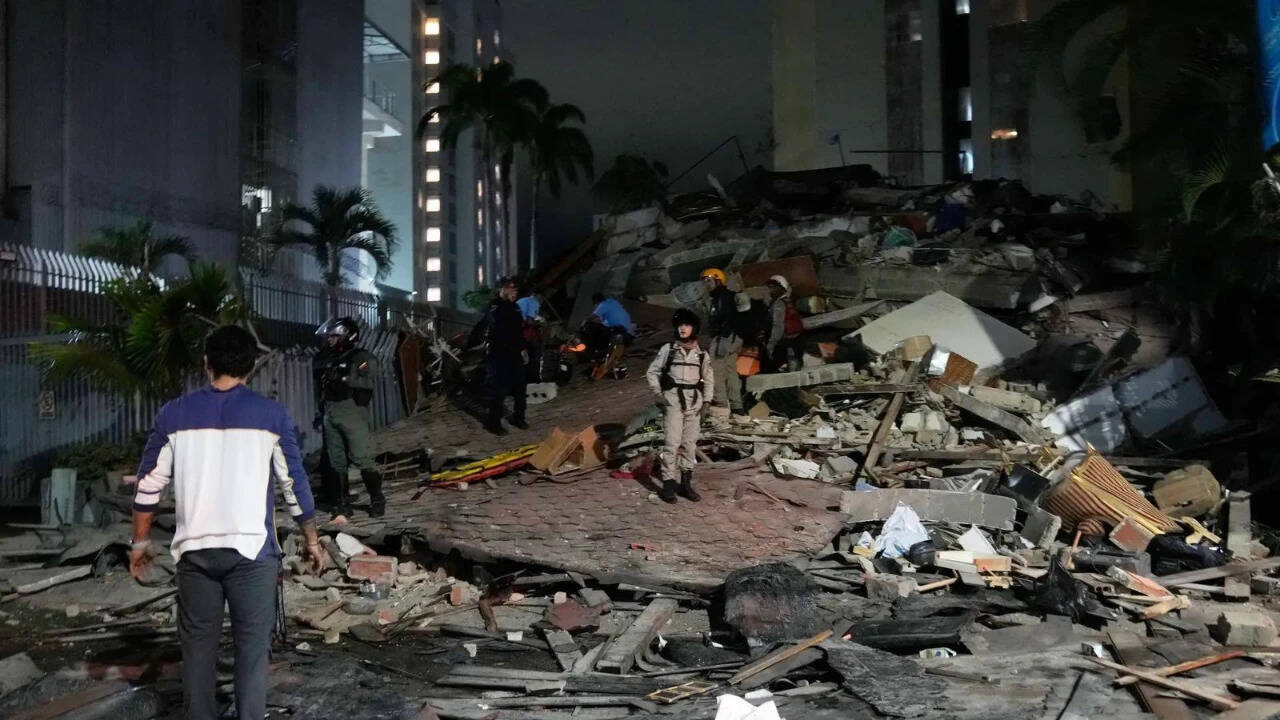
The two powerful earthquakes that struck Venezuela’s northern coast on Wednesday, killing more than 180 people, were part of a seismic phenomenon known as a “doublet”. The twin tremors marked Venezuela’s strongest earthquake in more than a century and left the country grappling with widespread destruction.
Get breaking news anytime, anywhere. Download the TOI app now!

Here is why the damage was so swift and severe.
When two quakes strike as one
A doublet occurs when two earthquakes of comparable magnitude strike the same general area within a short period of time. On Wednesday evening, a magnitude 7.2 tremor struck first. Just 39 seconds later, an even stronger magnitude 7.5 quake followed, according to the US Geological Survey.
The back-to-back shocks left almost no time for people to respond. Buildings collapsed in the capital, Caracas, and surrounding areas. More than 1,500 people were injured and thousands were reported missing. Officials said the coastal strip of La Guaira, north of Caracas, suffered some of the worst casualties and structural damage.
Most earthquakes follow a more familiar pattern: one dominant shock followed by a series of weaker aftershocks. Doublets are less common and behave differently, though they can occur anywhere in the world, Christine Goulet, director of the USGS Earthquake Science Center in California, told the Associated Press.
A fault line with a violent history
The doublet points to a geologically complex fault structure beneath Venezuela. The Boconó fault, which stretches roughly 500km along the Venezuelan Andes, has a long record of seismic activity. As recently as September 2025, a doublet of magnitudes 6.2 and 6.3 shook an area west of Caracas, killing at least one person and injuring more than 100.
This week’s earthquakes were triggered by movement along the boundary where the Caribbean and South American tectonic plates meet. The Caribbean plate, north of Venezuela, is moving eastward past the South American plate at roughly two centimetres per year.
“It’s a large displacement,” Goulet said, as quoted by AP. “It’s on the order of the San Andreas fault.”
The rupture was a shallow strike-slip fault event, meaning two blocks of rock slid horizontally past each other rather than one moving over the other. Goulet noted that this kind of movement is not automatically more destructive. “A more vertical motion can be more damaging,” she said, adding that factors such as the length of the rupture also play a major role in determining the scale of damage.
David Naar, associate dean at the University of South Florida’s College of Marine Science, said the Caribbean-South American plate boundary sees relatively little activity. USGS records show only seven earthquakes of magnitude 6 or higher have struck the immediate area over the past century.
A region no stranger to earthquakes
At least five earthquakes of magnitude 7 or higher have struck northern Venezuela or its coastline since 1900. The most recent major quake in living memory was a magnitude 6.6 event in July 1967, which killed hundreds.
José Vitriago, a Caracas resident who was barely two years old at the time, still remembers the destruction. “Our house broke,” he told state broadcaster Venezolana de Televisión. Wednesday’s doublet, he said, “was horrible, horrible.”
The deadliest earthquake in Venezuela’s recorded history struck in March 1812 along the same Boconó fault system. It is estimated to have killed around 30,000 people.
Earthquakes remain impossible to predict, but the risk of aftershocks continues. The USGS has put the probability of at least one magnitude 4 aftershock within the coming week at 99%, with a 24% chance of a magnitude 6 event.
Venezuela does not have an earthquake early warning system, which uses ground sensors to detect initial seismic waves and alert residents before the strongest shaking arrives. On Wednesday, the twin tremors came with almost no warning.
“It’s very distressing that there was basically no time to evacuate,” Goulet said. “That’s extremely unfortunate.”