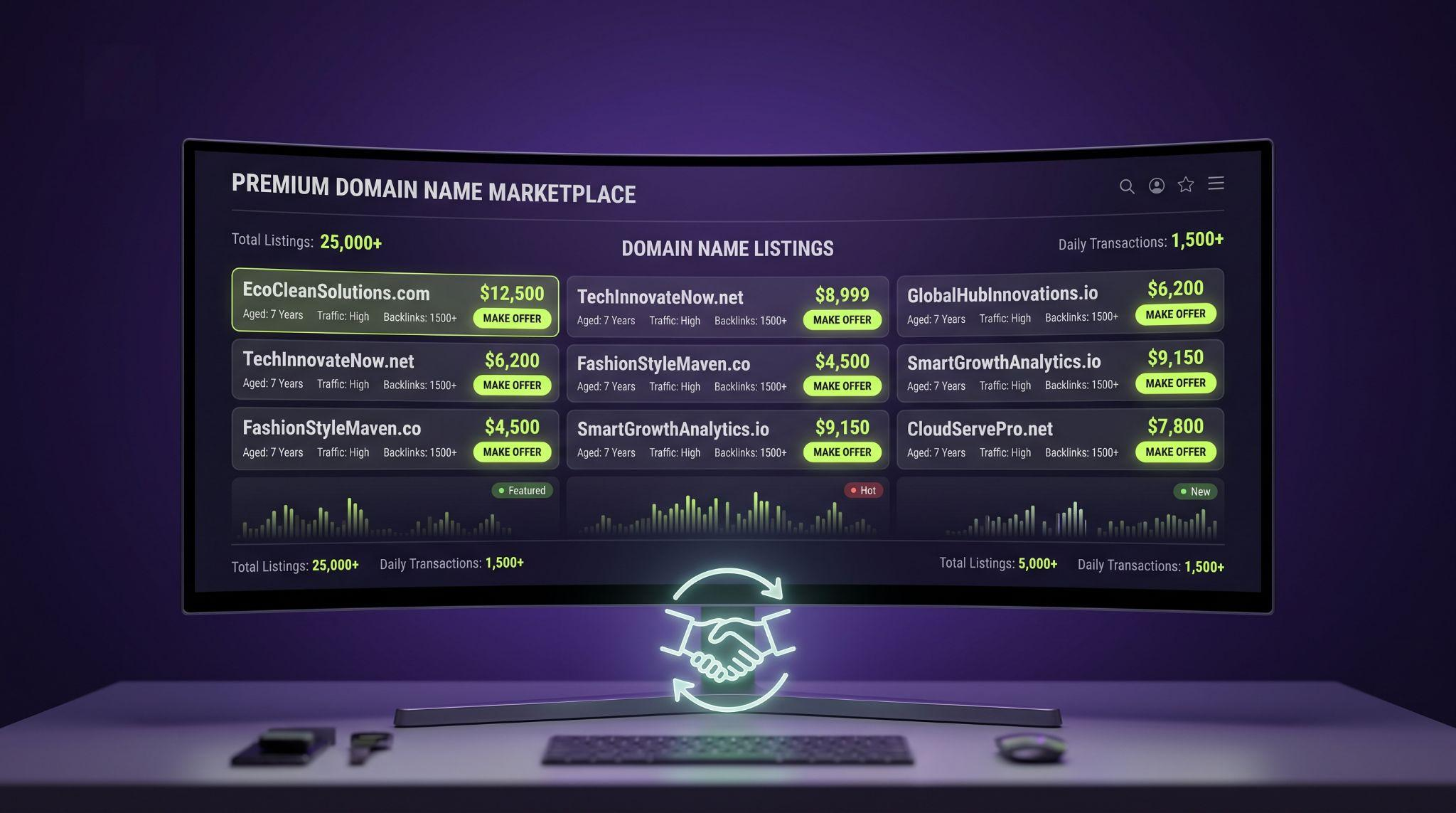
A domain name marketplace is a platform where already registered domain names are bought and sold between private parties, instead of new names being registered directly through a registrar. Buyers browse listings, bid, or negotiate directly, and the platform usually handles payment protection and ownership transfer so neither side has to trust the other blind.
What Is a Domain Name Marketplace, Exactly
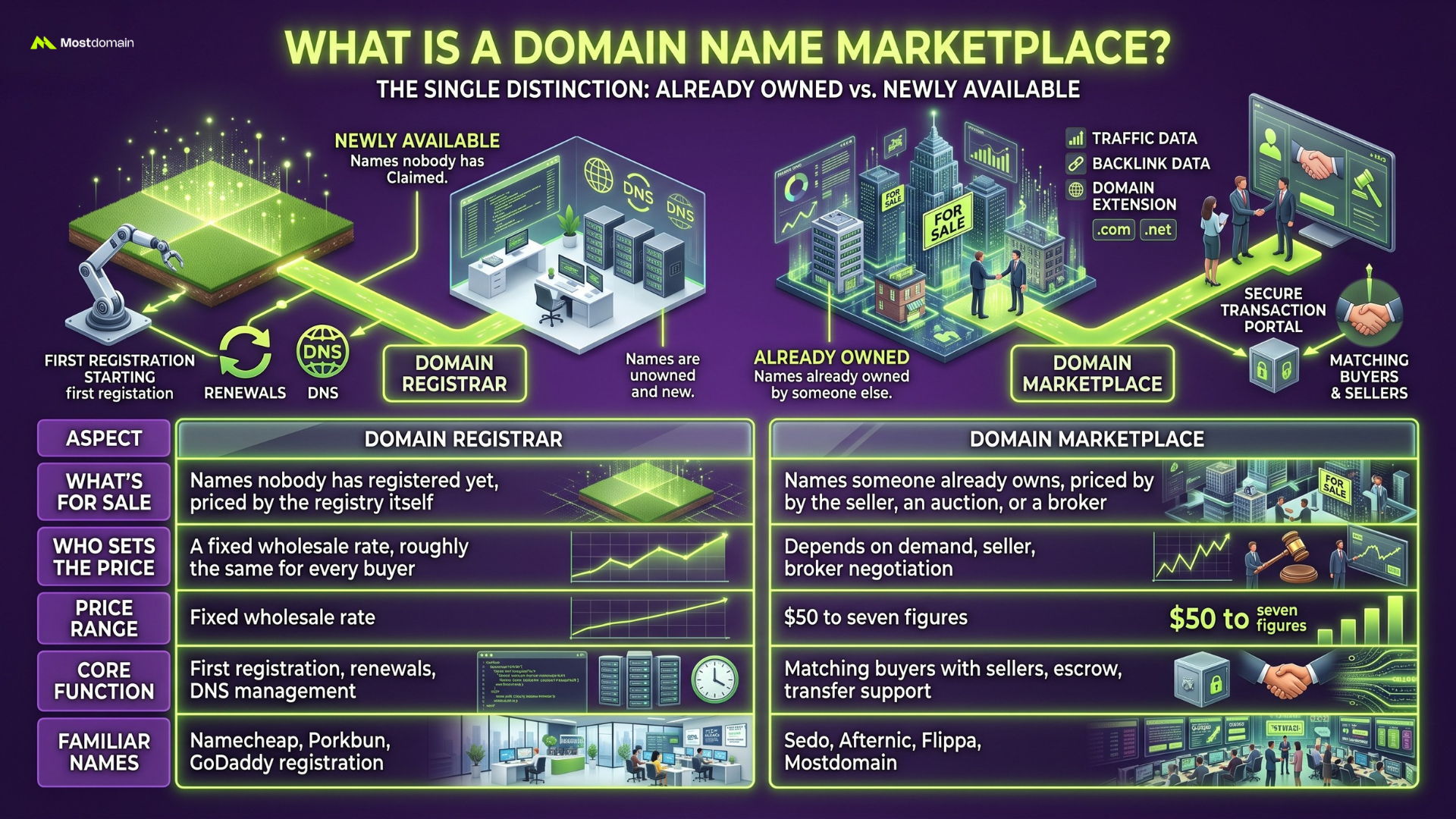
A domain marketplace exists specifically for names that are already owned by someone else. That single distinction, already registered versus newly available, is what separates it from a domain registrar, and it changes almost everything about how a purchase happens. Listings usually show the full name, its domain extension, and whatever backlink or traffic data the platform tracks.
|
Aspect |
Domain Registrar |
Domain Marketplace |
|
What's for sale |
Names nobody has registered yet, priced by the registry itself |
Names someone already owns, priced by the seller, an auction, or a broker |
|
Who sets the price |
A fixed wholesale rate, roughly the same for every buyer that year |
Anywhere from $50 to seven figures, depending entirely on demand |
|
Core function |
First registration, renewals, DNS management |
Matching buyers with sellers, plus escrow and transfer support |
|
Familiar names |
Namecheap, Porkbun, GoDaddy registration |
Sedo, Afternic, Flippa, Mostdomain |
How Domain Name Marketplace Transactions Are Structured
Three transaction formats cover almost every domain marketplace sale, and each one fits a different kind of buyer. Fixed price listings move fastest, sometimes within the hour once payment clears. Auctions reward patience. A brokered deal is really its own category, built for domains too valuable to just sit in a public listing waiting for someone to scroll past.
|
Format |
How it works |
Best suited for |
|
Fixed price (Buy It Now) |
Seller sets one price, buyer pays it, transfer starts right away |
Buyers who already know exactly what they want |
|
Auction |
Competitive bidding over a set window, usually 5 to 10 days |
Domains with uncertain value, where the market decides the number |
|
Brokered sale |
A broker approaches the current owner privately and manages the whole negotiation |
Premium single word or short brandable names, often above $10,000 |
What Types of Domain Marketplaces Actually Exist
Not every domain marketplace operates the same way, and the difference matters once real money is on the table. Four structures cover most of what's out there, and the types of domain names that move well on each one aren't identical either.
- Reseller network marketplaces.Afternic and similar platforms plug a single listing into dozens of partner registrars at once, so a domain shows up in search results across sites the seller never touched directly.
- Standalone open marketplaces.Sedo and comparable platforms run their own listing pool independent of any one registrar. Global reach, particularly into Europe, is usually the main draw here.
- Curated or vetted marketplaces.Every listing gets screened before it goes live. Fewer domains show up, but buyers spend less time doing their own diligence on each one.
- Escrow only facilitators.These don't list anything. A buyer and seller already agreed on terms somewhere else, and the facilitator's entire job is holding funds until the transfer clears.
How Much Domain Marketplace Fees Actually Cost
Commission is where most of a domain marketplace's revenue comes from, and the rate depends heavily on which platform and pricing tier a seller lands in. Nothing here is flat across the industry, which is exactly why sellers get caught off guard.
|
Fee type |
Typical range |
Who usually pays |
|
Reseller network commission |
15% with approved nameservers, up to 25% without them |
Seller, deducted from the final sale price |
|
Standalone marketplace commission |
Around 15% to 20%, sometimes split between both sides |
Buyer and seller together, depending on the platform's policy |
|
Lower fee platforms |
As low as 5% on some newer entrants |
Seller |
|
Escrow service fee |
Roughly 0.89% to 3.5% of the transaction |
Negotiable, often split evenly between buyer and seller |
How Escrow Actually Protects a Domain Marketplace Transaction
Escrow exists because neither side in a domain marketplace deal wants to move first. A licensed escrow service solves that by sitting in the middle, and the process follows roughly the same five steps no matter which provider handles it.
- Buyer sends payment to the escrow provider, not directly to the seller.
- The provider confirms the funds have actually cleared before telling the seller anything.
- Seller transfers the domain, either through a same-registrar push or an inter-registrar Auth Code.
- Buyer checks the WHOIS record and confirms they're now listed as the registrant. This one step alone catches most disputes before they start.
- Once ownership is verified, the provider releases payment to the seller.
What to Verify Before You Buy or Sell Through a Domain Marketplace
A handful of checks separate a clean domain marketplace transaction from one that gets stuck in limbo, and most of them take less than ten minutes.
- Confirm the domain isn't locked.A registrar lock has to come off before any transfer can start, and sellers sometimes forget this until the deal is already agreed.
- Match the WHOIS name to the seller.If the listed owner and the WHOIS registrant don't line up, stop and ask why before sending anything.
- Check the inspection window.Most escrow providers give buyers a few days after transfer to confirm everything works before funds release. Know that number before agreeing to terms.
- Get the Auth or EPP code written into the deal terms, not promised as something that shows up "after payment."
What Happens After You Buy Through a Domain Marketplace
Ownership technically finishes at transfer, but a domain marketplace purchase isn't really done until a few follow up steps happen too.
- Point the DNS somewhere.A domain with no nameserver configuration is invisible, and it stays that way until it's pointed at hosting.
- Set a renewal reminder immediately.The excitement of a fresh purchase fades fast, and a missed renewal on something that just cost real money stings in a specific way.
- Fold it into regular domain management, the same account security and access routines that apply to every other domain already in a portfolio.
- Check the price against domain value dataif the number still feels uncertain, especially on anything bought through negotiation instead of a fixed listing.
- If a different name is still just sitting with someone else and isn't for sale yet, a domain backorder is the right tool for that, not a marketplace listing.
- Which specific platform to use next time is really its own decision, and it's covered separately in the roundup of the best domain name marketplaces worth trying this year.
FAQ
Is a domain marketplace the same as a domain registrar
Not really. A registrar sells names nobody has claimed yet, at a wholesale rate set by the registry. A domain marketplace deals in names someone already owns, priced by negotiation or auction instead.
How long does a domain marketplace transfer usually take
Depends on the method. A same-registrar push can finish in minutes. An inter-registrar transfer using an Auth Code usually takes three to seven days, sometimes longer if the TLD adds extra verification steps.
Do I need escrow for every domain marketplace purchase
For anything beyond a trivial amount, yes. PayPal's buyer protection doesn't reliably cover domain transfers, and a direct bank transfer with no third party leaves either side exposed if the other stops responding.
Why do domain marketplace commissions vary so much between platforms
Reseller networks charge more because they're paying for distribution across dozens of partner sites. A standalone platform with lower overhead can afford to charge less. Neither number is really wrong. They're pricing different things.
Can a domain marketplace sale fall through after escrow starts
It can. Buyers get an inspection period for exactly this reason. If the domain doesn't check out, wrong WHOIS name, a lock that never got removed, DNS that won't resolve, the transaction gets rejected and the seller has to fix it or the deal unwinds.