
Get all your news in one place.
100's of premium titles.
One app.
Start reading
Digital Camera World
Kim Bunermann

What iconic fashion photography looked like behind the Berlin Wall in '70s and '80s East Germany

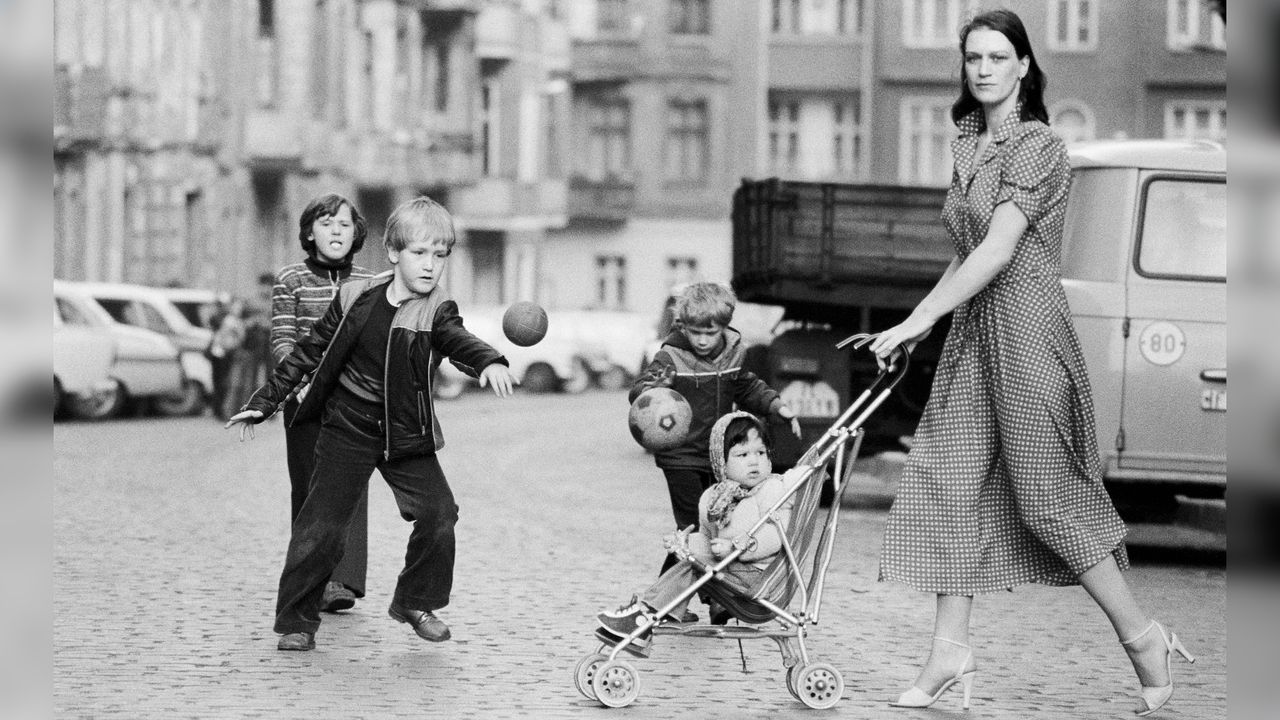
Black-and-white photo of a woman pushing a stroller past children playing with balls on a cobblestone street in a residential neighborhood.

Behind the Berlin Wall, fashion photography in the German Democratic Republic (GDR) during the Seventies and Eighties developed a visual language shaped by everyday life rather than consumption or spectacle.

At Photo London, a selection of 22 rare vintage prints by Ute Mahler from 1978 to 1989 is on view until tomorrow, presented by Galerie Peter Sillem – showing a defining body of work by one of the most influential figures in German photography.

Originally published in the East German magazine Sibylle, the images place fashion within ordinary streets, courtyards and urban settings.

Many of these photographs have since been widely regarded as iconic, reflecting a distinctive visual language that moves between editorial presentation and observation, capturing a society in which style, identity and social reality were closely intertwined.

Fashion photography in the GDR

Ute Mahler, Mode (Fashion), 1981. Vintage gelatin silver print (Image credit: Ute Mahler / courtesy Galerie—Peter—Sillem)

In the GDR, fashion operated within a planned economy rather than a consumer-driven market.

Clothing was produced in a limited variety, with access to international brands, trends and advertising culture restricted. As a result, fashion did not function the same way as in Western Europe, where mass consumption shaped visual culture.

Instead, personal style emerged through constraint. Fashion became less about consumption and more about personal interpretation within existing limits.

Within this framework, Ute Mahler developed an observational approach to fashion photography rooted in everyday life.

Ute Mahler: between fashion and observation

Ute Mahler, Jutta in Deutschland (Jutta in Germany), 1979. Modern gelatin silver print (Image credit: Ute Mahler / courtesy Galerie—Peter—Sillem)

The prints presented at Photo London are part of a rare surviving group of works that have become significant. They reflect a fashion culture shaped by the conditions of a restricted environment, where everyday life unfolded behind the Berlin Wall.

Seen today, the photographs offer a layered view of life in East Berlin at the time, positioned between editorial fashion and documentary photography.

Alongside this series is Monalisen der Vorstädte (Mona Lisas of the Suburbs, 2008–2010) by Ute Mahler and Werner Mahler. This series presents young women in a pared-back, classic style referencing Leonardo da Vinci's portrait to explore themes of identity, transition and belonging.

Ute Mahler and Werner Mahler have worked together for decades and co-founded the Ostkreuz photography agency in Berlin in 1990. Their shared practice continues to focus on portraiture and everyday life, positioned between documentary observation and careful visual construction.

For more information, visit the Photo London website.

You might also like...

Discover the women who defined and evolved photography – from Anna Atkins to Cindy Sherman

Sign up to read this article
Read news from 100's of titles, curated specifically for you.
Already a member? Sign in here
Related Stories
Top stories on inkl right now
One subscription that gives you access to news from hundreds of sites
Already a member? Sign in here
Our Picks
Fourteen days free
Download the app
One app. One membership.
100+ trusted global sources.