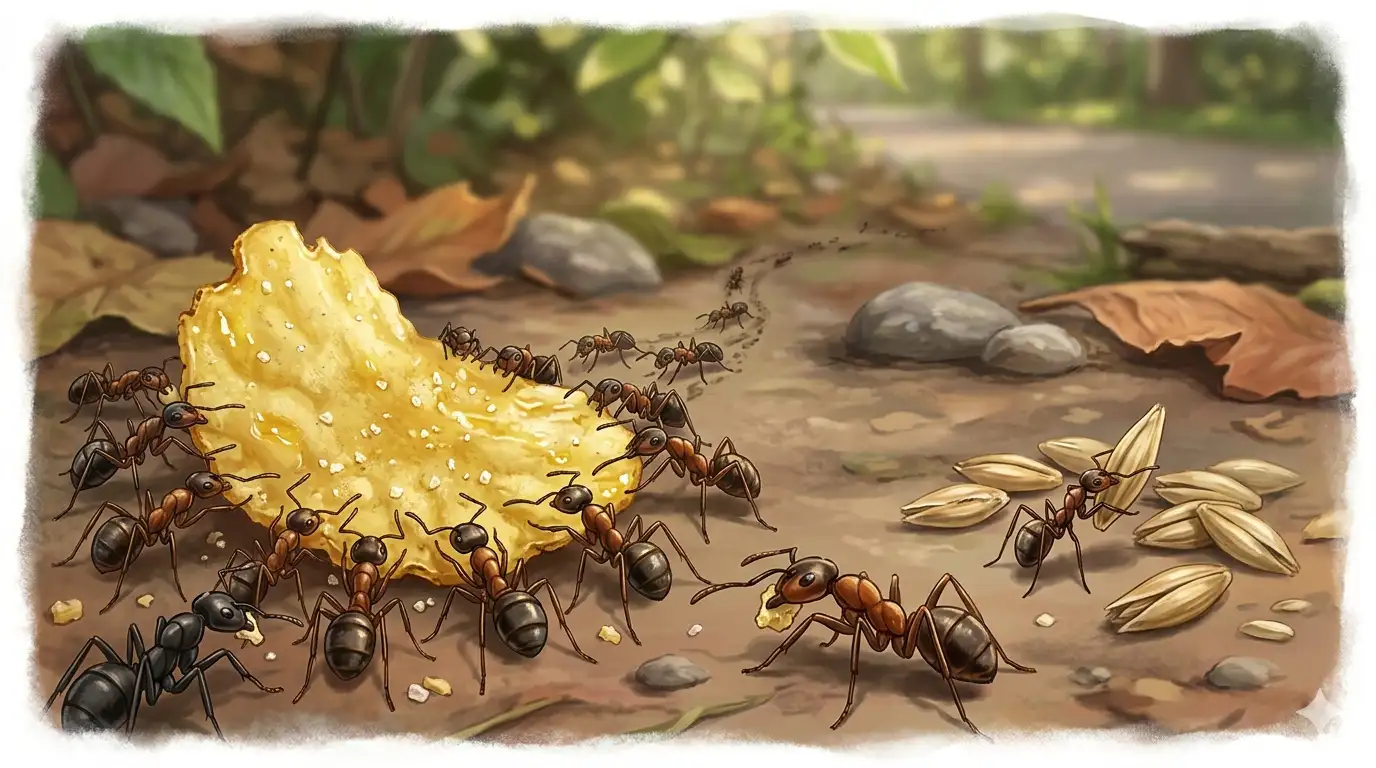
Ants eating junk food behavior study : A potato chip crumb may not seem like a big deal. To most people, it's just a forgotten snack left behind on a trail, a park bench, or the ground during a picnic. But for ants, that tiny piece of junk food can become a major distraction.
Researchers have found that ants are surprisingly attracted to the same processed foods humans enjoy. In fact, ants living in urban environments often show signs that they regularly consume human snacks. Previous research has even found higher levels of carbon isotopes associated with processed foods in city ants, suggesting they have developed a taste for the leftovers people leave behind, as per a report.

Now, a new study published in Biology suggests that this attraction to junk food may be interfering with one of ants' most important ecological jobs: moving seeds.
Why Seed Dispersal by Ants Matters
Many ant species help plants spread throughout forests and other environments.
Some seeds contain a nutrient-rich structure called an elaiosome, which attracts ants. The insects carry these seeds back to their nests, eat the nutritious part, and leave the seed intact. Other seeds are collected as food and transported underground, though ants sometimes drop or abandon them before eating them.
Either way, ants play an important role in helping plants move and grow in new places.
Researchers wanted to know what happens when processed foods enter that equation.
Can Chips and Cookies Distract Ants
The idea emerged during a master's course at the University of Panama, where researchers began discussing how urban environments affect ant behavior and whether junk food could influence their diets.
To find out, the team designed a series of experiments using two familiar snack foods: Lay's potato chips and Oreo cookies without the filling, as per a Smithsonian Magazine report.
The snacks were chosen because they represent the kinds of foods people commonly bring when hiking or visiting natural areas.
In their first experiment, researchers placed oat seeds in small seed stations. Some stations had potato chip crumbs nearby, while others contained only seeds.
The results suggested that ants removed seeds more slowly when chips were present.
Researchers later adjusted the experiment because they realized the ring of chips may have physically blocked the ants from reaching the seeds, as per the Smithsonian Magazine report.
Ants Chose Junk Food Over Their Usual Task
In the second experiment, potato chip crumbs or cookie crumbs were placed beside seed stations rather than surrounding them.
The study was conducted both on university grounds and in a forest within Soberanía National Park.
This time, the pattern became clear. The presence of chips and cookies significantly reduced the number of interactions ants had with seeds.
According to the researchers, the ants appeared to be distracted by the processed foods.
Ecologist Lara Dominguez said, “I was surprised to see how quickly the ants reacted to us placing chip crumbs on the ground,” adding, “Within 30 seconds of putting the crumbs down, there would suddenly be many ants. They wouldn’t react as quickly to the seeds in my experience,” as quoted by Smithsonian Magazine.
Urban Ants May Be Especially Vulnerable
Researchers also noticed differences between urban and forest ants.
More ants visited seed stations at the university site than in the forest. Yet both locations ended up with similar levels of seed removal.
The researchers believe this may indicate that urban ants were more easily distracted by junk food. If they had remained focused on seeds, the larger number of ants in urban areas might have resulted in more seed transport.
Distance Made a Difference
In the final experiment, researchers tested whether moving the junk food farther away would reduce the distraction. When potato chip crumbs were placed next to seeds or about one foot away, ants remained just as distracted.
However, the effect became weaker when the crumbs were placed about two feet away. This suggested that even small amounts of nearby food waste can influence ant behavior.
Why This Could Matter Beyond Ants
While ants choosing chips over seeds may seem like a minor issue. But researchers say the consequences could extend beyond the insects themselves.
Plants often depend on animals to help disperse their seeds. If ants spend less time transporting seeds and more time collecting processed food, it could affect how plants spread through an environment.
As insect ecologist Clint Penick noted, plants cannot move on their own and often rely on animals to help them reach new locations, as per the Smithsonian Magazine report.
The researchers stress that even small disturbances can add up over time.
In places where thousands of people regularly leave behind food scraps, the cumulative effect could influence seed dispersal patterns and impact plants that depend on ant activity.
FAQs
Do ants eat junk food?Yes. Researchers found that ants are strongly attracted to processed foods like potato chips and cookies.
Why is seed dispersal important?
Many plants rely on ants to move seeds, helping them spread and grow in new places.