
Get all your news in one place.
100's of premium titles.
One app.
Start reading
Golf Monthly
Golf Monthly
Sport
Fergus Bisset

What Does GUR Stand For In Golf?

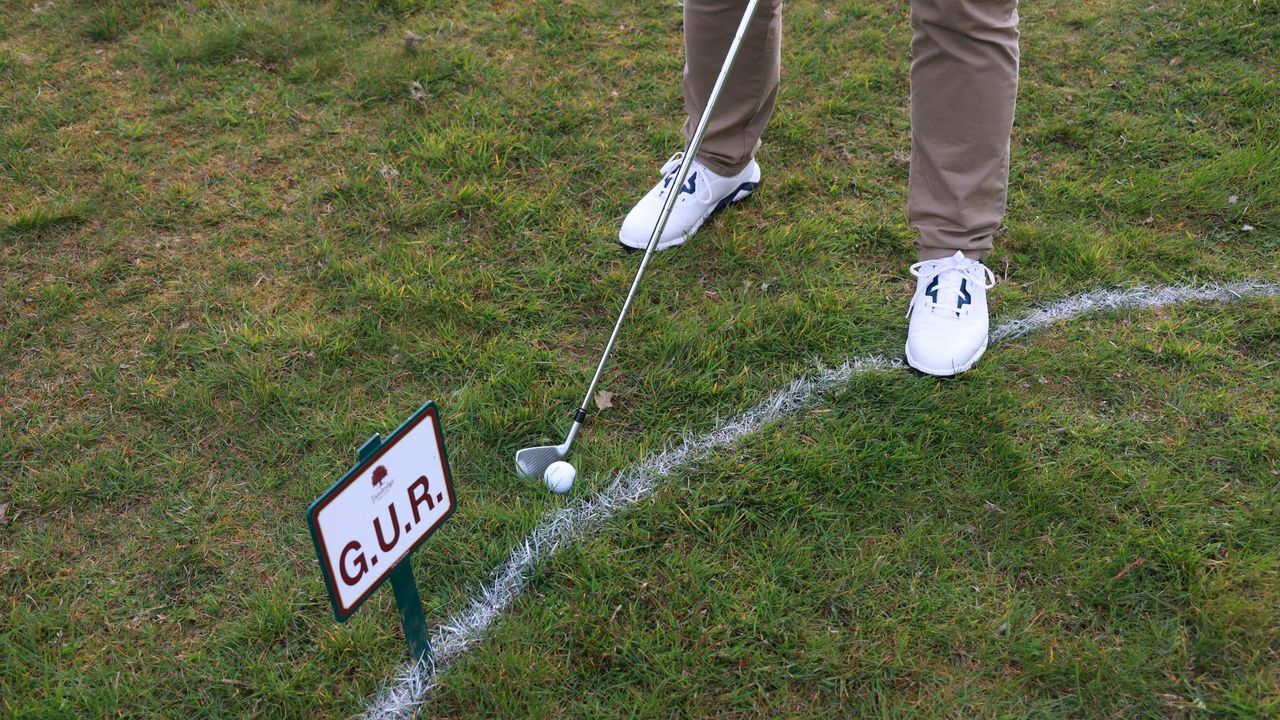
What is GUR in golf?.

This is a pretty straightforward one to answer quickly – GUR in golf stands for Ground Under Repair. There, article done.

But wait… there’s more about ground under repair to understand, and some useful things to know, to keep you right when it comes to The Rules of golf.

What is Ground Under Repair?

Taking a drop from ground under repair (Image credit: Kenny Smith)

Ground under repair is any part of the course defined as ground under repair by the committee, whether it’s marked as such or not. It will generally be an area that is either damaged or is being worked on by the greenkeeping team.

Ground under repair also includes a selection of things, even if not defined as such by the committee – A hole made in setting up the course for example, like a hole where a stake has been removed, or a hole made where work is being carried out to lay a pipeline. Aeration holes are not ground under repair.

Grass cuttings, leaves or other material piled for later removal are ground under repair, as is any animal habitat (a bird’s nest) for instance that might be damaged by your swing or stance. Worm casts or insect activity are not classed as ground under repair – they are loose impediments and would be dealt with under Rule 15.1.

It’s worth noting that ground under repair includes, not only all ground inside the edge of the defined area, but also anything rooted in the defined area and any part of that rooted object growing above the ground outside the edge of the defined area.

So, any part of a tree (above the ground) which is rooted in ground under repair is ground under repair, unless the part in question is attached or below the ground outside the ground under repair, like a protruding tree root.

What happens if your ball ends up in Ground Under Repair?

A player taking a drop from ground under repair (Image credit: Kevin Murray)

In the definitions of The Rules, Ground Under Repair is classed an Abnormal Course Condition, from which you are entitled to relief under Rule 16.1 provided the ball is lying on or touching the area of ground under repair, or the ground under repair interferes with either your stance or the area of your intended swing.

You should find the nearest point of complete relief, where the ground under repair no longer interferes with your lie, stance or area of intended swing. You then have a one club length relief area in which to drop from that point, no closer to the hole.

If your ball lies on the putting green, you would also be entitled to relief if the area of ground under repair intervened in your line of play.

Do you have to take a drop?

Can you play the ball from ground under repair? (Image credit: Kevin Murray)

You don’t have to take relief from ground under repair. You have the option to play the ball as it lies. That might be preferable if your nearest point of complete relief takes you into trouble… Remember – it’s nearest point of complete relief, not nicest!

You can play the ball from ground under repair, except if the committee has designated that area of ground under repair a “No Play Zone.” An area may be designated a no play zone for any reason, but likely it would be to protect the course, young trees or an environmentally sensitive area.

If the ground under repair is a no play zone then you would have to take complete relief under Rule 16.1.

So there you have it – GUR is Ground Under Repair – an important course condition to be aware of and knowing The Rules about it could just save you a shot or two!

Sign up to read this article
Read news from 100's of titles, curated specifically for you.
Already a member? Sign in here
Related Stories
Top stories on inkl right now
One subscription that gives you access to news from hundreds of sites
Already a member? Sign in here
Our Picks
Fourteen days free
Download the app
One app. One membership.
100+ trusted global sources.