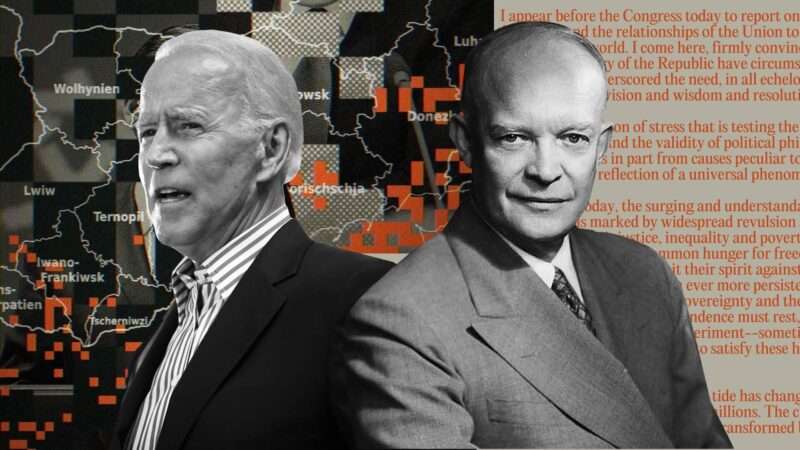
When President Joe Biden ambles to the podium at a joint session of Congress Tuesday night, he will be at an odd place for an American president. His country sits transfixed by a war more than 4,500 miles to the east, rooting openly in solidarity for the hopelessly outgunned underdogs fighting bravely for their homeland against a ruthless invader from Moscow. Hundreds of thousands of desperate refugees have already poured out to the West, while the young men back home fashion Molotov cocktails to hurl at tanks. The United States, unusually, is not a central protagonist in this military conflict, to the disappointment of both the ragtag rebels and some overenthusiastic hawks back home.
U.S. history being long enough, the above description fits another State of the Union address: Dwight D. Eisenhower's somber message to Congress on January 10, 1957, two months after the dramatic and bloody Soviet putdown of the Hungarian Revolution of 1956, an event seared into the memory of the Americans who lived through it. Time had declared the "Hungarian Freedom Fighter" its 1956 Man of the Year; Elvis Presley hawked donations for refugees on The Ed Sullivan Show. Even Jean-Paul Sartre broke with his longtime communist comrades (as did many fellow travelers in the West).