
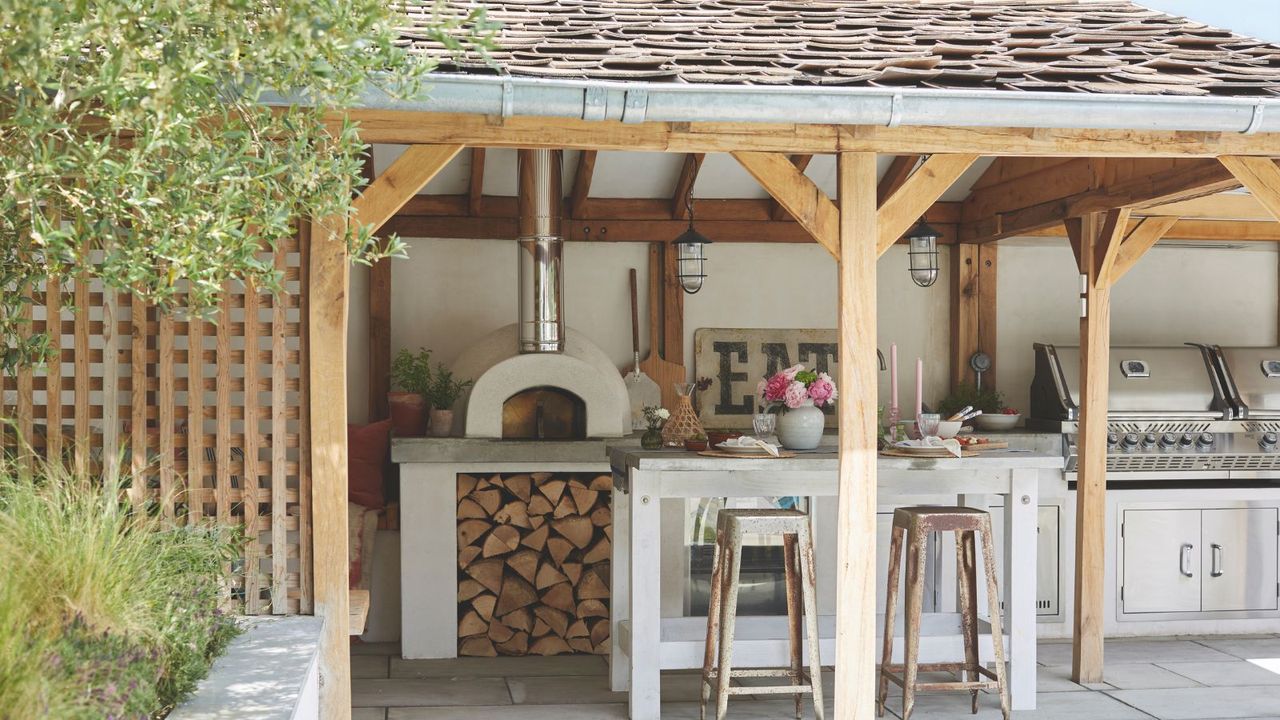
Choosing kitchen countertops is challenging enough indoors, where the biggest threats are usually a hot pan, a splash of red wine, or someone forgetting to engage the chopping board. Outside, it’s a completely different game. Your countertops are suddenly up against blazing UV rays, driving rain, freezing temperatures, chlorinated pool splashes, grease-heavy barbecue food, fallen leaves, bird poop, and heavy-duty grill tools all year round. Not every material is cut out for it.
That’s why choosing the best countertops for your outdoor kitchen design is less about chasing the prettiest slab and more about understanding how different materials will perform in the wild. ‘Outdoor worktops need to be specified with longevity in mind; they have to hold their own through shifting seasons without losing their finish or structural integrity,’ says Natalie Fry, founder of Grid Thirteen Design Studio. ‘It’s about choosing a material that doesn’t just perform outdoors, but one that still looks as good after five summers of grilling, storms, and spilled margaritas as it did on installation day.’ Some surfaces fade in direct UV light, others crack during freeze-thaw cycles, while some stain so easily that one unended pizza will leave a lasting souvenir.

The best outdoor kitchen countertops balance durability, weather resistance, maintenance, and style while sitting comfortably within the landscape. This guide covers the core countertop materials the experts rate most highly, and the practical realities worth knowing before you choose one.
What to Look for in an Outdoor Kitchen Countertop
When evaluating the best countertop for your outdoor kitchen ideas, appearance should almost be treated as the final consideration, not the starting point. ‘It starts with understanding your climate. If you live in an area with extreme temperature swings, durability is key,’ says Surrina Plemons, president and principal designer, Surrina Plemons Interiors. ‘You’ll want a material that can handle those shifts without cracking or breaking down over time. Sun exposure is another important factor. For countertops in full sun, lighter materials are typically a better choice, as darker surfaces tend to absorb and retain heat.’
No matter where you live, porosity matters. Beyond rain, outdoor kitchen countertops have to cope with everything from cooking oils and cocktail spills to damp leaves, pollen, and bird droppings, all of which can stain more absorbent surfaces. Non-porous materials are far more forgiving.
Heat resistance is another biggie. Hot grill tools, pizza ovens, cast-iron pans, and direct sunlight can all place significant stress on a surface. Some materials tolerate sudden temperature changes exceptionally well, while others are more vulnerable to thermal shock or surface degradation.
The way the kitchen is used should also guide your final decision. A heavily used entertaining kitchen with smokers, grills, refrigeration, and prep sinks demands something far more hardwearing than a small outdoor kitchen used occasionally for drinks and light cooking. Similarly, fully exposed kitchens require more resilient surfaces than those protected beneath covered pergolas or other outdoor roof structures.
Cost should also be considered in terms of longevity rather than the initial installation price alone. Some cheaper materials require so much ongoing maintenance or early replacement that they become more expensive over time than premium surfaces with higher upfront costs.
What Are The Best Outdoor Countertop Materials
Porcelain
Porcelain has rapidly become one of the most sought-after weatherproof countertops in high-end outdoor kitchens, largely because it combines exceptional durability with relatively low maintenance.
It’s worth noting that porcelain is also marketed as sintered stone, ceramic, or ultra-compact surface, with the terminology often coming down to branding and manufacturing methods rather than completely different materials. Products from brands such as Dekton, Neolith, Laminam, Ceralsio, and Sapienstone all sit within this broader family of high-performance mineral-based outdoor surfaces.
These modern surfaces are made using extreme heat and pressure in a process called sintering, where minerals are fused together to mimic the way natural stone forms geologically – just massively accelerated.
‘Sintered surfaces such as porcelain and ceramic offer excellent resistance to UV, heat, stains and scratches, making them particularly well suited to outdoor kitchens,’ explains Simon Boocock, managing director, CRL Stone. ‘The key consideration is installation, as these materials are extremely dense and require specialist fabrication to ensure a high-quality finish.’
Many of the latest designs also convincingly mimic marble, limestone, concrete, and metal with remarkable realism.
Pros:
- UV stable and fade resistant
- Non-porous and highly stain resistant
- Handles freeze-thaw conditions extremely well
- Very low maintenance
- Available in slim contemporary profiles
- Excellent resistance to heat and moisture
Cons:
- Edges can chip if poorly fabricated
- Requires experienced installers
- Premium products carry a high upfront cost
- Repairs are often difficult to disguise
Granite
Granite remains one of the most trusted outdoor kitchen countertops for good reason. It is exceptionally durable, naturally heat-resistant, and capable of handling extreme weather conditions with relatively little deterioration when properly specified and maintained. If you are hellbent on a natural material, granite is the go-to designers and outdoor experts recommend.
‘The reason is simple: it just holds up. Granite is dense, naturally UV-stable, and handles heat and weather swings without much issue, so you’re not dealing with fading, warping, or breakdown over time. It’s also hard enough to take real use –prepping, grilling, and setting hot pans down,’ explains Zach Epstein, chief product officer and president, Artistic Tile. ‘Granite does need to be sealed and occasionally resealed, especially outdoors, and not every slab is created equal – some are more porous or have more fill than others. But if you choose a good, dense slab and take care of it, granite is one of the most reliable, proven natural options you can put outside.’
The movement, veining, and mineral depth of granite also tend to feel more connected to surrounding landscaping and natural materials than ultra-uniform man-made options. One note, if you live in a very hot climate, go for light colors as dark granites like Nero Assoluto or Black Galaxy will get hotter than hell.
Pros:
- Excellent UV resistance
- Highly heat and scratch resistant
- Strong long-term durability
- Natural appearance suits outdoor settings
- Widely available in multiple finishes and price points
Cons:
- Requires periodic sealing
- Some lighter granites stain more easily
- Pattern consistency varies significantly
- Premium slabs can be expensive
Concrete
Concrete remains a favorite among landscape architects and outdoor kitchen designers because it offers almost limitless customization. Shapes, thicknesses, pigments, textures, drainage details, and integrated features can all be tailored precisely to the project.
It works especially well in contemporary outdoor spaces where homeowners want a monolithic or architectural appearance that feels fully integrated into the landscaping. The reality with concrete is that it’s best suited to those who can embrace a slightly lived-in appearance rather than expecting it to remain visually perfect forever. Patina, subtle movement, and minor tonal shifts are often part of the appeal.
Proper reinforcement and expansion detailing are critical outdoors, particularly in climates with significant seasonal movement. Poorly fabricated concrete countertops are far more vulnerable to cracking, staining, and water penetration than professionally engineered versions. ‘Concrete can be disastrous if neglected, especially in damp climates, and requires consistent maintenance, otherwise it can discolor, retain moisture, and develop a slimy surface over time,’ adds Hugh Leader-Williams, creative lead, Blakes London.
Finish selection also matters. Highly polished concrete can show etching and water marks all too easily, while softer matte finishes generally age more gracefully outdoors.
Pros:
- Fully customizable
- Works with curved or unusual layouts
- Can incorporate integrated sinks and drainboards
- Strong and durable when properly fabricated
- Develops character over time
Cons:
- Requires sealing and maintenance
- Hairline cracking is common
- Heavy and installation-intensive
- Can stain if neglected
- Finish quality depends heavily on craftsmanship
Tile
Tile countertops are less common in luxury outdoor kitchens today than they once were, but they still offer certain advantages, particularly in Mediterranean-style or highly decorative spaces.
‘Tile can work well for outdoor counters, but we don’t usually recommend them. The reason is less about the tile itself and more about the grout,’ explains Zach. ‘While the tile material, especially porcelain and ceramic, may be appropriate for outdoor countertops, grout is porous, collects dirt, and it’s where water gets in.’ Even when well-sealed, grout is the part that needs the most maintenance over time. ‘Tile can absolutely work outside, but you’re signing up for more upkeep, and you have to be okay with the fact that the grout lines are always going to be the weak link,’ he concludes.
If you’re still determined to tile, go for large format porcelain tiles with minimal grout lines and don’t hold back when slapping on the grout sealant!
Pros:
- Relatively affordable
- Wide design flexibility
- Good heat resistance
- Easier to repair small sections
Cons:
- Grout stains and cracks over time
- Uneven prep surface
- More maintenance long-term
- Can feel visually busy
Quartz
Quartz countertops dominate indoor kitchens because they are durable, low maintenance, and visually consistent. Outdoors, however, they become far more problematic.
Unlike porcelain or granite, quartz surfaces typically contain significant amounts of resin binders. ‘Any countertop materials with resins can’t withstand UV and will most likely discolor, fade, or bubble over time,’ explains Bambi A’Lynn Bratton, founder, Bambi A’Lynn Interior Design. It’s an important distinction because quartz and porcelain are often grouped together in kitchen showrooms, despite performing very differently outdoors due to how they’re made.
There are now some quartz products marketed specifically for exterior use, but most designers still recommend caution. In covered outdoor kitchens with limited direct sunlight, quartz may perform adequately. In fully exposed settings, it is usually considered a riskier long-term investment than porcelain or natural stone.
Pros:
- Consistent appearance
- Easy to clean
- Minimal maintenance indoors
- Wide design selection
Cons:
- Not UV stable
- Can discolor in direct sun
- Resin content may degrade outdoors
- Heat resistance is lower than natural stone or porcelain
- Generally unsuitable for fully exposed kitchens
Natural Stone
Granite may dominate the conversation around natural stone outdoor kitchen countertops, but other stones can work beautifully too when carefully selected. Soapstone, bluestone, quartzite, slate and some dense limestones all offer different aesthetic qualities and varying levels of weather resistance. The key is understanding that performance differs dramatically between stone types.
Quartzite deserves particular mention. Not to be confused with manmade quartz surfaces, quartzite is a natural stone formed deep within the earth under intense heat and pressure, making it exceptionally dense and durable outdoors. ‘Quartzite is an excellent choice. In fact, my mom’s outdoor countertop and pizza oven in South Florida features Botanic Green Quartzite, which is not only durable but also gorgeous, with intense green and aqua colors,’ says Zach of Artistic Tile. ‘Bluestone and soapstone also work well outdoors because they’re essentially non-porous and great with heat, but softer than granite and quartzite so they may scratch.’
Pros:
- Rich natural character
- Unique veining and variation
- Strong heat resistance
- Many stones age beautifully outdoors
Cons:
- Performance varies widely by stone type
- Some stones require extensive sealing
- Softer stones scratch more easily
- Premium slabs can be extremely expensive
Stainless Steel
Stainless steel countertops bring a distinctly commercial kitchen feel to outdoor entertaining spaces, but they are also one of the most practical materials available. Because stainless steel is non-porous and effectively impervious to moisture, UV exposure, and heat, it performs exceptionally well outdoors. It is also highly hygienic and easy to sanitize, which explains its longstanding popularity in professional kitchens.
Not all stainless steel is equal outdoors. Marine-grade stainless steel is generally recommended in coastal environments because it offers superior resistance to corrosion and salt air exposure. One of the most effective ways designers soften the industrial feel of stainless steel is by combining it with warmer materials such as teak cabinetry, natural stone, or textured landscaping.
‘Stainless works really well but actually requires a lot of upkeep if you want to keep it looking sleek,’ adds interior designer Andrea Goldman. Fingerprints, grease marks, hard water spots, and fine scratches show up quickly outdoors, particularly around grills and prep zones, so regular wiping and occasional polishing are part of the deal.
Pros:
- Completely weather resistant
- Non-porous and hygienic
- Excellent heat resistance
- Extremely durable
- Pairs well with grills and outdoor appliances
Cons:
- Shows fingerprints and scratches
- Can feel visually cold
- Higher-quality grades are expensive
- Reflective surfaces show smudges easily
Outdoor Kithcen Countertop Materials to Avoid
Some countertop materials simply are not designed for exterior conditions, no matter how attractive or affordable they may appear initially. Laminate is one of the biggest mistakes outdoors. Moisture infiltration quickly causes swelling, peeling, warping, and delamination, particularly around seams and edges.
Wood countertops can work in highly protected outdoor kitchens, but they demand significant maintenance. Constant oiling, sealing, and monitoring are required to prevent cracking, fading, mildew, and movement. Even durable species such as teak and iroko weather noticeably over time.
‘Basically, stay away from anything porous and unsealed, like marble and wood, that can split, rot, or harbor bacteria,’ says Bambi A’Lynn Bratton. ‘Because this countertop is meant to last outdoors, you should also avoid any materials with resins that can’t withstand UV, like quartz or laminate, that will discolor, fade, or bubble over time.’
Expert Tips for Choosing the Right Outdoor Countertop
Match the Material to Your Climate
Climate should be one of the first things driving your decision. In colder regions, like Chicago, Boston, or Denver, freeze-thaw resistance matters enormously because moisture trapped inside porous materials expands as temperatures drop, eventually leading to cracks, staining, or surface breakdown.
In hotter climates, such as Texas, California, or Florida, UV stability and heat retention become bigger considerations. Some darker stones can become uncomfortably hot in direct sun, particularly around poolside kitchens or south-facing patios. Lighter colors and honed finishes tend to stay cooler and show dust, pollen, and water spotting less readily.
‘All outdoor climates are not created equal! It’s always best to consult with local experts in your area. A material choice might start to fall apart after one or two years, but otherwise not show any initial signs of wear and tear,’ advises Andrea Goldman. ‘Countertops should always be outdoor rated, but you have to feel confident everything can live through severe cold like Chicago weather or handle salt water in Florida, California and Cabo.’
Think About Coverage
‘Coverage is a very important factor to assess when specifying outdoor countertop materials. A fully exposed kitchen requires the most resilient materials available, while a partially covered kitchen (closed patio roof but open on one or more sides) gives you more flexibility,’ says Nate Fox, lead designer, Foxterra Design.
This is particularly relevant with quartz. In covered outdoor kitchens with limited UV exposure, some designers are comfortable using it cautiously. In fully exposed environments, porcelain, granite, quartzite, and stainless steel are usually considered safer long-term choices.
It’s also worth considering what happens in the off-season. Outdoor countertops beneath trees may spend months covered in damp leaves, algae and other organic debris, while coastal kitchens have to cope with salty air and high humidity year-round. ‘I still prioritize low porosity in partially covered spaces as rain pushed in by the wind and indirect sun will still find their way in, but the options are considerably broader than a fully exposed installation,’ adds Nate.
Be Honest About How You Cook
‘When I'm designing an outdoor kitchen, it's very important to understand how my clients actually live in the space. Are they grilling every weekend? Hosting large gatherings? Keeping wine and fresh ingredients on the counter? That conversation shapes the material decisions we make,’ says Nate.
A compact setup used mainly for drinks and occasional grilling has very different demands from a fully equipped outdoor kitchen with smokers, pizza ovens, refrigeration, and regular entertaining.
If you cook heavily outdoors, prioritize surfaces that can tolerate high heat, grease, acidic spills, and constant cleaning without requiring significant upkeep. Non-porous materials are often the easiest to live with in busy entertaining spaces because they are less prone to staining from oils, marinades, wine, and barbecue sauces.
You should also think about comfort and practicality. Highly polished surfaces can show fingerprints and grease quickly, while heavily textured materials may be harder to wipe down after cooking.
Don't Overlook the Details
Small specification details can have a surprisingly big impact outdoors. ‘Safety is a real consideration in a high-traffic entertaining space, so I typically steer clients toward an countertops with a beveled edge rather than a sharp square profile, particularly in homes with children or that host frequent large gatherings,’ says Nate. Sharp contemporary edges are also more vulnerable to chipping, particularly on porcelain and natural stone.
Finishes matter too. Honed, leathered, and matte surfaces are generally more forgiving outdoors because they disguise water spots, dust, and fingerprints better than polished finishes. They also tend to feel more natural alongside landscaping and exterior materials.
‘Detailing can make a huge difference to longevity. We often incorporate subtle drainage channels along the front edge of the countertop to direct rainwater away from the cabinetry and stop it tracking down the cabinet fronts. It’s a simple detail, but essential, especially in wetter climates,’ adds Natalie from Grid Thirteen.
Ultimately, the best outdoor kitchen countertops are the ones that suit your climate, cooking style, and tolerance for upkeep. Porcelain and granite remain favorites for balancing durability, weather resistance, and low maintenance – particularly if you’d rather spend summer entertaining than constantly figuring out how to clean an outdoor kitchen.
Love beautiful design ideas, expert advice, and inspiring decor trends? Sign up for our newsletter and get the latest features delivered straight to your inbox.