
Get all your news in one place.
100's of premium titles.
One app.
Start reading
The Independent UK
The Independent UK
Science
David Keys

What a piece of 15,0000-year-old jewellery found in a Devon cave tells us about this prehistoric ‘civilization’

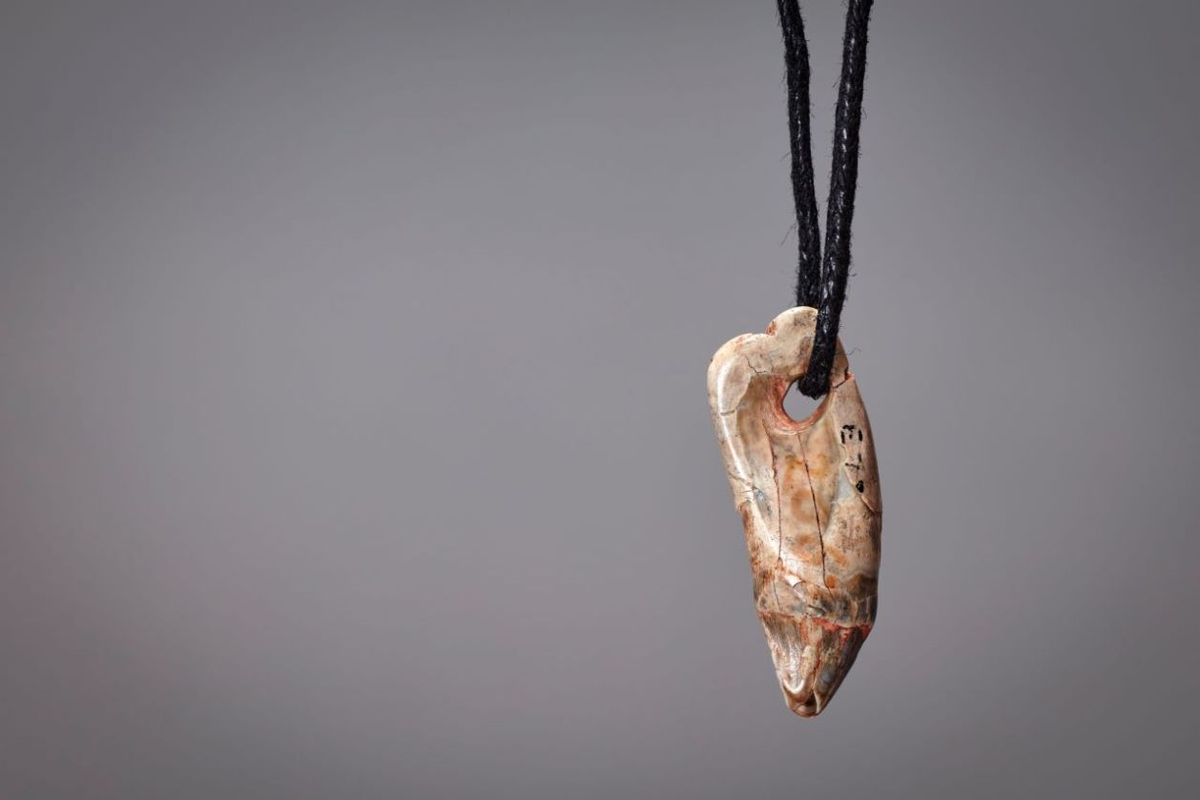
The Magdalenian seal-tooth pendant which scientists from University College London and the Natural History Museum have been studying - (Trustees of the Natural History Museum, London)

A piece of prehistoric jewellery, discovered in a West Country cave, is helping to shed new light on Stone Age Europe's most spectacular culture.

Known as the Magdalenian, that 21,000 to 13,000 year old prehistoric 'civilization' dominated much of Western Europe, particularly southwest France, northern Spain and parts of Britain and Germany for most of the final 10,000 years of the Ice Age. A detailed scientific analysis of the British Magdalenian jewellery item, carried out at University College London and the Natural History Museum, has now revealed that it was a polished pendant made from a seal's tooth.

It's the first such artefact identified in Britain - and only the fourth anywhere in Europe.

The discovery adds to the substantial evidence showing that Stone Age Magdalenians were extremely fashion-conscious - and that they had a particularly strong preference for maritime-originating jewellery.

For, as well as the four seal-tooth pendants, many sites across Europe, often located far from the sea, have yielded literally thousands of marine shells, virtually all of which would have been used as personal adornments (as pendants, like the seal tooth - but also to beautify clothing and for use in necklaces, bracelets, anklets and headwear).

Around 15,000 years ago this cave (near what is now the town of Torquay in Devon) was home to a group of Magdalenians - and was the place where the polished seal tooth pendant was originally discovered (Wiki)

The scientific investigation into the British artifact (found in Kent’s Cavern, Torquay, Devon) has identified it as a premolar tooth of a grey seal, that had been polished and perforated by a Magdalenian artisan, using a handheld flint boring tool. Microscopic analysis of the wear pattern in the hole has revealed that the tooth had been worn as a pendant, suspended on some sort of cord. The wear, caused by the cord, was so substantial that the pendant appears to have been worn for many years or even decades.

Indeed, it's conceivable that it may have been a valued heirloom, worn successively by several generations of the same family. Its value and significance to the Kent's Cavern Magdalenian community - probably an extended family living there seasonally for many generations - is underlined by the fact that the seal tooth would have had to have initially been imported from the seashore which in Magdalenian times was between 50 and 100 miles away.

However, there would have been a direct river connection between the Kent's Cavern area and the sea - along the river Teign's prehistoric lower course (now submerged under the English Channel) and then along a now long-vanished major prehistoric waterway, dubbed the Channel River by archaeologists, to the Atlantic. In Magdalenian times, the Thames, the Rhine and the Seine were merely that Channel River's major tributaries.

Even when living hundreds of miles from the sea, Magdalenian people had a strong cultural connection to it.

Via the Channel River and its many tributaries, they had an easy and direct connection to the Atlantic. They used large numbers of periwinkle, European cowrie and so-called 'tusk' shells as well as fossilised molluscs, sea urchin spines and sharks' teeth to make jewellery and other adornments.

Like ordinary Atlantic seashells, these fossils must have been highly valued because they were often imported from hundreds of miles away. Shells were also imported to inland Magdalenian sites in France, Spain, Germany and Czechia from the Mediterranean. Some had travelled up to 600 miles.

Large shells (specifically giant sea snails, up to 40 centimetres long) were also converted into very effective musical instruments - and marine mammals like seals and whales even feature in Magdalenian art in France, Germany and Spain. Indeed, in Germany, there are even 16,000 year old portrayals of fishing scenes, featuring nets and fish - but it's not known whether they portray maritime or riverine fishing activity.

It's almost certain that the Magdalenian connection with rivers and the ocean was made possible by their very early development of boat technology. Indeed, it's probable that they and their neighbours were the first Europeans to make and use boats. Certainly the neighbouring prehistoric Italian cultures were making and using boats for sea journeys at least 20,000 years ago and ancient people in the eastern Mediterranean were doing likewise by at least 14,000 years ago. In northern Europe, prehistoric people were almost certainly making and using substantial seagoing boats by around 12000 years ago (indeed the world's oldest image of a boat still survives as a rock engraving on the coast of northwest Norway, dating from some 11,000 years ago).

In the Magdalenian era, western European prehistoric cultures liked marine-originating jewellery and adornments. A key example from around the dawn of that epoch is the magnificent headwear, made partly of seashells, worn by a teenage boy who died around 23,000 years ago in north-west Italy. It is now in the archaeological museum in Genoa (Wiki)

The Magdalenians were amongst the very first culturally and socially complex and sophisticated societies on Earth. Archaeologists now believe that they owed their sophistication and complexity to a major increase in human population (and in the size of their individual communities, in some cases up to 100 individuals) - increases which were only made possible by a large expansion in the food resources - wild animals - available to them. That, in turn, was brought about by climatic changes which produced an environment ideally suited to large nutritious easy-to-hunt herbivores. Although best known for their art (at famous sites like Lascaux in France and Altamira in Spain) and dozens of other caves across Western Europe, research in Britain and on the continent is gradually revealing a more complete picture of this extraordinary Ice Age ‘civilization’. Indeed, recent investigations initiated by London's Natural History Museum have revealed that the Magdalenians used domesticated dogs which they would have been able to utilize to make their hunting economy much more efficient. Other research suggests that they were among the first to develop extensive long-distance trade networks - and that their social system involved largescale inter-communal gatherings of many hundreds of people. And over the past three years, British and other archaeologists have even been examining the possibility that the Magdalenians developed some form of writing system.

The Magdalenian era is most famous for its spectacular prehistoric art (like these cave paintings from Lascaux, France) - but Magdalenian culture as a whole was equally sophisticated (Wiki)

Although the seal tooth pendent has only just been identified as such, it was originally found back in the 19th century, together with lots of Magdalenian tools and hunting equipment (including flint and ivory spear points). Over recent years, scientists from Canada and California have been carrying out a GIS mapping survey of Kent's Cavern, where the seal tooth pendent and other Magdalenian artifacts were found, so as to better understand where the items were originally discovered and how the prehistoric inhabitants used the cave complex. Meanwhile, DNA from Magdalenian human bones Gough's Cave in Somerset is being studied by scientists from the Natural History Museum in order to try to help reveal the scale and nature of prehistoric ritual cannibalism. And later this year excavations in south-west Wales are likely to unearth potentially exciting additional evidence of Magdalenian culture.

The ground-breaking research into the seal-tooth pendent is being published this week in the international academic journal, Quaternary Science Reviews.

“The pendent offers a remarkable glimpse into the symbolic and social lives of people over 14,000 years ago,” said its lead author, prehistorian Dr Simon Parfitt of University College London's Institute of Archaeology.

"Although similar seal tooth ornaments have been discovered at Magdalenian sites in France and Spain, this is the first known example from the British Isles. Its discovery adds a new dimension to our understanding of shared cultural traditions and symbolic practices across Ice Age Europe," said Dr Silvia Bello of London's Natural History Museum.

Sign up to read this article
Read news from 100's of titles, curated specifically for you.
Already a member? Sign in here
Related Stories
Top stories on inkl right now
One subscription that gives you access to news from hundreds of sites
Already a member? Sign in here
Our Picks
Fourteen days free
Download the app
One app. One membership.
100+ trusted global sources.







